

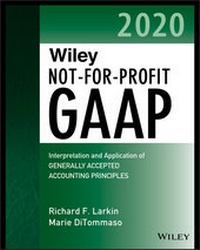
Wiley Not-for-Profit GAAP 2020
Description

Not-for profit organizations have unique characteristics, so they must adhere to a specific set of generally accepted accounting principles (GAAP). Wiley Not-For-Profit GAAP 2020 provides practical guidance on how to identify and apply the relevant standards. This guide is indispensable for professionals responsible for preparing and auditing not-for-profit accounts. You will learn how to interpret the relevant accounting principles and how to apply them, all while minimizing unnecessary effort and eliminating potentially costly errors.
This comprehensive yet concise text thoroughly examines the latest standards for measurement, presentation, and disclosure related to not-for-profits. It covers the Financial Accounting Standards Board (FASB) Accounting Standards Codification, all relevant Accounting Standards Updates, and other guidance that applies to not-for-profit organizations, particularly that of the American Institute of Certified Public Accountants (AICPA). With this unrivalled reference tool, your not-for-profit GAAP questions are answered.
* Easily understand the latest not-for-profit GAAP with visual aids, including flowcharts, diagrams, and illustrations
* Navigate complex requirements and ensure completeness of GAAP disclosures
* Stay current with all not-for-profit accounting pronouncements, including FASB, AICPA, and more
* Enjoy practical, user-friendly guidance on applying the relevant accounting standards in your not-for-profit organization
With Wiley Not-For-Profit GAAP 2020, you can be assured you have the most current, comprehensive accounting information that applies to nonprofit organizations. Stay in compliance and ensure timely, accurate reporting with this authoritative volume.
More details
Other editions
Additional editions
Persons
Richard F. Larkin, CPA (Bethesda, MD) is technical director of not-for-profit accounting and auditing for Long Group, Chartered, in Bethesda, Maryland. He is a certified public accountant with over 35 years of experience serving not-for-profit organizations. He teaches, speaks, and writes extensively on not-for-profit industry matters.
Content
Preface vii
About the Authors ix
Not-for-Profit Accounting Literature xi
Part 1 Overview of Not-for-Profit Organizations 1
Chapter 1 Overview of Not-for-Profit Organizations 3
Chapter 2 Cash versus Accrual-Basis Accounting 11
Part 2 Basic Financial Statements 21
Chapter 3 Statement of Financial Position 23
Chapter 4 Statement of Activities 31
Chapter 5 Statement of Cash Flows 39
Chapter 6 Other Financial Statement Issues 55
Part 3 Specific Not-for-Profit Accounting Topics 73
Chapter 7 Fund Accounting 75
Chapter 8 Net Assets 87
Chapter 9 Contributions, Pledges, Noncash Contributions, and Exchange Transactions 97
Chapter 10 Investments 143
Chapter 11 Affiliated Organizations 163
Chapter 12 Split-Interest Agreements 185
Chapter 13 Fundraising and Joint Costs 195
Chapter 14 Functional Reporting 209
Chapter 15 Collections 215
Part 4 Other Accounting-Related Not-for-Profit Topics 219
Chapter 16 Accounting for Specific Types of Not-for-Profits 221
Chapter 17 Importance of Budgets to a Not-for-Profit 235
Chapter 18 Principal Federal and State Tax Reporting and Regulatory Requirements 253
Part 5 General Accounting Topics Applied to Not-for-Profit Organizations 315
Chapter 19 Current Assets and Current Liabilities 317
Chapter 20 Inventory 325
Chapter 21 Long-Lived Assets, Depreciation, and Impairment 333
Chapter 22 Intangible Assets 345
Chapter 23 Contingencies 355
Chapter 24 Mergers and Acquisitions 371
Chapter 25 Accounting for Pensions and Postretirement Benefits 385
Chapter 26 Long-Term Liabilities 423
Chapter 27 Accounting Changes 441
Chapter 28 Accounting for Leases 447
Chapter 29 Financial Instruments 485
Chapter 30 Capitalization of Interest Costs 497
Appendix: Disclosure Checklist 503
Index 533
NOT-FOR-PROFIT ACCOUNTING LITERATURE
Cross-references between the FASB Accounting Standards Codification (ASC) and Previous Guidance
As more fully described in Chapter 1, the source of all authoritative generally accepted accounting principles (GAAP) for not-for-profit organizations is now contained in the FASB Accounting Standards Codification (ASC). The following tables cross-reference several of the more common ASC sections with the prior FASB pronouncements to assist readers in navigating the ASC. References in these charts to the AICPA Audit & Accounting Guide are to the 2019 edition of the Guide.
An additional table in this section provides the reader with a list of the relatively recently issued (2017 through 2019) Accounting Standards Updates ("ASUs," which amend the ASC) issued by the FASB. Most of the ASUs will not affect the accounting and financial reporting for many, if not all, not-for-profit organizations and are not discussed in this book. However, it is important for the reader to be aware of the changes being made to the ASC so that any potential impacts of these changes can be evaluated. Note that several ASUs beginning in 2014 are the result of consensus of the FASB's Private Company Council, which provides a simplified method of accounting and reporting for certain transactions of private business entities. These ASUs are not applicable to not-for-profit organizations.
Where a specific ASU is addressed in a chapter of this book, that chapter is indicated in the table.
ASC-from previous:
ASC Subject Matter Previous Guidance (primarily) 958- 10 Overall AAG (AICPA Audit Guide) Ch. 1 20 Financially-interrelated entities FAS 136 30 Split-interest agreements AAG Ch. 6 DIG B-35 205 Presentation of financial statements FAS 117, FSP 117-1, FAS 124 210 Balance sheet FAS 117 225 Income statement FAS 117, others 230 Statement of cash flows FAS 117, AAG Ch. 3 310 Receivables FAS 116, AAG Ch. 5 & others 320 Investments-debt and equity securities FAS 124, AAG Ch. 4 325 Investments-other FAS 124, FSP 124-1, AAG Ch. 4,8 360 Property, plant, and equipment FAS 116, FAS 93, AAG Ch. 7, 9 405 Liabilities AAG Ch. 10EITF D-089 450 Contingencies FAS 116, AAG Ch. 10 470 Debt AAG Ch. 10 605 Revenue recognition FAS 116, FAS 136, AAG Ch. 5,12 715 Compensation-retirement benefits FAS 87, 88, 106, 132 (R), 158 720 Other expenses FAS 117, SOP 98-2, AAG Ch. 13 805 Combinations FAS 164 810 Consolidation SOP 94-3, FSP 94-3-1, EITF 90-15, 96-21, ARB 51, AAG Ch. 3 815 Derivatives and hedging DIG B-35 840 Leases SOP 94-3, EITF 90-15, 96-21, 97-01Previous-to ASC:
Previous Guidance Subject Matter ASC (primarily) FAS 87, 88, 106, 132(R), 158 Retirement benefits 958-715 FAS 93 Depreciation 958-360 FAS 116 Contributions 958-605 FAS 117 Financial statement presentation 958-205, 210, 225, 230, 720 FSP 117-1 Endowments 958-205 FAS 124 Investments 958-320, 325, 205 FSP 124-1 Investments 958-325 FAS 136 Pass-through gifts 958-605-25-21 FAS 157 Fair value 820 FAS 164 Combinations 958-805 FIN 48 Uncertain tax positions 740-10 DIG B-35 Derivative in a split-interest 958-30, 815 SOP 94-3 Consolidation 958-810 FSP 94-3-1 Consolidation 958-810 SOP 98-2 Joint costs 958-720 AAG-NPO Chapter 1 Introduction 958-10 2 Auditing (not in ASC) 3 Financial reporting 958-205, 210, 230 4 Cash and investments 958-210, 320, 325 5 Contributions 958-605, 310 6, DIG B-35 Split-interest 958-30, 815 7 Other assets 958-605, 360 8 Programmatic investments 958-320, 325 9 Property, plant, and equipment 958-360 10 Liabilities 958-405, 450, 720 11 Net assets 958-225 12 Exchange transactions 958-605, 310 13 Expenses 958-720, 225 14 Auditors' reports (not in ASC) Para. 15.04 Tax 958-10 Rest of Ch. 15 Tax (not in ASC) 16 Fund accounting (not in ASC)Accounting Standards Updates Issued During 2017-December 2019 ASU Number Topic Chapter 2017-01 Business Combinations (Topic 805): Clarifying the Definition of a Business 2017-02 Not-for-Profit Entities-Consolidation (Subtopic 958-810): Clarifying When a Not-for-Profit Entity That Is a General Partner or a Limited Partner Should Consolidate a For-Profit Limited Partnership or Similar Entity 11 2017-03 Accounting Changes and Error Corrections (Topic 250) and Investments-Equity Method and Joint Ventures (Topic 323): Amendments to SEC Paragraphs Pursuant to Staff Announcements at the September 22, 2016 and November 17, 2016 EITF Meetings (SEC Update) 2017-04 Intangibles-Goodwill and Other (Topic 350): Simplifying the Test for Goodwill Impairment 22 2017-06 Plan Accounting: Defined Benefit Pension Plans (Topic 960), Defined Contribution Plans (Topic 962), Health and Welfare Benefit Plans (Topic 965): Employee Benefit Plan Master Trust Reporting (a consensus of the Emerging Issues Task Force) 2017-07 Compensation-Retirement Benefits (Topic 715) Improving the Presentation of Periodic Pension Cost and Net Periodic Postretirement Benefit Cost 25 2017-08 Receivables-Nonrefundable Fees and Other Costs (Subtopic 310-20): Premium Amortization of Purchased Callable Debt Securities 10 2017-09 Compensation-Stock Compensation (Topic 718): Scope of Modification Accounting 2017-10 Service Concession Arrangements (Topic 853): Determining the Customer of the Operation Services (a consensus of the FASB Emerging Issues Task Force) 2017-11 Earnings per Share (Topic 260); Distinguishing Liabilities from Equity (Topic 840); Derivatives and Hedging (Topic 815): (Part I) Accounting for Certain Financial Instruments with Down Round Features, (Part II) Replacement of the Indefinite Deferral for Mandatorily Redeemable Financial Instruments of Certain Nonpublic Entities and Certain Mandatorily Redeemable Noncontrolling Interests with a Scope Exception 2017-12 Derivatives and Hedging (Topic 815): Targeted Improvements to Accounting for Hedging...
