

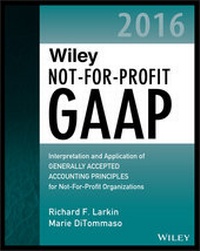
Wiley Not-for-Profit GAAP 2016
Description

Wiley Not-for-Profit GAAP 2016 is a thorough examination of the authoritative standards for measurement, presentation and disclosure as applied to not-for-profit organizations. Due to these organizations' unique characteristics, not-for-profit accountants must adhere to specific Generally Accepted Accounting Principles (GAAP). These requirements are complex and ever evolving, but this single volume brings them together, providing the most up-to-date information available. Flowcharts and diagrams are used to assist the reader's understanding of the material. Additionally, a financial statement disclosure checklist facilitates GAAP adherence.
Designed specifically for accountants in public practice and industry, this guide covers requirements from all relevant organizations, including the Financial Accounting Standards Board (FASB) and Accounting Principles Board (APB). Technical and accounting research bulletins are clearly and concisely summarized, as are all statements of position important to not-for-profit organizations. Together, these resources make Wiley Not-for-Profit GAAP 2016 a complete reference tool for auditors and financial personnel in the not-for-profit sector.
* Refine basic financial statements, including Financial Position, Activities and Cash Flow
* Tackle not-for-profit-specific issues like fundraising, noncash contributions, affiliations and pledges
* Tailor accounting methods to the specific type of organization, with budgeting, tax reporting and regulatory advice
* Discover how general accounting topics like assets, mergers and liabilities are applied to not-for-profit organizations
Preparers and auditors of not-for-profit accounts must stay up-to-date on the latest GAAP practices to best serve the organization, while complying with all disclosure, reporting and regulatory requirements. Wiley Not-for-Profit GAAP 2016 provides extensive coverage and practical advice on the latest GAAP, tailored to the not-for-profit organization's unique needs.
More details
Other editions
Additional editions
Persons
Marie DiTommaso, CPA, (Woodcliff Lake, NJ) is a partner in her own CPA practice, DiTommaso & Ruppel, CPAs. She has over 20 years of experience in accounting and financial reporting in both the not-for-profit and commercial accounting environments.
Content
About The Authors ix
Not-for-Profit Accounting Literature xi
Part 1 Overview of Not-for-Profit Organizations 1
Chapter 1 Overview of Not-for-Profit Organizations 3
Chapter 2 Cash Versus Accrual Basis Accounting 11
Part 2 Basic Financial Statements 21
Chapter 3 Statement of Financial Position 23
Chapter 4 Statement of Activities 31
Chapter 5 Statement of Cash Flows 41
Chapter 6 Other Financial Statement Issues 55
Part 3 Specific Not-for-Profit Accounting Topics 73
Chapter 7 Fund Accounting 75
Chapter 8 Net Assets 87
Chapter 9 Contributions, Pledges, Noncash Contributions, and Exchange Transactions 95
Chapter 10 Investments 139
Chapter 11 Affiliated Organizations 159
Chapter 12 Split-Interest Agreements 179
Chapter 13 Fundraising and Joint Costs 189
Chapter 14 Functional Reporting 203
Chapter 15 Collections 209
Part 4 Other Accounting-Related Not-for-Profit Topics 213
Chapter 16 Accounting for Specific Types of Not-for-Profits 215
Chapter 17 Importance of Budgets to a Not-for-Profit 229
Chapter 18 Principal Federal and State Tax Reporting and Regulatory Requirements 247
Part 5 General Accounting Topics Applied to Not-for-Profit Organizations 305
Chapter 19 Current Assets and Current Liabilities 307
Chapter 20 Inventory 315
Chapter 21 Long-Lived Assets, Depreciation, and Impairment 323
Chapter 22 Intangible Assets 335
Chapter 23 Contingencies 343
Chapter 24 Mergers and Acquisitions 359
Chapter 25 Accounting for Pensions and Postretirement Benefits 375
Chapter 26 Long-Term Liabilities 411
Chapter 27 Accounting Changes 429
Chapter 28 Accounting for Leases 435
Chapter 29 Financial Instruments 469
Chapter 30 Capitalization of Interest Costs 481
Appendix: Disclosure Checklist 487
Index 517
Not-for-Profit Accounting Literature
Cross-references between the FASB Accounting Standards Codification (ASC) and Previous Guidance
As more fully described in Chapter 1, the source of all authoritative generally accepted accounting principles for not-for-profit organizations is now contained in the FASB Accounting Standards Codification (ASC). The following tables cross-reference several of the more common ASC sections with the prior FASB pronouncements to assist readers in navigating the ASC. References in these charts to the AICPA Audit & Accounting Guide are to the 2012 edition of the Guide. Some chapters have been rearranged in the 2013 edition.
An additional table in this section provides the reader with a list of the relatively recently issued (2013 through September 2015) Accounting Standards Updates ("ASUs" which amend the ASC) issued by the FASB. Most of the ASUs will not affect the accounting and financial reporting for many, if not all, not-for-profit organizations and are not discussed in this book. However, it is important for the reader to be aware of the changes being made to the ASC so that any potential impacts of these changes can be evaluated. Note that several ASUs beginning in 2014 are the result of consensus of the FASB's Private Company Council, which provides a simplified method of accounting and reporting for certain transactions of private business entities. These ASUs are not applicable to not-for-profit organizations.
Where a specific ASU is addressed in a chapter of this book, that chapter is indicated in the table.
ASC-from previous:
ASC958- Subject Matter Previous Guidance (primarily) 10
20
30
205
210
225
230
310
320
325
360
405
450
470
605
715
720
805
810
815
840 Overall
Financially-interrelated entities
Split-interest agreements
Presentation of financial statements
Balance sheet
Income statement
Statement of cash flows
Receivables
Investments-debt and equity securities
Investments-other
Property, plant, and equipment
Liabilities
Contingencies
Debt
Revenue recognition
Compensation-retirement benefits
Other expenses
Combinations
Consolidation
Derivatives and hedging
Leases AAG (AICPA Audit Guide) Ch. 1 Para 15.04
FAS 136
AAG Ch. 6 DIG B-35
FAS 117, FSP 117-1, FAS 124
FAS 117
FAS 117, others
FAS 117, AAG Ch. 3
FAS 116, AAG Ch. 5 & others
FAS 124, AAG Ch. 8
FAS 124, FSP 124-1, AAG Ch. 8
FAS 116, FAS 93, AAG Ch. 7, 9
AAG Ch. 10, 11, 13, EITF D-089
FAS 116, AAG Ch. 10, 3
AAG Ch. 10
FAS 116, FAS 136, AAG Ch. 5
FAS 87, 88, 106, 132 (R), 158
FAS 117, SOP 98-2, AAG Ch. 13
FAS 164
SOP 94-3, FSP 94-3-1, EITF 90-15, 96-21, ARB 51
DIG B-35
SOP 94-3, EITF 90-15, 96-21, 97-01
Previous-to ASC:
Previous Guidance Subject Matter ASC (primarily) FAS 87, 88, 106, 132(R), 158FAS 93
FAS 116
FAS 117
FSP 117-1
FAS 124
FSP 124-1
FAS 136
FAS 157
FAS 164
FIN 48
DIG B-35
SOP 94-3
FSP 94-3-1
SOP 98-2
AAG-NPO Chapter:
1
2
3
4
5
6, DIG B-35
7
8
9
10
11
12
13
14
Para. 15.04
Rest of Ch. 15
16 Retirement benefits
Depreciation
Contributions
Financial statement presentation
Endowments
Investments
Investments
Pass-through gifts
Fair value
Combinations
Uncertain tax positions
Derivative in a split-interest
Consolidation
Consolidation
Joint costs
Introduction
Auditing
Financial reporting
Cash
Contributions
Split-interest
Other assets
Investments
Property, plant, and equipment
Liabilities
Net assets
Exchange transactions
Expenses
Auditors' reports
Tax
Tax
Fund accounting 958-715
958-360
958-605
958-205, 210, 225, 230, 720
958-205
958-320, 325, 205
958-325
958-605, 20
820
958-805
740-10
958-30, 815
958-810
958-810
958-720
958-10
(not in ASC)
958-205, 210, 230
958-210
958-605, 310
958-30, 815
958-605, 360
958-320, 325
958-360
958-405, 450, 720
958-225
958-605, 310
958-720, 225
(not in ASC)
958-10
(not in ASC)
(not in ASC)
Accounting Standards Updates Issued During 2013 through 2015 (September)
ASU Number Topic Chapter 2013-01 Balance Sheet (Topic 210): Clarifying the Scope of Disclosures about Offsetting Assets and Liabilities 3 2013-02 Comprehensive Income (Topic 220): Reporting of Amounts Reclassified Out of Accumulated Other Comprehensive Income 2013-03 Financial Instruments (Topic 825): Clarifying the Scope and Applicability of a Particular Disclosure to Nonpublic Entities 29 2013-04 Obligations Resulting from Joint and Several Liability Arrangements for Which the Total Amount of the Obligation is Fixed at the Reporting Date 23 2013-05 Foreign Currency Matters (Topic 830): Parent's Accounting for the Cumulative Translation Adjustment upon Derecognition of Certain Subsidiaries or Groups of Assets within a Foreign Entity or of an Investment in a Foreign Entity 2013-06 Not-for-Profit Entities (Topic 958): Services Received from Personnel of an Affiliate 11 2013-07 Presentation of Financial Statements (Topic 205): Liquidation Basis of Accounting 2013-08 Investment Companies (Topic 946): Amendments to the Scope, Measurement, and Disclosure Requirements 2013-09 Fair Value Measurement (Topic 820): Deferral of the Effective Date of Certain Disclosures for Nonpublic Employee Benefit Plans in Update No. 2011-04 2013-10 Derivatives and Hedging (Topic 815): Inclusion of the Fed Funds Effective Swap Rate (or Overnight Index Swap Rate) as a Benchmark Interest Rate for Hedge Accounting Purposes 29 2013-11 Income Taxes (Topic 740): Presentation of an Unrecognized Tax Benefit When a Net Operating Loss Carryforward, a Similar Tax Loss, or a Tax Credit Carryforward Exists 2013-12 Definition of a Public Business Entity 1 2014-01 Investments-Equity Method and Joint Ventures (Topic 323): Accounting for Investments in Qualified Affordable Housing Projects 2014-02 Intangibles-Goodwill and Other (Topic 350): Accounting for Goodwill-a consensus of the Private Company Council 2014-03 Derivatives and Hedging (Topic 815): Accounting for Certain Receive-Variable, Pay-Fixed Interest Rate Swaps-Simplified Hedge Accounting Approach-a consensus of the Private Company Council 2014-04 Receivables-Troubled Debt Restructurings by Creditors (Subtopic 310-40): Reclassification of Residential Real Estate Collateralized Consumer Loans upon Foreclosures 2014-05 Service Concession Arrangements (Topic 853) 28 2014-06 Technical Corrections and Improvements Related to Glossary Terms 2014-07 Consolidation (Topic 810): Applying Variable Interest Entities Guidance to Common Control Leasing Arrangements-a consensus of the Private Company Council 2014-08 Presentation of Financial Statements (Topic 205) and Property, Plant, and Equipment (Topic 360): Reporting Discontinued Operations and Disclosures of Disposals of Components of an Entity 2014-09 Revenue from Contracts with Customers (Topic 606) 9 2014-10 Development State Entities (Topic 915): Elimination of Certain Financial Reporting Requirements, Including an Amendment to Variable Interest Entities Guidance in Topic 810, Consolidation 2014-11 Transfers and Service (Topic 860): Repurchase-to-Maturity Transaction, Repurchase Financings, and Disclosures 2014-12 Compensation-Stock Compensation (Topic 718): Accounting for Share-Based Payments When the Terms of an Award Provide That a Performance Target Could Be Achieved after the Requisite Service Period 2014-13 Consolidation (Topic 810) Measuring the Financial Assets and the Financial Liabilities of a Consolidated Collateralized Financing Entity 2014-14 Receivables -...