

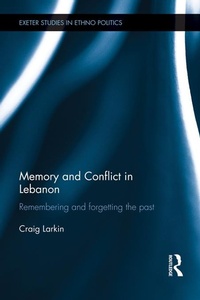
Memory and Conflict in Lebanon
Remembering and Forgetting the Past
1st Edition
Published on 15. March 2012
240 pages
978-1-136-49062-0 (ISBN)
Description

This book examines the legacy of Lebanon's civil war and how the population, and the youth in particular, are dealing with their national past. Drawing on extensive qualitative research and social observation, the author explores the efforts of those who wish to remember, so as not to repeat past mistakes, and those who wish to forget.
In considering how the Lebanese youth are negotiating this collective memory, Larkin addresses issues of:
Lebanese post-war amnesia and the gradual emergence of new memory discourses and public debates
Lebanese nationalism and historical memory
visual memory and mnemonic landscapes
oral memory and post-war narratives
war memory as an agent of ethnic conflict and a tool for reconciliation and peace-building.
trans-generational trauma or postmemory.
Shedding new light on trauma and the persistence of ethnic and religious hostility, this book offers a unique insight into Lebanon's recurring communal tensions and a fresh perspective on the issue of war memory. As such, this is an essential addition to the existing literature on Lebanon and will be relevant for scholars of sociology, Middle East studies, anthropology, politics and history.
In considering how the Lebanese youth are negotiating this collective memory, Larkin addresses issues of:
Lebanese post-war amnesia and the gradual emergence of new memory discourses and public debates
Lebanese nationalism and historical memory
visual memory and mnemonic landscapes
oral memory and post-war narratives
war memory as an agent of ethnic conflict and a tool for reconciliation and peace-building.
trans-generational trauma or postmemory.
Shedding new light on trauma and the persistence of ethnic and religious hostility, this book offers a unique insight into Lebanon's recurring communal tensions and a fresh perspective on the issue of war memory. As such, this is an essential addition to the existing literature on Lebanon and will be relevant for scholars of sociology, Middle East studies, anthropology, politics and history.
Reviews / Votes
"His writing remains always sober, collected, impartial, and most of all decent, adding much needed substance depth and class to the literature on Lebanon's history and memory."-Franck Salameh, The Levantine Review, 2012.More details
Series
Language
English
Place of publication
London
United Kingdom
Publishing group
Taylor & Francis Ltd
Target group
College/higher education
Illustrations
30 s/w Abbildungen, 1 s/w Tabelle, 28 s/w Photographien bzw. Rasterbilder, 2 s/w Zeichnungen
1 Tables, black and white; 2 Line drawings, black and white; 28 Halftones, black and white; 30 Illustrations, black and white
File size
4,69 MB
ISBN-13
978-1-136-49062-0 (9781136490620)
Copyright in bibliographic data and cover images is held by Nielsen Book Services Limited or by the publishers or by their respective licensors: all rights reserved.
Schweitzer Classification
Other editions
Additional editions
Book
05/2015
1st Edition
Routledge
€76.40
Shipment within 10-20 days
Book
01/2012
1st Edition
Routledge
€231.70
Shipment within 15-20 days
Person
Craig Larkin is a lecturer in Comparative Politics of the Middle East at Department of Middle East and Mediterranean Studies, King's College London. He was previously a research fellow at Exeter Politics department, working on an ESRC funded project 'Conflict in Cities and the Contested State' (2008-2012). He holds a PhD in Middle East Studies from the University of Exeter (Institute of Arab and Islamic Studies, 2009), an MA in Criminology and Criminal justice (LLM, 1999) and a BA(Hons) in Law and Politics (LLB, 1998) from Queen's University, Belfast.
His first monograph, Memory and Conflict in Lebanon: Remembering and Forgetting the Past was published by Routledge in January 2012. This research emerged from four years spent in the Middle East (2001-2004), studying Arabic at Damascus University while also assisting in community development projects in Lebanon, Jordan and Iraq. His second co-authored book, The Struggle for Jerusalem's Holy Places: Radicalisation and Conflict will be published by Routledge in 2013.
His first monograph, Memory and Conflict in Lebanon: Remembering and Forgetting the Past was published by Routledge in January 2012. This research emerged from four years spent in the Middle East (2001-2004), studying Arabic at Damascus University while also assisting in community development projects in Lebanon, Jordan and Iraq. His second co-authored book, The Struggle for Jerusalem's Holy Places: Radicalisation and Conflict will be published by Routledge in 2013.
Content
1. Introduction: Beyond the War? 2. Locating a Postmemory Generation 3. Contesting Lebanon: History, Identity and Co-existence 4. (Re)Imagining the Nation: School, Street and the 'Independence Intifada' 5. Space, Place and Site: Inhabiting Postwar Memoryscapes 6. Time, Story and Myth: Narrating Lebanon's Future 7. Conclusions
