

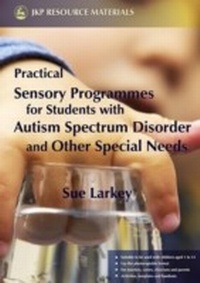
Practical Sensory Programmes
For Students with Autism Spectrum Disorder and Other Special Needs
1st Edition
Published on 15. October 2006
112 pages
978-1-84642-567-7 (ISBN)
Description

Children with autistic spectrum disorders (ASD) often have sensory processing difficulties. They may be very sensitive to particular sounds or materials, or unresponsive to injuries most children would find painful. This practical book offers a six-step approach to developing a successful programme to help children cope with sensory input they find overwhelming, and to identify activities they may find relaxing or rewarding.
Sue Larkey draws on her experience of working with children with autism to offer more than 30 activities using touch, sound, taste, vision and movement, and gives advice on how to use these activities as opportunities to improve children's communication skills. She provides detailed photocopiable checklists to assess children's sensory reactions, sleep patterns, sense of movement and use of eye contact. Parents, occupational therapists and educational professionals will find this workbook to be a rich source of fun ideas for improving sensory processing in autism, and easily adaptable for children with other special needs.
Sue Larkey draws on her experience of working with children with autism to offer more than 30 activities using touch, sound, taste, vision and movement, and gives advice on how to use these activities as opportunities to improve children's communication skills. She provides detailed photocopiable checklists to assess children's sensory reactions, sleep patterns, sense of movement and use of eye contact. Parents, occupational therapists and educational professionals will find this workbook to be a rich source of fun ideas for improving sensory processing in autism, and easily adaptable for children with other special needs.
Reviews / Votes
This practical book offers a six-step approach to developing a successful programme to help children cope with sensory input they find overwhelming, and to identify activities they may find relaxing or rewarding. Parents, occupational therapists and educational professionals will find this workbook to be a rich source of fun ideas for improving sensory processing in autism, and easily adaptable for children with other special needs. -- In the picture This easy to read and practical guide, written by a specialist autism teacher, is aimed at parents, occupational therapists and educational professionals. SLTs working with children with ASD and other special needs will find it useful.This would be a useful addition to any department as so many of the children we work with have sensory difficulties. -- Royal College of Speech & Language Therapists This practical guide for educators and parents describes a six-step approach they can use to design programs that help children with autism spectrum disorders learn to cope with sensory input. Consultant Larkey developed the activities while working in a specialist autism spectrum disorder school, but they may be applied in a variety of settings. Photocopiable checklists aid in the assessment of children's sensory reactions, sleep patterns, sense of movement, and use of eye contact. -- www.booknews.com This book's strength is in its jargon-free, and easy to use format, crammed full of practical suggestions and strategies. Professionals can pick up and use this immediately and know that they are addressing an important area of need. This is a godsend of a book for busy practitioners. SO much so, that the staff have already asked me to order more copies. What better recommendation? -- Good Autism Practice A highly effective way of working with people with autistic spectrum disorder is sensory integration therapy. In Sue Larkey's recently published Practical sensory programmes for students with autism spectrum disorder and other special needs, she has demystifies sensory integration and makes clear some of the mystifying behaviours associated with autism. This practical book encourages every person to use sensory integration as a meaningful way of understanding and helping the person with sensory issues. Parents and frontline staff will find this workbook a rich source of fun ideas for improving sensory processing in autistic spectrum disorder with techniques that are easily adaptable for people with other special needs. -- The Frontline of Learning Disability this book is a very useful tool that could help parents and carers to move from seeing their children's behaviour as "difficult" to seeing it as explicable in terms of sensory processing differences.
We feel this book will give parents and carers the confidence that they can support that they can support and help their child following a diagnosis of autism spectrum disorder and other special needs. -- Rostrum A book by an experienced practitioner with children who have ASD which offers over 30 activities using all the senses and movement to improve communication, but also to provide occupation which is relaxing, enjoyable and rewarding to the child. -- British Institute of Learning Disabilities I found Sue Larkey's book to be a useful practical resource for those educating children with autism spectrum disorder. In a wider context, many of the strategies that she describes can also be adapted for students with other special educational needs. -- Pastoral Care
More details
Language
English
Place of publication
London
United Kingdom
Target group
College/higher education
Professional and scholarly
ISBN-13
978-1-84642-567-7 (9781846425677)
Copyright in bibliographic data and cover images is held by Nielsen Book Services Limited or by the publishers or by their respective licensors: all rights reserved.
Schweitzer Classification
Other editions
Additional editions
Sue Larkey
Practical Sensory Programmes
For Students with Autism Spectrum Disorder and Other Special Needs
Book
10/2006
Jessica Kingsley Publishers
€37.50
Shipment within 15-20 days
Person
Sue Larkey is Director of Autism Consulting & Educational Services in southern Australia. She has taught both as a primary school teacher and as a special education teacher - teaching students with ASD in a mainstream and at a specialist autism school. She combines this practical experience with extensive research, having completed a Masters in Special Education and currently undertaking a Doctorate in Education. Sue has spoken at the World Autism Congress and regularly runs workshops on educational strategies for children with ASD. She is author of Making it a Success: Practical Strategies and Worksheets for Teaching Students with Autism Spectrum Disorder, also published by Jessica Kingsley Publishers.
Content
Introduction. Part 1 Getting Started. Part 2 The Six Steps to a Successful Sensory Programme. Step 1: Assessment - The Sensory Checklist. Step 2: Specific Sensory Aims and Strategies. Step 3: General Sensory Programme Activities. Steps 4, 5 and 6 Programming, Evaluation and Reassessment. Part 3 Positive Behaviour Support. Useful Resources.
