

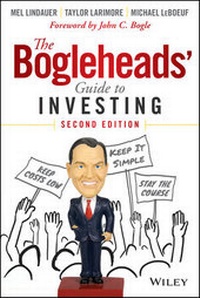
The Bogleheads' Guide to Investing
Description

More details
Other editions
Additional editions
Persons
Content
Foreword
Nothing is more deserving of your attention than the intellectual and moral associations of Americans. Americans of all ages, all conditions, and all dispositions constantly form associations [of a] thousand kinds . . . religious, moral, serious, futile, general or restricted, enormous or diminutive. I have often admired the extreme skill with which the inhabitants of the United States succeed in proposing a common object for the exertions of a great many men and inducing them voluntarily to pursue it.
As soon as several of the inhabitants of the United States have taken up an opinion or a feeling which they wish to promote, they look out for mutual assistance, and as soon as they have found one another out, they combine. From that moment they are no longer isolated men, but a power seen from afar, whose actions serve for an example and whose language is listened to.
Only by the reciprocal influence of men upon one another are feelings and opinions recruited, is the heart enlarged, and is the human mind developed. . . . This can only be accomplished by associations. What political power could ever carry on the vast multitude of lesser undertakings which the American citizens perform every day, with the assistance of the principle of association?
—Alexis de Tocqueville
Democracy in America, 1840
The Bogleheads of the Internet, it seems to me, are the paradigm of the American association described with such perceptive power by Alexis de Tocqueville in his seminal work. This association of intelligent, integrity-laden, and like-minded investors has provided not only a sound intellectual rationale for the successful accumulation of wealth but, just as de Tocqueville suggested, a sound moral rationale as well. No wonder Democracy in America—from a Frenchman who visited America for just nine months when he was but 25 years old!—has stood the test as the defining text of the American way for nearly 170 years.
During its decade-plus of existence, the Bogleheads have moved from a loose association of dedicated investors to a formal website, Bogleheads.org. (The Bogleheads previously gathered online at the Vanguard Diehards message board on Morningstar.com.) The Bogleheads website now attracts an incredible 50,000 visits and as many as 1,500 individual posts each day. The Bogleheads’ Guide to Investing marks a major milestone for this extraordinary association.
Two especially notable characteristics mark the Boglehead culture. One is rationality. These individual investors are awash in common sense, intolerant of illogic, and permeated with a preference for facts over hyperbole. Today’s popular investment misconceptions—short-term focus and fast-paced trading, the conviction that exceptional past fund performance will recur, the ignorance of the importance of fund operating expenses, sales commissions, hidden portfolio turnover costs, and state and federal taxes—are anathema to them. Bogleheads have come to accept as the core of successful investing what I have called “the majesty of simplicity in an empire of parsimony.”
The second characteristic is, of all things, caring. Bogleheads care about one another. They are eager to help all investors—regular visitors to the website and new ones, informed and naïve, experienced and novice alike—who have questions on almost any investment subject, and willing to discuss the investment issues of the day, sometimes even the national and global issues, with no holds barred (except for rudeness or coarseness). Fund selection, fund performance, types of investments, retirement planning, savings programs, tax management—none are beyond the scope of this remarkable association of investors who, without compensation or bias, strive to help their fellow investors. If there is a website that bespeaks the Golden Rule, surely the Boglehead site is its paradigm.
BOGLE AND THE BOGLEHEADS
The Bogleheads had been associating for at least three years before they came to my attention. I had heard them discussed by Vanguard’s public relations staff, and early on got the idea that they were not only firm advocates of my approach to investing—expressed in the investment strategies and human values that represented Vanguard’s rock foundation when I created this upstart firm in 1974—but were also a pretty special group of people.
However, it was not until February 3, 1999, that I met my first Boglehead. The occasion was “The Money Show” in Orlando, Florida, where I gave a contentious speech about investment principles (“The Clash of the Cultures in Investing: Complexity vs. Simplicity”) that at once seemed to confound the hosts who invited me to address the show, to infuriate the sponsor firms (all offering their own routes to easy riches), and to amaze and delight the audience of several thousand individual investors.
Shortly before my talk, Taylor Larimore (there with his wife Pat) introduced himself to me. Taylor, then and now considered the unofficial leader of the Bogleheads, proved to be as fine a human being as I’ve ever met—warm, thoughtful, intelligent, investment-savvy, and eager to help others. A combat veteran of World War II and an exceptional sailor are only a few aspects of Taylor’s background. I mention them because the first demands courage and discipline; the second, careful planning and staying the course one has set, all the while adjusting to the winds and tides. These traits, as it happens, are the principal traits of the successful investor.
In March 2000, when I spoke again in Florida, Taylor invited me to meet with the Bogleheads at his Miami condominium located at virtually the same location where Taylor was born—he honors me by calling it “the house that Jack built”—and I enthusiastically agreed. When I came down into the hotel lobby, there to meet me was Mel Lindauer, unofficial associate leader of the group, next to a sign that read “Bogleheads Meet Here.”1 We all went to Taylor’s lovely home, and Pat’s hospitality at dinner made what came to be known as Diehards I an evening of extraordinary warmth, energy, and delightful conversation, and some 20 investors who had never met one another before quickly became friends.
The following year, at Diehards II, the group met in Valley Forge, Pennsylvania. The festivities began on June 8, 2001, with a dinner addressed by Money journalist Jason Zweig, now with 40 Bogleheads in attendance. He would later write an article extolling the group: “By singing in harmony from the same page of the same investing hymnal, the Diehards drown out market noise.” The next day included an extended visit to Vanguard’s head office in Valley Forge, where I acted as host, tour guide, and keynote speaker. The questions and answer session that followed was broad-ranging, and ended with the Reverend Bob Stowe, a Massachusetts Boglehead, presenting me, on behalf of the association, with a handsome regimental bugle of World War II vintage, symbolizing my “clarion call to build an industry that protects and serves the average investor.” (I couldn’t help but respond with this quotation from St. Paul: “If the trumpet shall give an uncertain sound, who shall prepare himself to the battle?”)
Diehards III, kindly hosted by website provider Morningstar, took place in Chicago on June 26, 2002, as some 50 Bogleheads from all over the country participated in the firm’s annual investment conference, taking in my speech (“The Tell-Tale Chart”), and having an active series of gatherings. In Chicago, this association of good human beings who happen to be intelligent investors and who seek to spread the gospel grew ever more familiar and friendly.
The next gathering (Diehards IV) took place on May 10, 2004, when some 60 Bogleheads gathered in Denver, Colorado, guests of the annual conference of the Association for Investment Management and Research, the professional organization that represents securities analysts and money managers. (AIMR has now taken the name The CFA Institute, with the acronym standing for Chartered Financial Analyst.) The Bogleheads were given seats in a special section for my speech (“Creating Sound Governance: The Shareholder’s Perspective”), which was followed by an extensive question and answer session. The final question put to me by the moderator was “What is a Boglehead?” What a treat it was to have the opportunity to tell the 1,000-person audience of investment professionals about the wonderful people who constitute this dedicated association of individual investors and the sound investment strategies that they both employ and propagate.
The annual Bogleheads gatherings have continued to attract passionate investors to reconnect with friends old and new, to hear speeches from investment professionals, and, of course, to meet with their namesake. The conferences have been held all over the country—in Las Vegas, Washington, DC, San Diego, and Dallas/Ft. Worth. In recent years, the Bogleheads have held their annual conference in Valley Forge, Pennsyl-vania, where Vanguard’s headquarters is located.
THE BOGLEHEADS MESSAGE
The Bogleheads’ Guide to Investing is a wonderful, witty, and wise book. As an investor for my entire adult lifetime, I found most rewarding the sage understanding of Messrs. Larimore, Lindauer, and LeBoeuf that the practice of investing is, as they put it, “so different from most of...
