

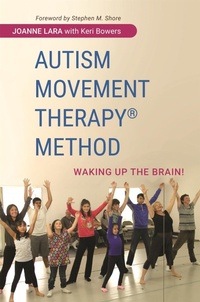
Autism Movement Therapy (R) Method
Waking up the Brain!
Published on 21. October 2015
128 pages
978-1-78450-173-0 (ISBN)
Description

A practical guide to the innovative Autism Movement Therapy (R) (AMT) approach - structured movement and music classes designed to stimulate the brain, aid sensory processing and decrease problem behaviours in children with autism spectrum disorders.
Reflecting a growing interest in the body-brain connection, and incorporating the principles of Applied Behavior Analysis, the AMT approach uses music and movement to develop audio, visual, gross motor and spatial awareness skills in children with autism. The book breaks down the components of the typical 45 minute session, from circle games to story dances, and explains how the reader can create their own AMT program.
This exciting new approach will complement other therapeutic techniques for children on the autism spectrum and can be used by a wide range of professionals, such as teachers, arts therapists and dance instructors, as well as parents and carers.
Reflecting a growing interest in the body-brain connection, and incorporating the principles of Applied Behavior Analysis, the AMT approach uses music and movement to develop audio, visual, gross motor and spatial awareness skills in children with autism. The book breaks down the components of the typical 45 minute session, from circle games to story dances, and explains how the reader can create their own AMT program.
This exciting new approach will complement other therapeutic techniques for children on the autism spectrum and can be used by a wide range of professionals, such as teachers, arts therapists and dance instructors, as well as parents and carers.
Reviews / Votes
Autism Movement Therapy (R) Method: Waking up the Brain! is a groundbreaking work and a joyously life-affirming book. Here, the dance studio is both a classroom as well as a warm, safe, and fun community, fostering the development of the participants' awareness from the inside out. Unlocking the unknown potential of those on the autism spectrum through dance and music, it offers new hope and real answers for those often pre-judged as incapable of change and a clarion call for the absolute necessity of arts education in child development. -- James Sutton, Ballet master, Choreographer and Writer, Former Associate Arts Professor, Tisch School of the Arts at New York University In addition to being a "must read", Autism Movement Therapy (R) as described in this book is a "must experience" for anyone wishing to learn how to empower individuals on the autism spectrum to first be more comfortable within their bodies, and second, achieve greater success interacting with the surrounding environment. -- From the foreword by Stephen M. Shore, Clinical Assistant Professor at Adelphi University, and internationally-known author, speaker, and individual on the autism spectrum Joanne Lara has taken the art of dance and movement and turned it into a therapy that all children with autism can benefit from. Joanne's book is fun and inspiring; she instilled a love of dance in my son that is beautiful to watch. -- Navah Paskowitz-Asner, Executive Director of Programs & Development for The Friendship Circle By The Sea Joanne's book captures it all: how AMT works, the impact of art and art expression, and the relationship of music and movement with the brain and its pathways. Joanne's unique way of intertwining her real life experience with children and their progress through AMT provides the reader with a true understanding of how AMT can impact every facet of a person's life by 'waking up the brain'. -- Lisa M. Gifford, Autism Supports and Innovations Director, AMT Workshop Instructor, Authorized Social Stories Coach, Herkimer ARC Programs like Joanne's Autism Movement Therapy offer opportunities for our kids to develop the necessary and fundamental skills that benefit all our kids. Art saved my life! -- Temple Grandin, Ph.D. Since I first participated in Joanne Lara's Autism Movement Therapy, it has really helped me to connect the right side of my brain to the left. It helps people with autism to learn how to focus more through movement. -- Dani Bowman, autism advocate, and founder of Power Light Animation Studios The arts empower people with autism to connect. Joanne's "whole brain" approach, and the stories of the children and adolescents Joanne works with are inspiring and accessible, with the guidance of her book. -- Jane Ferris Richardson, EdD, ATR-BC, Associate Professor of Art Therapy, Lesley University, and Art Therapist in Private Practice, specialising in children and young people on the autism spectrum The authors include a number of diagrams and photographs and then provide an outline of a typical session, including information about music, linked to other skills being taught...this is an interesting introduction to this approach and it is written in a practical style. -- SEN Magazine The beauty of this book is that Joanne breaks down AMT (R) for all those interested in not only delivering a music and movement program but one specifically designed for individuals on the autism spectrum, including pedagogy and Best Practices ideology. -- Erica Frailey-Matthews, The Autism & Movement ProjectMore details
Edition
Digital original
Language
English
Place of publication
London
United Kingdom
Target group
Primary & secondary/elementary & high school
Edition type
Digital original
Illustrations
43 black and white photos
File size
2,43 MB
ISBN-13
978-1-78450-173-0 (9781784501730)
Copyright in bibliographic data and cover images is held by Nielsen Book Services Limited or by the publishers or by their respective licensors: all rights reserved.
Schweitzer Classification
Other editions
Additional editions
Book
10/2015
Jessica Kingsley Publishers
€29.00
Shipment within 15-20 days
Persons
Joanne Lara, MA was a professional dancer before becoming a classroom education specialist and university professor. She was the founder of the nonprofit organization Autism Movement Therapy (R), based in Los Angeles, California, which certifies, trains, and licenses dancers, educators, parents, and professional service providers in AMT. Joanne was a Core Adjunct Professor at National University in LA, California and taught weekly Autism Movement Therapy classes in Van Nuys, CA, where she had a private ABA behavioral consultation practice. She produced the documentary Generation A: Portraits of Autism and the ARTS, was the executive producer of the LA musical event Temple Grandin & Friends: Autism Works Now and was a columnist for Autism Asperger's Digest and Sensory World.
Content
- Intro
- AUTISM MOVEMENT THERAPY® METHOD: WAKING UP THE BRAIN!
- Foreword
- Acknowledgments
- Preface
- Part 1. Understanding Autism Movement Therapy®
- 1. The Benefits of a Movement and Music Program
- Movement and music helps develop essential core skills
- Say "Cheese!"
- The ease and naturally enjoyable aspects of Autism Movement Therapy
- Shoshana's journey
- What is Autism Movement Therapy?
- Big dreams, big goals
- Brain matter: What the heck is neuroplasticity?
- Our brains are like computers
- The corpus callosum: Understanding the left and right brain hemispheres
- The cerebral cortex: Information highway
- Evidence of success
- The Dali Lama, the brain and meditation
- 2. What Does an Autism Movement Therapy® Session Look Like?
- Inclusion with neurotypical peers and Autism Movement Therapy
- Getting Started
- Raising the bar of expectations
- The urgency for quality of life
- Autism Movement Therapy: 45-minute session
- Let's break it down
- 3. Music and Movement in Every Language
- What we know about music
- Pianist Timothy Drury on music is math
- China and music
- Rocking to the beat-interesting facts about music
- Music is math-summing it up!
- Part 2. Behavior-Behavior-Behavior and The Value of Teaching Social Skills
- 4. Behavior-Behavior-Behavior
- What should a behavior plan look like? Tools for challenging behaviors
- What is Positive Behavior Support?
- Determining the function of the behavior
- Implementing PBS strategies: "The Big Three" components
- 5. Social Ability: You Dance and So Shall I
- A Cold, hard fact
- In the beginning there was impaired social understanding .
- Prioritize the most critical challenges in order of importance to success
- AMT predictability helps grow confidence
- AMT students show tremendous growth
- Relating to others in class and social situations
- Standing on the dot: a place to start
- Video modeling: Show me, Don't tell me
- Let's review the basic characteristics of social skills
- Now go out and make it happen!
- In conclusion
- References
- Index
- Blank Page
