

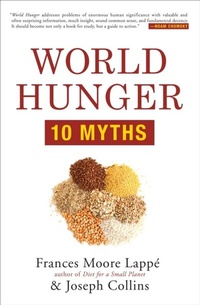
World Hunger
10 Myths
1st Edition
Published on 1. September 2018
396 pages
978-0-8021-9098-7 (ISBN)
Description

"The definitive solutions-based book for all those questioning why hunger still exists when there is such an abundance of food." -
The Huffington Post, "Food Tank's 2015 Recommended Fall Reading List"
From bestselling authors Frances Moore Lappé and Joseph Collins comes the twenty-first century's authoritative book on world hunger. Lappé and Collins refute the myths that prevent us from addressing the root causes of hunger across the globe. World Hunger: 10 Myths draws on extensive new research to offer fresh, often startling, insights about tough questions-from climate change and population growth to genetically modified organisms (GMOs) and the role of US foreign aid, and more.
Brimming with little-known but life-changing examples of solutions to hunger worldwide, this myth-busting book argues that sustainable agriculture can feed the world, that we can end nutritional deprivation affecting one-quarter of the world's people, and that most in the Global North have more in common with hungry people than they thought. For novices and scholars alike, World Hunger: 10 Myths will inspire a whole new generation of hunger-fighters.
" World Hunger... should become not only a book for study, but a guide to action." -Noam Chomsky
From bestselling authors Frances Moore Lappé and Joseph Collins comes the twenty-first century's authoritative book on world hunger. Lappé and Collins refute the myths that prevent us from addressing the root causes of hunger across the globe. World Hunger: 10 Myths draws on extensive new research to offer fresh, often startling, insights about tough questions-from climate change and population growth to genetically modified organisms (GMOs) and the role of US foreign aid, and more.
Brimming with little-known but life-changing examples of solutions to hunger worldwide, this myth-busting book argues that sustainable agriculture can feed the world, that we can end nutritional deprivation affecting one-quarter of the world's people, and that most in the Global North have more in common with hungry people than they thought. For novices and scholars alike, World Hunger: 10 Myths will inspire a whole new generation of hunger-fighters.
" World Hunger... should become not only a book for study, but a guide to action." -Noam Chomsky
All prices
More details
Other editions
Additional editions
Book
11/2015
Grove Press / Atlantic Monthly Press
€36.08
Article not available at the moment
Persons
From best-selling authors Frances Moore Lappé and Joseph Collins comes the 21st century's definitive book on world hunger. Driven by the question, "Why hunger despite an abundance of food?" Lappé and Collins refute the myths that prevent us from addressing the root causes of hunger across the globe. World Hunger: Ten Myths draws on extensive new research to offer fresh, often startling, insights about tough questions-from climate change and population growth to genetically modified organisms (GMOs) and the role of U.S. foreign aid, and more.Brimming with little-known but life-changing examples of solutions to hunger worldwide, this myth-busting book argues that sustainable agriculture can feed the world, that we can end nutritional deprivation affecting one-quarter of the world's people, and that most in the Global North have more in common with hungry people than they thought. For novices and scholars alike, World Hunger: Ten Myths will inspire a whole new generation of hunger-fighters.
Content
- Intro
- World Hunger
- Other books by both authors
- Title Page
- Copyright Page
- Dedication
- Epigraph
- Contents
- Acknowledgments
- Beyond Guild Fear & Despair
- myth 1: Too Little Food, Too Many People
- myth 2: Climate Change Makes Hungry Inevitable
- myth 3: Only Industrial Agriculture & GMO's Feed a Hungry World
- myth 4: Organic & Ecological Farming Can't Feed a Hungry World
- myth 5: Greater Fairness or More Production? We Have to Choose
- myth 6: The Free Market Can't End Hunger
- myth 7: Free Trade is the Answer
- myth 8: U.S. Foreign Aid Is the Best Way to Help the Hungry
- myth 9: It's Not Our Problem
- myth 10: Power Is Too Concentrated for Real Change-It's Too Late
- Beyond the Myths of Hunger: The Takeaway
- Right to Food Fundamentals
- Connection & Action Opportunities: What Can We Do?
- About the Authors
- Notes
- Index
- Back Cover
