

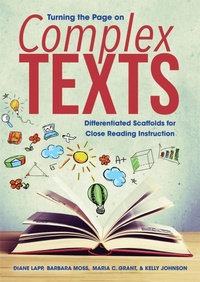
Turning the Page on Complex Texts
Description

Ensure all learners become successful close readers. In this powerful resource, the authors examine what features make a text complex. Learn how to select appropriate complex texts and design instruction to meet the needs of every student. Explore grade-specific classroom scenarios that illustrate how to scaffold lessons to foster close reading and deepen comprehension at all stages of K-12 education.
Benefits
- Gain practical teaching strategies for creating close reading lessons.
- Consider grade-level-specific instructional scenarios that illustrate how to support students' reading comprehension as they learn to read closely.
- Learn how to evaluate a text's complexity and how to ask text-dependent questions that can help students engage with a text.
- Study evidence for why continuous close assessment of student performance is vital for making sure all students learn to closely read complex texts.
- Discover potential contingency scaffolds for the classroom and how to use them to promote student success in closely reading a text.
Contents
Introduction
Part I: Background and Planning Information
1 Understanding Close Reading
2 Identifying Text Complexity
3 Making Decisions That Support Close Reading Instruction
4 Assessing During Close Reading
Part II: Instructional Scenarios
5 Understanding What the Text Says Through Differentiated Scaffolds
6 Understanding How the Text Works Through Differentiated Scaffolds
7 Understanding What the Text Means Through Differentiated Scaffolds
8 Supporting Knowledge Demands with Differentiated Scaffolds
Epilogue
Appendix A
References and Resources
More details
Other editions
Additional editions
Content
- Intro
- Acknowledgments
- Table of Contents
- About the Authors
- Introduction
- Part I
- Chapter 1
- Chapter 2
- Chapter 3
- Chapter 4
- Part II
- Chapter 5
- Chapter 6
- Chapter 7
- Chapter 8
- Epilogue
- Appendix A
- References and Resources
