

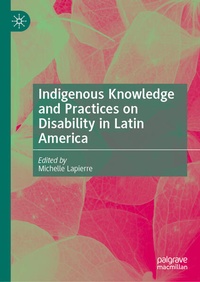
Indigenous Knowledge and Practices on Disability in Latin America
Description

More details
Other editions
Additional editions
Person
Michelle Lapierre is Assistant Professor in the Department of Rehabilitation Sciences at the University of La Frontera, Chile. Her research focuses on critical disability studies, disability in Indigenous people, intercultural health, and disability activism. She is part of the Critical Disability Studies Working Group in the Latin American Council of Social Sciences (CLACSO) and the Millennium Nucleus Studies on Disability and Citizenship (DISCA), Chile.
Content
Chapter 1: Introduction.- PART I: THEORETICAL APPROACH.- Chapter 2: Is there such a thing as Indigenous Disability Studies?.- PART II: REFLECTIONS ON DISABILITY AND INDIGENOUS CULTURAL SYSTEMS.- Chapter 3: An anti-ableist rereading of Andean paleopathology.- Chapter 4: Reflections on the relationship between indigenous language and disability in Indigenous peoples.- Chapter 5: Challenges of inclusion for Indigenous people with disabilities in community management and access to land in Mexico.- Chapter 6: Schooling of Indigenous Students with Disabilities in Brazil.- PART III: CASE STUDIES AND LIFE EXPERIENCES OF INDIGENOUS PEOPLE WITH DISABILITIES.- Chapter 7: Reflections on childbirth and disability among the Amazonian Kichwa people of Loreto, Ecuador. The birth of María.- Chapter 8: Mbyá Guaraní Cosmopraxis and the Experience of Disability: Memories of a Spiritual Dialogue in Misiones, Argentina.- Chapter 9: Lawentuchefe, Kimche and Artisans with Disabilities in the Mapuche-Williche Territory.- Chapter 10: Becoming Machi, Becoming disabled: Ontological Tensions in the Machi Calling.- Chapter 11: Community Participation of Indigenous deaf women. Three personal stories.- Chapter 12: Contributions of Latin American indigenous philosophy to disability studies.
