

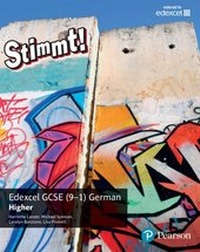
Stimmt! Edexcel GCSE German Higher Student Book
1st Edition
Published on 17. January 2017
240 pages
978-1-292-20533-5 (ISBN)
Description

Expertly structured Student Book for Edexcel GCSE (9-1) German (higher tier). Designed to help learners use language independently and to the best of their ability, with fresh and engaging content from the target language culture. Suitable for the new Edexcel GCSE (9-1) German qualification (higher tier). A carefully designed programme of learning teaches the building blocks of German grammar and vocabulary. Includes popular topics, authentic material and real life-contexts, all with links to the German culture. Each unit and module is structured to allow gradual progression. Exam preparation units are included for Reading, Writing, Speaking and Listening. Revision forms the final module.
More details
Other editions
Additional editions

Harriette Lanzer | Michael Spencer | Carolyn Batstone
Stimmt! Edexcel GCSE German Higher Student Book
Book
09/2016
Pearson Education Limited
€44.00
Shipment within 10-20 days
Content
- Cover
- Inhalt
- Kapitel 1: Auf in die Schule! Theme: School
- Startpunkt 1: So ist das Schulleben!
- Talking about school subjects and clothes
- Using verbs in the present tense
- Startpunkt 2: Es beginnt mit der Grundschule
- Talking about what's in your pencil case
- Using the past tense (imperfect and perfect)
- Einheit 1: Mit Freude in die Schule?
- Talking about what you are and are not looking forward to at school this year
- Giving opinions with reasons, using denn and weil
- Einheit 2: Der Schultag
- Describing a school day
- Asking and answering questions
- Einheit 3: Ordnung muss sein!
- Discussing school rules
- Using modal verbs: mu¨ssen, können, du¨rfen
- Einheit 4: Wissenswertes: Das Schulsystem
- Learning about different types of German schools
- Understanding a literary text
- Einheit 5: Wir fahren mit der Klasse weg!
- Talking about school exchanges and class trips
- Using the future tense
- Einheit 6: Erfolge feiern
- Talking about success and achievement at school
- Perfect tense of separable verbs
- Lese- und Hörtest
- Mu¨ndlicher Test
- Schreibtest
- Wörter
- Kapitel 2: Zeit fu¨r Freizeit Theme: Identity and culture
- Startpunkt: Verschiedene Freizeitaktivitäten
- Discussing leisure activities
- Using nouns and articles
- Einheit 1: Wer liest heute noch Bu¨cher?
- Discussing reading habits
- Using some adverbs of frequency and place
- Einheit 2: Musik ist mein Leben
- Discussing music
- Expressing preferences using gern, lieber, am liebsten
- Einheit 3: Film und Fernsehen
- Discussing film and television
- Using plural nouns
- Einheit 4: Sport fu¨r alle
- Discussing sport in Switzerland
- Using the conditional
- Einheit 5: Wir feiern!
- Learning about celebrations and festivals
- Using several tenses together
- Lese- und Hörtest
- Mu¨ndlicher Test
- Schreibtest
- Wörter
- Kapitel 3: Menschliche Beziehungen Theme: Identity and culture
- Startpunkt: Wir machen Fotos
- Describing photos
- Reviewing adjectives
- Einheit 1: Auf gute Freundschaft!
- Talking about what makes a good friend
- Using possessive adjectives
- Einheit 2: Wir verstehen uns gut . manchmal!
- Describing relationships
- Using the dative with mit
- Einheit 3: Mein Wochenende
- Discussing weekend activities
- Using the prepositions in and an
- Einheit 4: Wer ist dein Vorbild?
- Discussing role models
- Using pronouns to talk about different people
- Einheit 5: Damals und heute
- Comparing your life as a child with your life now
- Using modal verbs in the imperfect tense
- Lese- und Hörtest
- Mu¨ndlicher Test
- Schreibtest
- Wörter
- Kapitel 4: Willkommen bei mir! Theme: Identity and culture
- Startpunkt 1: So ist es bei mir
- Describing your house and home
- Using irregular verbs in the present tense
- Startpunkt 2: Leckerbissen?!
- Describing food and drink items
- Using separable verbs
- Einheit 1: Herzlich willkommen!
- Meeting and greeting an exchange partner
- Applying the correct register: du or Sie
- Einheit 2: Rund um mein Zuhause
- Describing your home
- Prepositions with accusative and dative
- Einheit 3: Ein Tag in meinem Leben
- Talking about what you do on a typical day
- Using reflexive and separable verbs
- Einheit 4: Zu Tisch!
- Discussing traditional German meals
- Giving opinions in the past tense
- Einheit 5: Total vernetzt
- Discussing how and when you use social media and technology
- Using wenn clauses
- Einheit 6: Technologiefeind oder -freund?
- Discussing advantages and disadvantages of social media and technology
- Expressing complex opinions with dass
- Lese- und Hörtest
- Mu¨ndlicher Test
- Schreibtest
- Wörter
- Kapitel 5: Ich Wien Theme: Local area, holiday and travel
- Startpunkt: Reiseplanung richtig machen!
- Describing forms of transport and making a hotel booking
- Using clauses and subordinate clauses with two verbs
- Einheit 1: Wie fahren wir nach Wien?
- Discussing ways of travelling and buying train tickets
- Comparative and superlative adjectives
- Einheit 2: Wo u¨bernachten wir?
- Describing accommodation and associated problems
- Using the demonstrative article dieser
- Einheit 3: Wie komme ich zur Oper?
- Asking for and understanding directions to sights in Vienna
- Using imperatives
- Einheit 4: Ein Wiener Schnitzel, bitte!
- Ordering at a restaurant
- Using wenn clauses with the subjunctive
- Einheit 5: Einkaufen in der Kärntner Straße
- Shopping for souvenirs
- Nominative and accusative adjective endings (definite and demonstrative articles)
- Einheit 6: Probleme im Prater
- Describing problems
- Using seit + present tense
- Lese- und Hörtest
- Mu¨ndlicher Test
- Schreibtest
- Wörter
- Kapitel 6: Im Urlaub und zu Hause Theme: Local area, holiday and travel
- Startpunkt 1: Beliebte Reiseziele
- Talking about popular holiday destinations
- Using nach, in and an to say where you are going to
- Startpunkt 2: Das Wetter
- Talking about the weather
- Using werden in the present tense
- Einheit 1: Dein Urlaubsstil
- Discussing different types of holidays
- Using prepositions with the genitive
- Einheit 2: Wie war der Urlaub?
- Discussing holiday experiences
- Using the pluperfect tense
- Einheit 3: Urlaubspläne
- Discussing holiday plans
- Using infinitive constructions with zu
- Einheit 4: Willkommen auf Sylt
- Describing places where people live
- Using es gibt with ein and kein
- Einheit 5: Meine Stadt: Vor- und Nachteile
- Assessing the advantages and disadvantages of where you live
- Saying what you could, should or would do
- Lese- und Hörtest
- Mu¨ndlicher Test
- Schreibtest
- Wörter
- Kapitel 7: Rund um die Arbeit Theme: Future aspirations, study and work
- Startpunkt 1: Arbeiterinnen und Arbeiter
- Describing jobs and places of work
- Using masculine and feminine nouns
- Startpunkt 2: Was macht man bei der Arbeit?
- Asking and answering questions about a job
- Using conjunctions and intensifiers
- Einheit 1: Berufsbilder
- Understanding job descriptions
- Recognising sequencers
- Einheit 2: Mein Berufsprofil
- Preparing a personal profile for job applications
- Developing an understanding of word order with weil
- Einheit 3: Traum und Wirklichkeit
- Talking about your dream job
- Using a variety of tenses
- Einheit 4: Sprachen öffnen Tu¨ren
- Discussing reasons for learning German and other languages
- Using um . zu
- Einheit 5: Sprachen verbessern Chancen
- Talking about using German beyond school
- Using etwas plus an adjective
- Lese- und Hörtest
- Mu¨ndlicher Test
- Schreibtest
- Wörter
- Kapitel 8: Eine wunderbare Welt Theme: International and global dimension
- Startpunkt 1: Festivals und Events
- Describing international festivals and events
- Forming questions
- Startpunkt 2: Der Berlin-Marathon
- Discussing ways of being involved in a sporting event
- Using prepositions with the accusative
- Einheit 1: Die Olympischen Winterspiele
- Debating the advantages and disadvantages of a global sporting event
- Coping with numbers and dates
- Einheit 2: Der Eurovision Song Contest
- Discussing the positive and negative aspects of a global music event
- Developing an awareness of adjectival nouns
- Einheit 3: Umwelt macht Schule
- Explaining what a school does to be environmentally friendly
- Using comparative and superlative adjectives and adverbs
- Einheit 4: Wie werden wir "gru¨ner"?
- Explaining what a country can do to be environmentally friendly
- Using subordinate clauses
- Einheit 5: Kampagnen und gute Zwecke
- Understanding texts about international and local campaigns
- Developing an awareness of the passive
- Lese- und Hörtest
- Mu¨ndlicher Test
- Schreibtest
- Wörter
- Wiederholung
- Kapitel 1: Auf in die Schule!
- Kapitel 2: Zeit fu¨r Freizeit
- Kapitel 3: Menschliche Beziehungen
- Kapitel 4: Willkommen bei mir!
- Kapitel 5: Ich Wien
- Kapitel 6: Im Urlaub und zu Hause
- Kapitel 7: Rund um die Arbeit
- Kapitel 8: Eine wunderbare Welt
- General conversation questions
- Extra: Kapitel 1-8
- Grammatik
- Verbtabellen
