

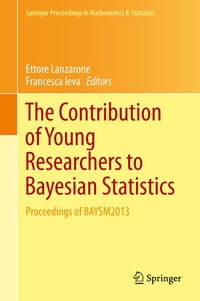
The Contribution of Young Researchers to Bayesian Statistics
Description

The first Bayesian Young Statisticians Meeting, BAYSM 2013, has provided a unique opportunity for young researchers, M.S. students, Ph.D. students, and post-docs dealing with Bayesian statistics to connect with the Bayesian community at large, exchange ideas, and network with scholars working in their field. The Workshop, which took place June 5th and 6th 2013 at CNR-IMATI, Milan, has promoted further research in all the fields where Bayesian statistics may be employed under the guidance of renowned plenary lecturers and senior discussants. A selection of the contributions to the meeting and the summary of one of the plenary lectures compose this volume.
More details
Other editions
Additional editions
Persons
Ettore Lanzarone is a Permanent Researcher at the division of Milan of the Institute of Applied Mathematics and Information Technology (IMATI) of the National Research Council of Italy (CNR), Milan, Italy. He is also Adjunct Professor Mathematical Analysis at the Politecnico di Milano, Milan, Italy. He obtained his Ph.D. in Bioengineering in June 2008 at the Politecnico di Milano, and his master degree in Biomedical Engineering cum laude in April 2004 at the Politecnico di Milano. He is member of the European Working Group on Operational Research Applied to Health Services (ORAHS) and of the Italian National Bioengineering Group (GNB). His current research interests include: parameter estimation and stochastic evolution of dynamic systems described by ordinary and partial differential equations; stochastic models for estimating the demand and planning the activities in healthcare structures; modelling and in-vitro studies of the cardiovascular fluid dynamics.
Francesca Ieva is a Postdoctoral Research Fellow at the Modeling and Scientific Computing Lab (MOX), Department of Mathematics, Politecnico di Milano, Milan, Italy. She obtained her Ph.D. in Mathematical Models and Methods for Engineering and her master degree in Mathematical Engineering at the Politecnico di Milano in 2012 and 2008, respectively. She is member of ISBA (and Program Chair of the junior section), RSS, SIS (and Chair of the young section) and SIAM. Her research activities include Statistical Learning in Biomedical context, focused on modelling data arising from integration of clinical surveys and administrative databanks, Clinical Biostatistics, Healthcare assessment, Mixed Effects Models and Semi-parametric Bayesian hierarchical models, Depth Measures and Multivariate Functional Data Analysis for applications to ECG signals, Multi State Models for the analysis of chronic diseases progression like heart failures.
Content
- Intro
- Preface
- Contents
- Part I Theoretical Bayes
- 1 A Nonparametric Model for Stationary Time Series
- 1.1 Introduction
- 1.2 The Model
- 1.2.1 Illustrations
- References
- 2 Estimation of Optimally Combined-Biomarker Accuracy in the Absence of a Gold Standard Reference Test
- 2.1 Introduction
- 2.2 Methods
- 2.3 Results
- 2.4 Conclusions
- References
- 3 On Bayesian Transformation Selection:Problem Formulation and Preliminary Results
- 3.1 Introduction
- 3.2 Bayesian Formulation
- 3.3 Results
- 3.4 Conclusions
- References
- 4 A Simple Proof for the Multinomial Version of the Representation Theorem
- 4.1 Introduction
- 4.2 De Finetti's Method for Multinomial Trials
- References
- 5 A Sequential Monte Carlo Framework for Adaptive Bayesian Model Discrimination Designs Using MutualInformation
- 5.1 Introduction
- 5.2 Notation
- 5.3 Sequential Monte Carlo Incorporating Model Uncertainty
- 5.4 Mutual Information for Model Discrimination
- 5.5 Examples
- 5.6 Conclusion
- References
- 6 Joint Parameter Estimation and Biomass Tracking in a Stochastic Predator-Prey System
- 6.1 Introduction
- 6.2 Method
- 6.2.1 State-Space Model
- 6.2.2 Rao-Blackwellized Particle Filter
- 6.3 Experimental Results
- 6.3.1 Dataset Simulation
- 6.3.2 Validation of the RBPF Algorithm
- 6.4 Conclusions
- References
- 7 Adaptive Bayes Test for Monotonicity
- 7.1 Introduction
- 7.2 Theoretical Results
- 7.3 Conclusion
- References
- 8 Bayesian Inference on Individual-Based Models by Controlling the Random Inputs
- 8.1 Introduction
- 8.2 Controlling Random Inputs
- 8.3 Woodhoopoe Model
- 8.4 Summary of the Talk
- References
- 9 Consistency of Bayesian Nonparametric Hidden Markov Models
- 9.1 Introduction
- 9.2 The Model
- 9.3 Consistency
- References
- 10 Bayesian Methodology in the Stochastic Event Reconstruction Problems
- 10.1 Introduction
- 10.2 Theoretical Preliminaries
- 10.3 Methods and Results
- References
- Part II Computational Bayes
- 11 Efficient Fitting of Bayesian Regression Models with Spatio-Temporally Varying Coefficients
- 11.1 Introduction
- 11.2 A Spatio-Temporal Model
- 11.2.1 Parameterisation, Marginalisation and Interweaving
- 11.2.2 Model Specifications
- 11.3 Results
- 11.4 Summary
- References
- 12 PAWL-Forced Simulated Tempering
- 12.1 A Parallel Adaptive Wang-Landau Algorithm
- 12.2 Simulated Tempering
- 12.3 Conclusion
- References
- 13 Approximate Bayesian Computation for the Elimination of Nuisance Parameters
- 13.1 Introduction
- 13.2 The Elimination of Nuisance Parameters
- 13.2.1 Examples
- 13.3 Conclusions
- References
- 14 Reweighting Schemes Based on Particle Methods
- 14.1 Introduction
- 14.2 Particle Move-Reweighting Strategies
- 14.3 Closing Remarks
- References
- 15 A Bayesian Nonparametric Framework to Inference on Totals of Finite Populations
- 15.1 Introduction
- 15.2 Inference on Planned Domains
- 15.2.1 Posterior Point Estimates
- 15.2.2 Full Posterior Inference
- 15.3 Simulation Results
- 15.4 Discussion
- References
- 16 Parallel Slice Sampling
- 16.1 Introduction
- 16.2 The Algorithm
- 16.2.1 First Step
- 16.2.2 Second Step
- 16.3 A Simple Example
- 17 Approximate Bayesian Computation in Quantile Regression
- 17.1 Summary
- References
- Part III Bayes @ Work: Appraisal of Applications to the Real World
- 18 Spatiotemporal Model for Short-Term Predictions of Air Pollution Data
- 18.1 Introduction
- 18.2 Data-Fusion Model
- 18.3 Analyses and Results
- References
- 19 Predicting Rainfall Fields from Lightning Records: A Hierarchical Bayesian Approach
- 19.1 Introduction
- 19.2 The Model
- 19.2.1 The Fixed Effect
- 19.2.2 The Spatial Component
- 19.3 Estimation of Parameters and Preliminary Results
- References
- 20 Bayesian Approach to Environmental Problem Based on PFLOTRAN Package
- 20.1 Introduction
- 20.2 Problem
- 20.3 Bayesian Approach
- 20.4 Results and Discussion
- References
- 21 Bayesian Hierarchical Modeling of Growth via Gompertz Model: An Application in Poultry
- 21.1 Introduction
- 21.2 Material and Method
- 21.3 Results
- References
- 22 Bayesian Prediction of SMART Power Semiconductor Lifetime with Bayesian Networks
- 22.1 Introduction
- 22.2 Data Characteristics and Available Information
- 22.3 Model Development and Evaluation Results
- 22.4 Summary
- References
- 23 Consumer-Oriented New-Product Development in Fruit Flavor Breeding: A Bayesian Approach
- 23.1 Introduction
- 23.2 Material and Methods
- 23.3 Results
- 23.4 Concluding Remarks
- References
- 24 Bayesian Layer Counting in Ice-Cores: Reconstructing the Time Scale
- 24.1 Introduction
- 24.2 The Model
- 24.2.1 Priors
- 24.3 MCMC Implementation
- 24.3.1 Updating ?: Maintaining the Cycle Count
- 24.3.2 Updating ?: Changing the Cycle Count
- 24.3.3 Hyper-parameters
- 24.4 Conclusions
- References
- Part IV A Bayesian Approach to Biostatistics and Health Sciences
- 25 Bayesian Analysis and Prediction of Patients' Demands for Visits in Home Care
- 25.1 Introduction
- 25.2 Bayesian Model
- 25.3 Application to a Real Case
- 25.4 Results
- 25.5 Conclusion
- References
- 26 Exploiting Adaptive Bayesian Regression Shrinkageto Identify Exome Sequence Variants Associatedwith Gene Expression
- 26.1 Introduction
- 26.2 Modelling Using the Normal-Gamma Prior
- 26.2.1 Including Uncertainty in Gene Expression (y)
- 26.2.2 Including Uncertainty in SNP Calls (X)
- 26.2.3 Including Functional Annotation Information
- 26.3 Preliminary Results
- 26.4 Conclusion
- References
- 27 Randomized Phase II Trials: A Bayesian Two-Stage Design
- 27.1 Introduction
- 27.2 A Bayesian Two-Stage Design
- 27.3 Numerical Results
- References
- 28 Bayesian Matrix Factorization for Outlier Detection: An Application in Population Genetics
- 28.1 Introduction
- 28.2 Bayesian Matrix Factorization for Outlier Detection
- 28.2.1 Model
- 28.2.2 Posterior Inference and Algorithm
- 28.3 Results
- 28.4 Conclusions
- References
- 29 Noise Model Selection for Multichannel Diffusion-Weighted MRI
- 29.1 Introduction
- 29.2 Background
- 29.2.1 Data
- 29.2.2 Models
- 29.2.3 Methods
- 29.3 Result Summary
- References
- 30 Analysis of Hospitalizations of Patients Affected by Chronic Heart Disease
- 30.1 Introduction
- 30.2 The Dataset
- 30.3 The Model
- 30.4 Posterior Inference
- 30.5 Conclusion
- References
- 31 A Semiparametric Bayesian Multivariate Model for Survival Probabilities After Acute Myocardial Infarction
- 31.1 Introduction
- 31.2 The Bayesian Model in a Nutshell
- References
- 32 Particle Learning Approach to Bayesian Model Selection: An Application from Neurology
- 32.1 Introduction
- 32.2 The Neuromuscular Model
- 32.3 Methodology
- 32.4 Discussion
- References
- Part V Bayesian Models for Stochastic and Economic Processes
- 33 Analysis of Italian Financial Market via Bayesian Dynamic Covariance Models
- 33.1 Bayesian Covariance Regression for Financial Data
- 33.2 Application to National Stock Indices (NSI)
- References
- 34 Bayesian Model Selection of Regular Vine Copulas
- 34.1 Introduction
- 34.2 Regular Vine Copulas
- 34.3 Model Selection Algorithm
- General Reversible Jump MCMC-Based Model Selection
- 34.4 Simulation Study and Application Study
- Reference
- 35 Analysis of Exchange Rates via Multivariate Bayesian Factor Stochastic Volatility Models
- 35.1 Introduction
- 35.2 Factor SV Estimation
- 35.3 Application
- References
- 36 On Some Stationary Models: Construction and Estimation
- 36.1 Markovian Models with Given Marginal Distributions
- 36.2 Poisson Weighted Density
- 36.2.1 Estimation
- References
- 37 Claim Sizes in the Compound Poisson Processfrom a Bayesian Viewpoint
- 37.1 Introduction
- 37.2 Estimation of the Claim Count and Claim Amount Distribution
- References
- 38 Land Rental Market and Agricultural Production Efficiency: A Bayesian Perspective
- 38.1 Introduction
- 38.2 Research Methodology
- 38.3 Data and Estimation Strategy
- 38.4 Empirical Results
- 38.5 Conclusions
- References
- Part VI Suggestions for Young Researchers
- 39 The Point Is.to Publish?
- 39.1 From the Big Technical Rules to My WHW Rules
- 39.2 The Point Is to Publish
- 39.3 How to Share and the RELUKE Rule
- 39.4 Presenting a Paper in a Talk: My WHW Rules
- 39.5 Writing a Manuscript for Submission: My WHW Rules
- 39.6 .and the Grand Final: Submission and the Publishing Process
- References
