

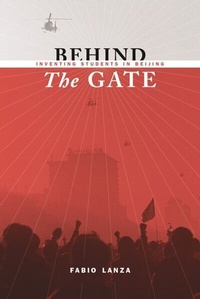
Behind the Gate
Inventing Students in Beijing
1st Edition
Published on 25. September 2015
320 pages
978-0-231-52628-9 (ISBN)
Description

On May 4, 1919, thousands of students protested the Versailles treaty in Beijing. Seventy years later, another generation demonstrated in Tiananmen Square. Climbing the Monument of the People's Heroes, these protestors stood against a relief of their predecessors, merging with their own mythology while consciously deploying their activism. Through an investigation of twentieth-century Chinese student protest, Fabio Lanza considers the marriage of the cultural and the political, the intellectual and the quotidian, that occurred during the May Fourth movement, along with its rearticulation in subsequent protest. He ultimately explores the political category of the "student" and its making in the twentieth century.
Lanza returns to the May Fourth period (1917-1923) and the rise of student activism in and around Beijing University. He revisits reform in pedagogical and learning routines, changes in daily campus life, the fluid relationship between the city and its residents, and the actions of allegedly cultural student organizations. Through a careful analysis of everyday life and urban space, Lanza radically reconceptualizes the emergence of political subjectivities (categories such as "worker," "activist," and "student") and how they anchor and inform political action. He accounts for the elements that drew students to Tiananmen and the formation of the student as an enduring political category. His research underscores how, during a time of crisis, the lived realities of university and student became unsettled in Beijing, and how political militancy in China arose only when the boundaries of identification were challenged.
Lanza returns to the May Fourth period (1917-1923) and the rise of student activism in and around Beijing University. He revisits reform in pedagogical and learning routines, changes in daily campus life, the fluid relationship between the city and its residents, and the actions of allegedly cultural student organizations. Through a careful analysis of everyday life and urban space, Lanza radically reconceptualizes the emergence of political subjectivities (categories such as "worker," "activist," and "student") and how they anchor and inform political action. He accounts for the elements that drew students to Tiananmen and the formation of the student as an enduring political category. His research underscores how, during a time of crisis, the lived realities of university and student became unsettled in Beijing, and how political militancy in China arose only when the boundaries of identification were challenged.
All prices
More details
Other editions
Additional editions
Book
08/2010
Columbia University Press
€76.88
Shipment within 10-20 days
Person
Fabio Lanza hails from Venice, Italy, and earned his Ph.D. in modern Chinese history at Columbia University. He is assistant professor of history at the University of Arizona, Tucson.
Content
List of Illustrations
Acknowledgments
List of Abbreviations
Introduction
Part I: Lived Space
1. Through the Walls: Everyday Life in the University
2. Untrained Bodies and Frugal Habits
Part II: Intellectual Space
3. The Displacement of Learning
Part III: Political Space
4. Learning Politics
5. Improper Places
Part IV: Social Space
6. Between Streets and Monuments
7. The Pedagogy of the City
Epilogue
8. The End of Students?
Notes
Bibliography
Index
Acknowledgments
List of Abbreviations
Introduction
Part I: Lived Space
1. Through the Walls: Everyday Life in the University
2. Untrained Bodies and Frugal Habits
Part II: Intellectual Space
3. The Displacement of Learning
Part III: Political Space
4. Learning Politics
5. Improper Places
Part IV: Social Space
6. Between Streets and Monuments
7. The Pedagogy of the City
Epilogue
8. The End of Students?
Notes
Bibliography
Index

