

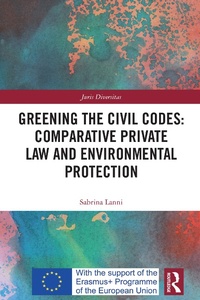
Greening the Civil Codes: Comparative Private Law and Environmental Protection
1st Edition
Published on 12. May 2023
150 pages
978-1-000-87736-6 (ISBN)
Description

This book examines the greening of civil codes from a comparative perspective. It takes into account the increasing requirements of supranational rules, which favour measures to reduce global warming and its negative environmental impacts; it discusses the necessity to expand distributive justice given the current ecological emergency; and it reflects on which private law legal tools potentially may be employed to defend nature's interests. The work fills a gap in the growing literature on developing rights of nature and ecosystem in transnational law. While the focus is on the environmental issues pertaining to the new civil codes and new projects of civil codes, the book promotes interdisciplinary research applicable to a range of environmental and natural resources-focused courses across the social sciences, especially those related to comparative law systems, legal anthropology, legal traditions in the world, political science and international relations.
Reviews / Votes
"Taking you on a journey from Latin-America to China via the EU to explore how environmental concerns have integrated civil codes, this accurate and critical study paves the way for rethinking the role of private law in the field of environmental protection. A must read!"Elise Poillot, Full Professor of Civil law at the University of Luxembourg
"Greening civil law is the responsibility of private law scholarship. Sabrina Lanni impressively leads the paths to a fundamental reorientation of private law by means of comparative law. The fundamental orientation of the private law system towards nature and the limits of human freedom set by nature creates the basis for revolutionary processes."
Martin Schmidt-Kessel, Full Professor of Consumer Law, Private Law and Comparative Law at the University of Bayreuth
"This book is very helpful for the constructive dialogue between private law and environmental law. The author analyses in depth a new trend of civil law codification, which makes environmental protection one of the fundamental values of private law."
Xue Jun, Full Professor of Civil Law at the Peking University
"An in-depth and comprehensive research on the increasing inclusion of environmental issues in current and draft Civil Codes in Europe, Asia and Latin America, thereby blending supranational regulations with private law, consumer protection and the natural world."
Ricardo Lorenzetti, Judge of the Supreme Court of Argentina and Professor of Civil and Commercial Contracts at the University of Buenos Aires
More details
Series
Edition
1. Auflage
Language
English
Place of publication
London
United Kingdom
Publishing group
Taylor & Francis Ltd
Target group
College/higher education
Illustrations
1 Halftones, black and white; 1 Illustrations, black and white
ISBN-13
978-1-000-87736-6 (9781000877366)
Copyright in bibliographic data and cover images is held by Nielsen Book Services Limited or by the publishers or by their respective licensors: all rights reserved.
Schweitzer Classification
Other editions
Additional editions
Sabrina Lanni
Greening the Civil Codes: Comparative Private Law and Environmental Protection
Comparative Private Law and Environmental Protection
Book
12/2024
1st Edition
Routledge
€65.00
Shipment within 10-20 days
Sabrina Lanni
Greening the Civil Codes: Comparative Private Law and Environmental Protection
Comparative Private Law and Environmental Protection
Book
05/2023
1st Edition
Routledge
€195.60
Shipment within 10-20 days
Person
Sabrina Lanni is Professor of Private Comparative Law at the Department of International, Legal, Historical and Political Studies at Milan University (Italy). She has been Visiting Researcher Fellow several times at European and Latin American universities, where an enduring and fruitful scientific collaboration began with many foreign colleagues. She has been a member of many national and international research projects in the fields of civil law, torts law and consumer law. Recently, with the Project ENFASIS (European Novel Foods Agreement and Sustainable Intercultural Systems), she was awarded the Jean Monnet Chair for the years 2020-2023 by the European Union. As both main author and co-author, she has published more than 60 scientific works on civil law and new trends in private law codifications, Latin American law, indigenous peoples' rights, consumer law, contract law, tort liability, comparative food law and sustainability, consumer law and new technologies. More information is available at her personal web page: www.sabrinalanni.eu
Content
Preface
Introduction
Chapter I Green Civil Codes
1. Overview of Key Issues on the Environment in the Old Civil Code's Models
2. The Progressive Greening of Civil Law Between Europe, Asia and Latin America
3. New Lemmas and New Lexicon for Civil Codes
Chapter II Stopping the Consumer Machine and Listening to the Nature's Voice
1. Sustainable Consumption as Part of Sustainable Development
2. Protection of Natural Resources as a Limit to Economic Development: Latouche v. Daly
3. Private Law and Common Goods: What Are Civil Codes' Responses to the Environment?
4. Comparative Political Efforts to Limit the Dark Side of Consumption
5. Making Informed Environmental Choices: The Climatarian Consumer
6. Balancing Ethical Values Through Civil Codes
Chapter III The New Round for the Environment Through Civil Codes
1. Global Pushes to Involve People in Preserving the Environment
2. Where Civil Codes Intersect With Constitutional Purposes
3. Consumo Sustentable and the Ecological Turn of the Argentine Civil Code
4. Luese Yuanze as the Super Green Principle of the New Chinese Civil Code
5. The Convivencia Ecologica According to the Draft of New Colombian Civil Code
6. Civil Codes and Anthropocene: Looking for a New Biocultural-Based Approach?
Chapter IV Nature as Grundnorm
1. Nature's Rights and the Andean Approach
2. Buen Vivir as a Legal Norm
3. New Zealand's Whanganui River as a Legal Person
4. A New Paradigm for Humans' Private Ecological Overtures
5. Private Law Yardsticks in the Courts' Environmental Sensitivity
6. Ecosophy: Looking for a Deep Ecological Civil Law
Conclusions
Author Index
Subject Index
Introduction
Chapter I Green Civil Codes
1. Overview of Key Issues on the Environment in the Old Civil Code's Models
2. The Progressive Greening of Civil Law Between Europe, Asia and Latin America
3. New Lemmas and New Lexicon for Civil Codes
Chapter II Stopping the Consumer Machine and Listening to the Nature's Voice
1. Sustainable Consumption as Part of Sustainable Development
2. Protection of Natural Resources as a Limit to Economic Development: Latouche v. Daly
3. Private Law and Common Goods: What Are Civil Codes' Responses to the Environment?
4. Comparative Political Efforts to Limit the Dark Side of Consumption
5. Making Informed Environmental Choices: The Climatarian Consumer
6. Balancing Ethical Values Through Civil Codes
Chapter III The New Round for the Environment Through Civil Codes
1. Global Pushes to Involve People in Preserving the Environment
2. Where Civil Codes Intersect With Constitutional Purposes
3. Consumo Sustentable and the Ecological Turn of the Argentine Civil Code
4. Luese Yuanze as the Super Green Principle of the New Chinese Civil Code
5. The Convivencia Ecologica According to the Draft of New Colombian Civil Code
6. Civil Codes and Anthropocene: Looking for a New Biocultural-Based Approach?
Chapter IV Nature as Grundnorm
1. Nature's Rights and the Andean Approach
2. Buen Vivir as a Legal Norm
3. New Zealand's Whanganui River as a Legal Person
4. A New Paradigm for Humans' Private Ecological Overtures
5. Private Law Yardsticks in the Courts' Environmental Sensitivity
6. Ecosophy: Looking for a Deep Ecological Civil Law
Conclusions
Author Index
Subject Index
