

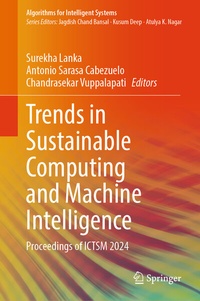
Trends in Sustainable Computing and Machine Intelligence
Description

This book is a collection of best selected research papers presented at International Conference on Trends in Sustainable Computing and Machine Intelligence (ICTSM 2024) organized by Stamford International University, Bangkok, Thailand, during September 12-13, 2024. The book includes original research by researchers working in the field of machine learning. The book covers important topics like decision support systems, neural networks and applications, machine learning, natural language processing, automated problem solving, AI and evolutionary algorithms, intelligent information systems, computational intelligence, computer vision and image processing, cognitive and biologically inspired vision, soft computing and applications, hybrid intelligent systems, distributed computing, pattern recognition and analysis, ubiquitous and high-performance computing, security, trust and privacy, big data for sustainable computing, and energy-aware machine learning.
More details
Other editions
Additional editions
Persons
Dr. Surekha Lanka holds a Doctoral degree in Computer Science with a specialization of Artificial Intelligence from University of Swahili, Panama and a Master's degree of Computer Science from Andhra University, India, Master of Technology of computer science and engineering from Nagarjuna University , India, She also has done Master courses in Wireless communication from University of Athens, Greece. She has more than 13 years' experience in teaching in various countries Thailand, Saudi Arabia, India, Bahrain and also worked as a Research Assistant at the International Institute of Research and Management in India. Currently, she is pursuing her second PhD in the Education Administration and Leadership at Stamford University, Thailand.
Antonio Sarasa Cabezuelo has a Ph.D. in Computer Science from the Complutense University of Madrid. In 1999 he joined the UCM as Professor, where he has been Assistant Professor, Associate Professor at full time, Collaborating Professor and since July 2013 he is Contracted Doctor Professor. From the point of view of research, he has focused mainly on e-learning issues, standardization, digital heritage, and software development using techniques inspired by the design and implementation of computer languages. He is a member of the official Research Group of the UCM in Engineering of Software Languages and Applications (ILSA).
Chandrasekar Vuppalapati graduated from San Jose State University Master's Program, specializing in Software Engineering, and completed his Master of Business Administration from Santa Clara University, Santa Clara, California, USA. He is Software IT Executive and Entrepreneur with diverse experience in Software Technologies, Enterprise Software Architectures, Cloud Computing, Machine Learning, Data Analytics, Internet of Things (IoT), and Software Product & Program Management. Chandra has held engineering architecture and product leadership roles at Microsoft, GE Healthcare, Cisco Systems, St. Jude Medical, and Lucent Technologies, a Bell Laboratories Company. He teaches Software Engineering, Mobile Technologies, Cloud Technologies, Data Science, Large Scale Analytics, and Advanced Data Mining for graduate programs in San Jose State University.
