

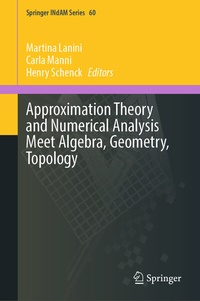
Approximation Theory and Numerical Analysis Meet Algebra, Geometry, Topology
Description

The book, based on the INdAM Workshop "Approximation Theory and Numerical Analysis Meet Algebra, Geometry, Topology" provides a bridge between different communities of mathematicians who utilize splines in their work.
Splines are mathematical objects which allow researchers in geometric modeling and approximation theory to tackle a wide variety of questions. Splines are interesting for both applied mathematicians, and also for those working in purely theoretical mathematical settings. This book contains contributions by researchers from different mathematical communities: on the applied side, those working in numerical analysis and approximation theory, and on the theoretical side, those working in GKM theory, equivariant cohomology and homological algebra.
More details
Other editions
Additional editions
Persons
Martina Lanini earned a joint PhD from the Universita Roma Tre and Universität Erlangen-Nürnberg in 2012, under the supervision of Lucia Caporaso, Corrado De Concini, and Peter Fiebig. Between 2012 and 2016 she was a postdoctoral researcher at the University of Melbourne (AUS), at Universität Erlangen-Nürnberg, and at University of Edinburgh, as well as a short term postdoc at ICERM (Brown University) and RIMS (JSPS short term fellowship in Kyoto). Since 2016 she has been at the Universita Roma Tor Vergata, becoming an Assistant Professor in 2019. Her work is mainly on representation theory (of Lie algebras, algebraic groups, quivers, ...) and its interplay with combinatorics (Coxeter groups, Kazhdan-Lusztig polynomials, moment graphs, ...) and geometry (quiver Grassmannians, equivariant cohomology, tropical Grassmannians).
Carla Manni is a Full Professor of Numerical Analysis at the Department of Mathematics, University of Rome Tor Vergata, Italy. She received her Ph.D. in Mathematics from the University of Florence in 1990. Her research interest is primarily in spline functions and their applications, constrained interpolation and approximation, computer aided geometric design and isogeometric analysis. She is the author of more than 100 peer-reviewed research publications.
Hal Schenck received a BS in Applied Math and Computer Science from Carnegie-Mellon University in 1986. From 1986 to 1990 he served as an Army officer in Georgia and Germany, then returned to graduate school at Cornell, earning his Ph.D. in 1997. After an NSF postdoc at Harvard and Northeastern, he was a professor at Texas A&M (2001-2007), at the University of Illinois (2007-2017), and Chair at Iowa State (2017-2019). Since 2019 he has been the Rosemary Kopel Brown Eminent Scholars Chair at Auburn University. He has earned teaching awards from Cornell and Illinois, and awards for departmental leadership and outreach to student veterans from Iowa State. He was elected as a fellow of the AMS in 2020, and as a fellow of the AAAS in 2023; recent academic visits include a Leverhulme Professorship at Oxford, and a Clare Hall Fellowship at Cambridge. His research is at the interface of algebra, geometry, and computation.
Content
Introduction.- Bernstein Bézier form and its role in studying multivariate splines.- The algebra of splines group actions and homology.- A study on approximation by quartic splines defined on refined triangulations.- Construction of 2D explicit cubic.- Overlap Splines and Meshless Finite Difference.- A characterization of linear independence of THB splines in R n.- Restriction and Extension for planar splines on triangulations.- Supersmoothness of multivariate splines.- Using Geometric Symmetries to Achieve Super Smoothness for Cubic Powell-Sabin Splines.- Finite element diagram chasing.- On tensor product bases of PHT splinespaces.- Momentum graphs, Chinese remainder theorem and the surjectivity of the restriction map.- A Parsimonious Approach to $C^2$ Cubic Splines on Arbitrary Triangulations.- Alcove Walks and GKM Theory for Affine Flags.- Open problems in splines.
