

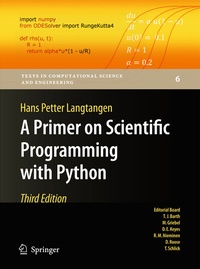
A Primer on Scientific Programming with Python
Description

Reviews / Votes
From the reviews of the third edition:
"A Primer on Scientific Programming with Python simultaneously introduces us to the Python programming language and its use in scientific computing. . The reader will learn good Python programming style from the Primer. The book will often present a direct solution using only the most basic language features . . Those of us who have learned scientific programming in Python 'on the streets' could be a little jealous of students who have the opportunity to take a course out of Langtangen's Primer." (John D. Cook, The Mathematical Association of America, September, 2011)
"This voluminous book offers an excellent and detailed explanation of programming paradigms and mathematical lexicons. . The author includes many programs, explanations, and exercises. . This book will prove very useful for mathematicians and statisticians. . I definitely recommend this book to university students for a six-month course or classroom discussions. If someone wants to quickly learn Python concepts, it can be used as a reference." (Naga Narayanaswamy, ACM Computing Reviews, February, 2013)
More details
Other editions
New editions
Additional editions
Previous edition
Person
Hans Petter Langtangen is a professor of computer science at the University of Oslo. He has formely been a professor of mechanics and is now the director of a Norwegian Center of Excellence: "Center for Biomedical Computing", at Simula Research Laboratory. Langtangen has published over 100 scientific publications and written several books, including papers and a book on Python's potential for scientific computing. He has also developed open source and commercial software systems for computational sciences.
