

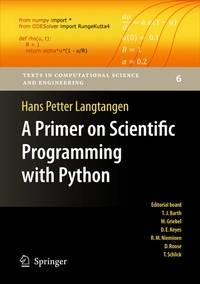
A Primer on Scientific Programming with Python
Description

Reviews / Votes
From the reviews:
"This book is an introduction to computer programming using the Python programming language. It focuses on numerical methods as the context for examples, exercises, and assignments. . Langtangen . does an excellent job of introducing programming as a set of skills in problem solving. He guides the reader into thinking properly about producing program logic and data structures for modeling real-world problems using objects and functions and embracing the object-oriented paradigm. . Summing Up: Highly recommended. Upper-division undergraduates through professionals; general readers." (F. H. Wild III, Choice, Vol. 47 (8), April, 2010)
"It is an authoritative and almost monumental work that covers most aspects of the Python language and its numerical modules. It definitely has a prominent place on my bookshelf. . The text is well written . . In summary, this is the book (the only book) to have if you are an aspiring Python programmer of scientific applications." (Jaan Kiusalaas, SIAM Review, Vol. 52 (3), September, 2010)
"The book's title reflects its content accurately, the content is substantively scientific and the book is a very good programming book. . This excellent book is quite rich mathematically, numerical methods, differential equations, treatments of shape, and a variety of exercises and projects are included. It will also impart a deep knowledge of python, one of today's most useful languages. I have learned a great deal from this book and recommend it highly." (George Hacken, ACM Computing Reviews, September, 2010)
More details
Other editions
New editions
Additional editions
Person
Hans Petter Langtangen is a professor of computer science at the University of Oslo. He has formely been a professor of mechanics and is now the director of a Norwegian Center of Excellence: "Center for Biomedical Computing", at Simula Research Laboratory. Langtangen has published over 100 scientific publications and written several books, including papers and a book on Python's potential for scientific computing. He has also developed open source and commercial software systems for computational sciences.
