

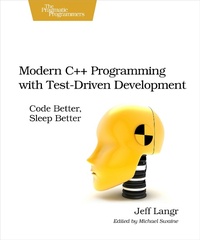
Modern C++ Programming with Test-Driven Development
Code Better, Sleep Better
Published on 10. October 2013
368 pages
978-1-68050-402-6 (ISBN)
Description

If you program in C++ you've been neglected. Test-driven development (TDD) is a modern software development practice that can dramatically reduce the number of defects in systems, produce more maintainable code, and give you the confidence to change your software to meet changing needs. But C++ programmers have been ignored by those promoting TDD--until now. In this book, Jeff Langr gives you hands-on lessons in the challenges and rewards of doing TDD in C++.Modern C++ Programming With Test-Driven Development, the only comprehensive treatment on TDD in C++ provides you with everything you need to know about TDD, and the challenges and benefits of implementing it in your C++ systems. Its many detailed code examples take you step-by-step from TDD basics to advanced concepts. As a veteran C++ programmer, you're already writing high-quality code, and you work hard to maintain code quality. It doesn't have to be that hard.In this book, you'll learn:how to use TDD to improve legacy C++ systemshow to identify and deal with troublesome system dependencieshow to do dependency injection, which is particularly tricky in C++how to use testing tools for C++ that aid TDDnew C++11 features that facilitate TDDAs you grow in TDD mastery, you'll discover how to keep a massive C++ system from becoming a design mess over time, as well as particular C++ trouble spots to avoid. You'll find out how to prevent your tests from being a maintenance burden and how to think in TDD without giving up your hard-won C++ skills. Finally, you'll see how to grow and sustain TDD in your team.Whether you're a complete unit-testing novice or an experienced tester, this book will lead you to mastery of test-driven development in C++.What You NeedA C++ compiler running under Windows or Linux, preferably one that supports C++11. Examples presented in the book were built under gcc 4.7.2.Google Mock 1.6 (downloadable for free; it contains Google Test as well) or an alternate C++ unit testing tool. Most examples in the book are written for Google Mock, but it isn't difficult to translate them to your tool of choice.A good programmer's editor or IDE.cmake, preferably. Of course, you can use your own preferred make too. CMakeLists.txt files are provided for each project. Examples provided were built using cmake version 2.8.9.Various freely-available third-party libraries are used as the basis for examples in the book. These include:cURLJsonCppBoost (filesystem, date_time/gregorian, algorithm, assign)Several examples use the boost headers/libraries. Only one example uses cURL and JsonCpp.
More details
Other editions
Additional editions
Book
01/2014
The Pragmatic Programmers
€37.50
Shipment within 3-4 weeks
Content
- Cover
- Table of Contents
- Foreword
- Introduction
- But Can It Work for Me on My System?
- Who This Book Is For
- What You'll Need
- How to Use This Book
- About "Us"
- About Me
- About the C++ Style in This Book
- Acknowledgments
- Dedication
- 1. Global Setup
- Setup
- The Examples
- C++ Compiler
- CMake
- Google Mock
- CppUTest
- libcurl
- JsonCpp
- rlog
- Boost
- Building Examples and Running Tests
- Teardown
- 2. Test-Driven Development: A First Example
- Setup
- The Soundex Class
- Getting Started
- Fixing Unclean Code
- Incrementalism
- Fixtures and Setup
- Thinking and TDD
- Test-Driving vs. Testing
- What If?
- One Thing at a Time
- Limiting Length
- Dropping Vowels
- Doing What It Takes to Clarify Tests
- Testing Outside the Box
- Back on Track
- Refactoring to Single-Responsibility Functions
- Finishing Up
- What Tests Are We Missing?
- Our Solution
- The Soundex Class
- Teardown
- 3. Test-Driven Development Foundations
- Setup
- Unit Test and TDD Fundamentals
- The TDD Cycle: Red-Green-Refactor
- The Three Rules of TDD
- Getting Green on Red
- Mind-Sets for Successful Adoption of TDD
- Mechanics for Success
- Teardown
- 4. Test Construction
- Setup
- Organization
- Fast Tests, Slow Tests, Filters, and Suites
- Assertions
- Inspecting Privates
- Testing vs. Test-Driving: Parameterized Tests and Other Toys
- Teardown
- 5. Test Doubles
- Setup
- Dependency Challenges
- Test Doubles
- A Hand-Crafted Test Double
- Improving Test Abstraction When Using Test Doubles
- Using Mock Tools
- Getting Test Doubles in Place
- Design Will Change
- Strategies for Using Test Doubles
- Miscellaneous Test Double Topics
- Teardown
- 6. Incremental Design
- Setup
- Simple Design
- Where Is the Up-Front Design?
- Refactoring Inhibitors
- Teardown
- 7. Quality Tests
- Setup
- Tests Come FIRST
- One Assert per Test
- Test Abstraction
- Teardown
- 8. Legacy Challenges
- Setup
- Legacy Code
- Themes
- The Legacy Application
- A Test-Driven Mentality
- Safe Refactoring to Support Testing
- Adding Tests to Characterize Existing Behavior
- Sidetracked by the Reality of Legacy Code
- Creating a Test Double for rlog
- Test-Driving Changes
- A New Story
- A Brief Exploration in Seeking Faster Tests
- Mondo Extracto
- Spying to Sense Using a Member Variable
- Spying to Sense Using a Mock
- Alternate Injection Techniques
- Large-Scale Change with the Mikado Method
- An Overview of the Mikado Method
- Moving a Method via Mikado
- More Thoughts on the Mikado Method
- Is It Worth It?
- Teardown
- 9. TDD and Threading
- Setup
- Core Concepts for Test-Driving Threads
- The GeoServer
- Performance Requirements
- Designing an Asynchronous Solution
- Still Simply Test-Driving
- Ready for a Thready!
- Exposing Concurrency Issues
- Creating Client Threads in the Test
- Creating Multiple Threads in the ThreadPool
- Back to the GeoServer
- Teardown
- 10. Additional TDD Concepts and Discussions
- Setup
- TDD and Performance
- Unit Tests, Integration Tests, and Acceptance Tests
- The Transformation Priority Premise
- Writing Assertions First
- Teardown
- 11. Growing and Sustaining TDD
- Setup
- Explaining TDD to Nontechies
- The Bad Test Death Spiral, aka the SCUMmy Cycle
- Pair Programming
- Katas and Dojos
- Using the Code Coverage Metric Effectively
- Continuous Integration
- Deriving Team Standards for TDD
- Keeping Up with the Community
- Teardown
- A1. Comparing Unit Testing Tools
- Setup
- TDD Unit Testing Tool Features
- Notes on Google Mock
- Notes on CppUTest
- Other Unit Testing Frameworks
- Teardown
- A2. Code Kata: Roman Numeral Converter
- Setup
- Let's Go!
- Practice Makes Perfect
- Teardown
- A3. Bibliography
- Index
- - A -
- - B -
- - C -
- - D -
- - E -
- - F -
- - G -
- - H -
- - I -
- - J -
- - K -
- - L -
- - M -
- - N -
- - O -
- - P -
- - Q -
- - R -
- - S -
- - T -
- - U -
- - V -
- - W -
- - Z -
