

The Face of It
Published on 26. October 2012
64 pages
978-1-84777-592-4 (ISBN)
Description

Roger Langley's poems explore perception. They take their bearings from forms as diverse as Renaissance hermeticism, a Greek vase, Rauschenberg's painting, Bottom's dream, a green beetle. Here the world may chime, like a building by Palladio, or disappear on a parting wave as in a film by Bergman. Surprise and truth come together. Things are both ordinary and vivid, distinct and universal. Langley's poems take delight in the sound and sense of language: for him, etymology can be revelation. In the interplay of word and object, each poem attempts an epiphany.
Reviews / Votes
R. F. Langley's Collected Poems (2000) was a book that rightly reflected some glory on a poet who previously had only slipped in and out of the occasional daylight of pamphlet publishing. Although there were only seventeen poems to collect, each was unique and substantial piece, and Langley evidently had a rare ear, trained on the more hummable Modernist musicians: Basil Bunting, Wallace Stevens, W. S. Graham. Even at its most abstract, the writing had a mosaic quality of insights tweezered into place: 'Hopes and memories / play lips and blinks with blues / and pinks'. Reviewers quickly registered their puzzlement over certain aspects, but also conceded their pleasure in work that made such a rich and careful use of words. The judges of the Whitbread Prize for Poetry that year duly short-listed the 62-year-old's life's work for national attention, and he was featured on a Radio 3 arts programme.But when The Face of It, Langley's second full volume, appeared last year it received no prize nominations, no arts programming, and only one national review, in The Times Literary Supplement. Yet it is the work of a master poet, who deserves - in his seventieth year - to be recognised as one of the finest writers in England today.
Since Collected Poems, the literary discipline that lies behind the vivid compressions of Langley's poems has been revealed by the publication of entries from his prose journals: serially in PN Review magazine, and then as a book in 2006. These record hours of intense observational experience, focused on the world of nature and art.
The emotions of daily life are not so much absent from these diary entries as held at bay by a more formal space for reflection. This may be found in a landscape, a church, or a museum. It becomes an occasion for the meditative mind to roam and return to mortality, illuminated - and as such sets a pattern for Langley's poems.
An entry from November 1997, for example, begins 'The funeral is over by mid-day' and then makes its way from crematorium to a display of Chinese porcelain, where Langley encounters bowls of
Fire and air. Fresh cream. Copper-bound rims with no joins in them, cut from one sheet, glinting mouth-rim.
Ten years later, in The Face of It, this transition from sadness to consolation becomes the poem 'After the Funeral'. Langley's verse pares his prose down to the connection it finds between the dignity of the deceased and the fineness of the china:
Givesome mind to an empty dish. How, in theCeramic Gallery, metal lips fit.Her passport photograph looks like the moonin a tight woollen hat. She had given
her money away. Herstare will say nothing ofthat.
The unspoken idea that connects the poet's observations is the relationship between frugality and fidelity in life and art. As you 'give / some mind to an empty dish', you come to appreciate how extravagantly attentive the unknown potter has been to produce a piece of such bare perfection. Similarly, the blank look of the dead woman in the photograph only negatively communicates her silent generosity.
The revelation of The Face if It, after Collected Poems, is the exacting precision to which Langley has brought his collaged arguments. Where before poems like 'The Ecstasy Inventories' were marvellous rag-bags of patterning - such as 'sunbursts / of logical straps, rays, pips, / split pods or crooked stars' found in lacework - here every detail is 'woven deep in' to the 'blanket design' of its text.
The needle that he has found for the job is rhyme. In 1985, he wrote - with one eye on Tennyson - a poem called 'Mariana', which was the result of wondering 'what would happen if rhyme came back in to do a lot of the running'. Rhyme's running between words, and ahead of thought, was then fully embodied in the familiar spirit of the 'Jack' poems, who is said by the poet to be 'your man in things... a step ahead, deep in the hedge, on / edge' ('Man Jack').
The Face of It retires Jack as a conceit, but retains his sprightly style of trouvaille. What brings the thought behind the lines from 'After the Funeral' to life is, firstly, the neat assonance between 'empty dish' and 'metal lips'. The admirable 'fit' found between these things is then taken up in the rhyme that frames the snapshot of the dead woman: superficially comic and pitiable in her 'tight woollen hat', she hides a noble spirit whose tight-lipped stare will 'say nothing of / that'. Langley's versification recreates his unexpected apprehension.
T. S. Eliot, a modern poet who felt the power of rhyme, wrote that a 'precise fitness of form and matter means also a balance between them: thus the form, the pattern movement, has solemnity of its own [...] however light and gay the human emotion concerned, and a gaiety of its own however serious or tragic the emotion'.
This contrary balance is important to appreciate in Langley's later verse. The irregular rhymes, and the rhythms that join their dots, do add gaiety. But verbal vivacity can conceal tragic steel. The TLS reviewer was perhaps a little misled by the author's cryptic statement that 'A Midsummer Night's Dream might still be the answer to everything' when he wrote that Langley's use of myths, folklore and archaic 'Merrie English' in The Face of It 'seeks to re-enchant the world, to see a modern-day pub, the doings of beetle and spider as a way into the realms of trolls and fairies'.
As A. D. Nuttall has written in Shakespeare the Thinker (2007), A Midsummer Night's Dream is not an escapist play, but a play 'about escapism', a work of 'darkened pastoral' well aware that its fairies are a consoling fiction. Like Bottom's dream, its deepest implications for the mind of man have 'no bottom'.
So, Langley's lovely but shadowy poem about A Midsummer Night's Dream, placed at the heart of this book, is pointedly called 'Cash Point'. This plays on two kinds of 'hole in the wall': the one where Pyramus and Thisbe keep their doomed love alive in the Mechanicals' comically acted tragedy, and the one where we enchanted moderns still tragi-comically hope to cash in dreams for reality, language for things: 'With your last twitch you can / point at the letters that make up / the spell'.
Elsewhere, Langley's exuberant allegory of 'the beetle and wasp', 'Depending on the Weather', concerns the territorial aggression of the former towards the latter. This develops into a fragmentary meditation on the social psychology of witch trials: 'I believe the old / widow knew well enough what went right to my / heart'. The paranoia which conjures an 'evil fairy' from an old widow, or a hovering wasp, is what allows you to justify 'your own ill-treatment' of it. Fantasy, in other words, is a tragic as well as a comic faculty, which may deny the world as it is: 'The / wasp reads on. The beetle rips up what is read'.
The great tragic vision of The Face of It is 'Achilles', which climaxes in a startlingly direct statement of universal delusion: 'Maybe everyone is dazzled / here by simultaneous death and love?'. Such naked profundity is only possible to poets who have lived in the dazzle, and found their own way through it. Langley's way has been via the consolations of cool observation: it is appropriate, perhaps, that the English sculpture he most admires should be the funerary monuments of one Nicholas Stone.
Stone's carved slab in memory of the twenty-five year-old Elizabeth Haves is at the centre of 'Achilles'. Writing of the same monument in his journals, Langley noted that this memorial portrait drawn on a piece of marble is 'not quite perfectly done as might repel involvement, but seriously deft' ('the squiggles of her hair are like a jiggling cloud'). The description might apply to his own lapidary yet vital art, in which lines of verse are cut strictly to syllable counts, but rhymes rove over the whole, sparking runs of fancy, and involving the ready in simultaneous solemnity and gaiety:
Did she have time to walk out......turn round, look back, and shoutthat she could see what it might mean? That thatwas the place where she had been? She is awhisper. Smoke and cream.
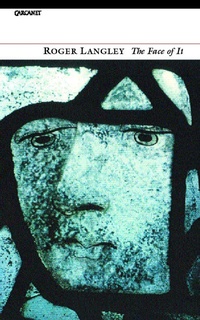
The cover of Langley's Collected Poems was a photograph of a church floor: a sunlit patchwork of bricks and tiles, ranging from red ochre to creamy yellow, intersecting at angles. The Face of It presents a single fragment of blue-green medieval window glass, framed by black lead, on which has been sketched a human countenance somewhere between calm introspection and tender concern. As a symbol of the development of Langley's poetry between the two books - and of what this brilliantly filigree and clear-eyed body of new work might mean - it is perfectly seen. Accept that there is a Cambridge School, and J. H. Prynne's friend and contemporary R. F. Langley is an original staff member. Yet, until his retirement in 1999, Langley was more concerned with teaching English and Art History in schools in Wolverhampton and Sutton Coldfield than with publishing many poems. The twenty-one poems in The Face of It, added to the seventeen in Collected Poems (2000) make it clear, however, that Langley is not a minor coterie poet but a distinct and significant talent.
Langley's debts to the Objectivists and Black Mountain poets, his Cambridge tics and traits have been absorbed into a poetic that is characteristically English and traditional. Poems echo to Shakespeare, the Romantics and Hopkins, will be wrought to strict, often syllabic forms, and laced with rhyme. Langley mixes dictions, lets the modern everyday mingle with the time-honoured aureate, but he does not make them clash; and there is always a fairly stable, somewhat formal, poetic voice. There are poems of ekphrasis, poems inspired by literature and poems that reveal a fondness for churches, amateur entomology and Suffolk. Compression, ellipsis and the compounding of images and ideas can make the poems tricky to follow, and dictionaries of art and entomology and Langley's Journals (2006) prove handy aids to interpretation. Still, one can always get a fair gist at first reading, and it would be wrong to describe the poetry as purposively difficult.
'a distinct and significant talent'
The blurb asserts that 'R. F. Langley's poems explore perception'. There are indeed moments when the poems are like notes of immediate impression and reaction. Nevertheless, the poet typically oscillates between close attention to the world and his responses to it and a discursive fondness for abstractions or for trains of thought. 'Thoughtstone' turns this into a rhetorical device as it pronounces for or against great thinkers and their view of time and matter, before hopping to birdsong on an August night:
Kepler was wrong to
talk of forces as if they
were things. Here they are
generated by the robin...
The technique gives a conventionally poetic subject novel handling and yields some interesting observations. Moreover, it looks to overcome Eliot's 'dissociation of sensibility' whereby : 'a man falls in love, or reads Spinoza, and these two experiences have nothing to do with each other'. However, the deliberateness of the yoking - the willingness to make the robin's song not interfused with thought and sensuous experience but an exemplum - achieves something rather different.
'Brute Conflict' plays on the calculi, the pebbles the Romans used for counters, wishing pebbles, and the idea of pebbles, to be conjured up and conjured away:
To calculate without
desires, so the pebbles
vanish when it comes to
calculation. Desire for
pebbles.
As he circles around words and their etymologies, painting, pigments, and sense impressions, Langley seeks to objectify experience, language and the world, while also seeking to resist this process. The fastidiousness with word and though risks the higher pedantry, and Langley's foregrounding of language and artifice can get precious and tired. You need to be a wittier writer than Langley to get away with turning to a painting and thanking 'the old man, the moon, Bellini, / hoping the next words he reads will / mention me as someone here in "line 57"'. For the most part, however, Langley's regard for the surface of poems and canvases is not just a late modernist habit but proceeds from the same attentiveness to detail that is there in his meticulous observation of the behaviour of wasps.
Much of Langley's poetry is disquisitional, and many of its propositions are susceptible to conventional debate. Yet, he practices poetry as a magical art as well as a rational one. His belief that 'A Midsummer Night's Dream might still be the answer to everything' may come from long thought on the play, but even when Langley is not putting 'the magus, Agrippa Von / Nettesheim' among the rude mechanicals there is an occult quality to his Shakespeariana. Furthermore, Langley's use of myth and folklore, his fondness for a Merrie English of brimmers and Nuncles seeks to re-enchant the world, to see a modern-day pub, the doings of beetle and spider as a way into the realm of trolls and fairies.
Such contrary urges, which make Langley hard to characterize, champion or dismiss, make for a read that peculiar and rewarding. Not only do the ornate and awkward beauties of the poems deserve to be appreciated more widely; their qualities mean there is a good chance that this will happen.
More details
Language
English
Place of publication
United Kingdom
Publishing group
Carcanet Press Ltd
File size
0,43 MB
ISBN-13
978-1-84777-592-4 (9781847775924)
Copyright in bibliographic data and cover images is held by Nielsen Book Services Limited or by the publishers or by their respective licensors: all rights reserved.
Schweitzer Classification
Other editions
Additional editions
R.F. Langley
Face of it
Book
04/2007
Carcanet Press Ltd
€18.50
Article exhausted; check different version
Person
R.F. LANGLEY was born in Rugby in 1938. He was educated at Jesus College, Cambridge and went on to teach English and Art History in secondary schools. He has lived in Staffordshire for most of his life, but the inspiration for much of his work comes from the landscapes of Suffolk. He has published pamphlets and his work has appeared in many journals and anthologies, most recently The Harvill Book of Twentieth-Century Poetry in English (1999). He died in 2011. He was posthumously awarded the 2011 Forward Prize for Best Single Poem, for 'To a Nightingale'.
Click here to read a full obituary of R.F. Langley.
Click here to read a full obituary of R.F. Langley.
