

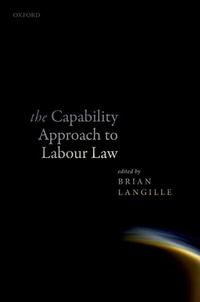
The Capability Approach to Labour Law
1st Edition
Published on 4. April 2019
368 pages
978-0-19-257309-4 (ISBN)
Description

Forty years ago Amartya Sen introduced to the world a novel approach to the idea of equality: the notion of 'basic capability' as 'a morally relevant dimension' and the claim that we should focus upon equality of basic capabilities ('a person being able to do certain basic things'). These ideas, as developed by Sen and Martha C. Nussbaum, have launched an academic armada now proceeding under the flag of the 'capability approach' (CA). While that flag has ventured far and wide and engaged many areas of inquiry, this volume of essays is the first to explore how CA might shed light upon labour law.
The capabilities approach can illuminate our understanding of labour law across three dimensions. Part I looks at the nature of the basic relationship between CA and labour law-do they share common ground or disagree about what is important? Can the CA provide a normative 'foundation' for labour law? Part II goes further by examining the relationship of the CA and other well-established perspectives on labour law, including economics, history, critical theory, restorative justice, and human rights. Part III examines the possible relevance of the CA to a range of specific labour law issues, such as freedom of association, age discrimination in the workplace, trade, employment policy, and sweatshop goods.
More details
Other editions
Additional editions
Brian Langille
The Capability Approach to Labour Law
Book
04/2019
Oxford University Press
€140.70
Shipment within 15-20 days
Person
Brian Langille is a professor in the Faculty of Law of the University of Toronto. His work examines how we think about labour law and he is currently working on an ongoing project addressing 'The Capability Approach to Labour Law', of which this volume of essays is an essential part.
Content
- Introduction: The Capability Approach to Labour Law-Why Are We Here?
- Part I: The Capability Approach and Labour Law: Fundamental Questions
- 1: Hugh Collins: What Can Sen's Capability Approach Offer to Labour Law
- 2: Guy Davidov: The Capability Approach and Labour Law: Identifying the Areas of Fit
- 3: Martha C. Nussbaum: Labor Law and the Capabilities Approach
- 4: Riccardo Del Punta: Is the Capability Theory an Adequate Normative Theory for Labour Law?
- 5: Supriya Routh: The Need to Become Fashionable
- 6: Brian Langille: 1. What is Labour Law? Implications of the Capabilities Approach
- Part II: The Capability Approach to Labour Law from Other Disciplinary Perspectives
- 7: Simon Deakin: The Capability Approach and the Economics of Labour Law
- 8: Laura Weinrib: Labor History and the Clash of Capabilities
- 9: Pascal McDougall: Capabilities, Utility, or Primary Goods? On Finding a Conceptual Framework for (International) Labour Law
- 10: Virginia Mantouvalou: Work, Human Rights, and Human Capabilities
- 11: Bruce P. Archibald: Capabilities Approaches and Labour Law through a Restorative Regulatory Lens
- Part III: The Capability Approach to Labour Law and Important Labour Law Controversies
- 12: Alan Bogg: The Constitution of Capabilities: The Case of Freedom of Association
- 13: Pnina Alon-Shenker: Capabilities and Age Discrimination
- 14: Clair Gamage: (Re)Imagining the Trade-Labour Linkage: The Capabilities Approach
- 15: Robert Salais: Freedom in Work and the Capability Approach: Towards a Politics of Freedoms for Labour?
- 16: Lyn K. L. Tjon Soei Len: Capabilities, Contract, and Causality: The Case of Sweatshop Goods
