

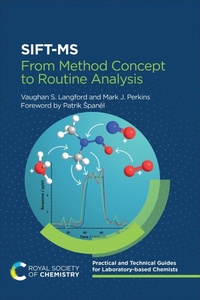
SIFT-MS
From Method Concept to Routine Analysis
Published on 20. June 2025
XX, 404 pages
978-1-83767-792-4 (ISBN)
Description

Selected ion flow tube mass spectrometry (SIFT-MS) is a chromatography-free, direct-analysis technique that is ideally suited to real-time, quantitative analysis of volatile compounds in air at trace concentrations. SIFT-MS utilises highly controlled, soft chemical ionisation - in the form of gas-phase ion-molecule reactions - coupled with mass spectrometry detection to provide both broad-spectrum and specific analysis of volatiles with diverse functionalities.
This book provides readers with a broad understanding of the principles of the SIFT-MS technique and how it differs from conventional chromatographic approaches that are used for analysis of volatiles. It will also aid users to identify existing and new methods where adoption of SIFT-MS would be advantageous, e.g. through reduction in sample preparation or higher throughput, and provides the knowledge and insight required to develop best-practice methods and effectively evaluate the data that they generate and approaches to optimising, validating, and transferring methods to routine analysis and other applications.
This book addresses two needs for SIFT-MS users:
- As a reference work, it gathers the fundamental principles from the literature and laboratory experience to provide a practical textbook for those using SIFT-MS in routine laboratories, research organisations and academia.
- It utilises a procedure-based approach to apply principles to routine analysis, simplifying implementation in routine analysis laboratories, while also accelerating effective application in other specialisations.
The audience for this book is method developers and laboratory technicians engaged in routine analysis and research laboratories, but it is also well suited to graduate students, reducing the mentoring load for academics and research fellows.
This book provides readers with a broad understanding of the principles of the SIFT-MS technique and how it differs from conventional chromatographic approaches that are used for analysis of volatiles. It will also aid users to identify existing and new methods where adoption of SIFT-MS would be advantageous, e.g. through reduction in sample preparation or higher throughput, and provides the knowledge and insight required to develop best-practice methods and effectively evaluate the data that they generate and approaches to optimising, validating, and transferring methods to routine analysis and other applications.
This book addresses two needs for SIFT-MS users:
- As a reference work, it gathers the fundamental principles from the literature and laboratory experience to provide a practical textbook for those using SIFT-MS in routine laboratories, research organisations and academia.
- It utilises a procedure-based approach to apply principles to routine analysis, simplifying implementation in routine analysis laboratories, while also accelerating effective application in other specialisations.
The audience for this book is method developers and laboratory technicians engaged in routine analysis and research laboratories, but it is also well suited to graduate students, reducing the mentoring load for academics and research fellows.
More details
Other editions
Additional editions
Book
06/2025
1st Edition
Royal Society of Chemistry
€46.00
Shipment within 3-4 weeks
Persons
Mark Perkins is a senior applications chemist at Element Materials Technology Laboratory Instrumentation in Cambridge, United Kingdom (formerly Anatune), and a global authority in automated SIFT-MS. Dr Perkins has extensive experience in both conventional chromatographic methods as well as SIFT-MS. Prior to joining Anatune in 2015, he spent 12 years as a senior analyst and chromatography section manager at the Malaysian Rubber Board's UK research centre, working on regulated pharmaceutical applications within a GMP environment.
Vaughan Langford obtained BSc(Hons) and PhD degrees in chemistry at the University of Canterbury (Christchurch, New Zealand) in 1993 and 1997, respectively. He then completed postdoctoral research fellowships at the Universities of Geneva (Switzerland) and Western Australia (Perth, Australia). He moved from optical spectroscopy to SIFT-MS upon taking up a postdoctoral fellowship at the University of Canterbury in late 2002. The commencement of this fellowship coincided with the founding of Syft Technologies where Dr Langford has worked ever since. He has extensive experience in SIFT-MS application and method development plus data interpretation. Additionally, from 2005 to 2018 he managed a small contract testing service using SIFT-MS, from sample analysis through to reporting and quality assurance. Dr Langford is active in providing SIFT-MS training (both in the science and application) and publishing in the literature on the diverse applications of SIFT-MS (40 peer-reviewed publications, including 9 book chapters and reviews).
Vaughan Langford obtained BSc(Hons) and PhD degrees in chemistry at the University of Canterbury (Christchurch, New Zealand) in 1993 and 1997, respectively. He then completed postdoctoral research fellowships at the Universities of Geneva (Switzerland) and Western Australia (Perth, Australia). He moved from optical spectroscopy to SIFT-MS upon taking up a postdoctoral fellowship at the University of Canterbury in late 2002. The commencement of this fellowship coincided with the founding of Syft Technologies where Dr Langford has worked ever since. He has extensive experience in SIFT-MS application and method development plus data interpretation. Additionally, from 2005 to 2018 he managed a small contract testing service using SIFT-MS, from sample analysis through to reporting and quality assurance. Dr Langford is active in providing SIFT-MS training (both in the science and application) and publishing in the literature on the diverse applications of SIFT-MS (40 peer-reviewed publications, including 9 book chapters and reviews).
Content
- Introduction
- The Principles of the SIFT-MS Technique
- SIFT-MS Data Analysis
- Sample Preparation and Delivery
- Safety, Maintenance, and Troubleshooting
- Assessing SIFT-MS Method Feasibility (Procedure 1)
- Preparing the Automated SIFT-MS Instrument for Analysis (Procedure 2)
- Method Development - Phase I (Procedure 3)
- Method Development - Phase II (Procedure 4)
- Method Validation and Documentation (Procedure 5)
- Routine Analysis (Procedure 6)
- Modifying an Existing SIFT-MS Method (Procedure 7)
- Data Analysis and Reporting
- Quality Assurance
- Complete Workflows for Routine Headspace Approaches
- Routine Headspace Applications
- Other Selected Applications
- The Principles of the SIFT-MS Technique
- SIFT-MS Data Analysis
- Sample Preparation and Delivery
- Safety, Maintenance, and Troubleshooting
- Assessing SIFT-MS Method Feasibility (Procedure 1)
- Preparing the Automated SIFT-MS Instrument for Analysis (Procedure 2)
- Method Development - Phase I (Procedure 3)
- Method Development - Phase II (Procedure 4)
- Method Validation and Documentation (Procedure 5)
- Routine Analysis (Procedure 6)
- Modifying an Existing SIFT-MS Method (Procedure 7)
- Data Analysis and Reporting
- Quality Assurance
- Complete Workflows for Routine Headspace Approaches
- Routine Headspace Applications
- Other Selected Applications
