

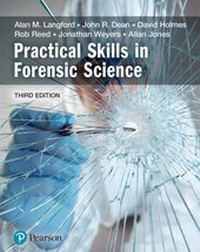
Practical Skills in Forensic Science
Description

If you are studying forensic science, or a related course such as forensic chemistry or biology, then this book will be an indispensable companion throughout your entire degree programme. This 'one-stop' text will guide you through the wide range of practical, analytical and data handling skills that you will need during your studies. It will also give you a solid grounding in the wider transferable skills such as teamwork and study skills.
The full text downloaded to your computer
With eBooks you can:
- search for key concepts, words and phrases
- make highlights and notes as you study
- share your notes with friends
eBooks are downloaded to your computer and accessible either offline through the Bookshelf (available as a free download), available online and also via the iPad and Android apps.
Upon purchase, you'll gain instant access to this eBook.
Time limit
The eBooks products do not have an expiry date. You will continue to access your digital ebook products whilst you have your Bookshelf installed.
All prices
More details
Other editions
Additional editions
Persons
ALAN LANGFORD is Senior Lecturer and Programme Leader in Criminology and Forensic Sciences at Northumbria University, UK; JOHN DEAN is Professor of Analytical and Environmental Sciences and Director of the Graduate School at Northumbria University, UK; ROB REED is Professor of Biomedical Science and Director of Undergraduate Science Programs at CQUniversity, Australia; DAVID HOLMES is Director of Collaborative Programs in Applied Sciences at Northumbria University, UK; JONATHAN WEYERS is Director of Quality Assurance at the University of Dundee, UK; and ALLAN JONES is Senior Lecturer and Chancellor's Award Fellow in Ecology, Environmental Science and Zoology at the University of Dundee, UK.
Content
- 1 Essentials of practical work
- 2 Health and safety
- 3 Making measurements and observations
- 4 SI units and their use
- 5 Scientific method and design of experiments
- 6 Working with liquids
- 7 Basic laboratory procedures
- 8 Principles of solution chemistry
- 9 pH and buffer solutions
- 10 Introduction to microscopy
- 11 Setting up and using microscopes
- 12 Sample preparation
- 13 DNA analysis - fundamental principles
- 14 Chromatography
- 15 Mass spectrometry
- 16 Basic spectroscopy
- 17 Atomic spectroscopy
- 18 X-ray fluorescence spectroscopy
- 19 Infrared and Raman spectroscopy
- 20 Nuclear magnetic resonance spectroscopy
- 21 Immunoassay
- 22 Electrophoresis
- 23 Personnel and recording the scene
- 24 Collecting evidence - basic principles
- 25 Digital evidence
- 26 Investigating fingerprints
- 27 Footwear marks and impressions
- 28 Investigating other marks
- 29 Document analysis
- 30 Analysis of biological fluids
- 31 DNA analysis - forensic applications
- 32 Analysis of hair
- 33 Analysis of skeletal remains
- 34 Forensic odontology
- 35 Forensic entomology
- 36 Forensic botany
- 37 Alcohol analysis
- 38 Forensic toxicology
- 39 Bulk drug analysis
- 40 Analysis of paint
- 41 Analysis of glass
- 42 Analysis of fibres
- 43 Firearms and ballistic evidence
- 44 Analysis of fires and explosions
- 45 Finding and citing published information
- 46 Using online resources
- 47 Evaluating information
- 48 Word processors, databases and other packages
- 49 Using Spreadsheets
- 50 Fundamental principles of quantitative chemical analysis
- 51 Calibration and quantitative analysis
- 52 Using graphs
- 53 Presenting data in tables
- 54 Hints for solving numerical problems
- 55 Descriptive statistics
- 56 Choosing and using statistical tests
- 57 Chemometrics and advanced statistics
- 58 General aspects of scientific writing
- 59 Giving a spoken presentation
- 60 Writing a forensic statement and presenting evidence in court
- 61 Reporting practical and project work
- 62 Writing essays, literature surveys and reviews
- 63 Organising a poster display
- 64 The importance of transferable skills
- 65 Managing your time
- 66 Working with others
- 67 Taking notes from lectures and texts
- 68 Learning and revising effectively
- 69 Assessments and exams
- 70 Preparing your curriculum vitae
