

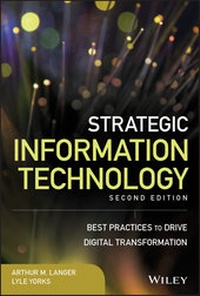
Strategic Information Technology
Description

Successfully navigate the changing face of the CIO role
Strategic Information Technology offers CIOs a handbook for engaging with the senior management conversations surrounding strategy. The CIO role is currently undergoing a massive transition from technology-focused expert to a more strategic mindset, and this book provides proven methods for taking your seat at the table. Lessons from high-performing CIOs and a wealth of leading-edge insight provide invaluable guidance for positioning technology as a strategic driver across the business, while a focus on building the necessary connections-for example, an alliance between IT and HR-provide a multimodal approach to navigating the transition.
The evolution of the CIO's role involves more than simply technical knowledge; the new CIO must be an influencer, an engager, and just as adept at the soft skills that become increasingly crucial as you climb the management ladder. It's about changing mindsets, translating hard skills into strategic advantages, and demonstrating IT's value to the strategic decision making process. This book provides best practices, illustrative examples, and up-to-date perspective for CIOs wanting to:
- Position IT as a critical driver of overall strategy
- Build on functional expertise with strategic insight
- Learn from the stories of successful tech-to-strategy transformations
- Engage C-Suite peers in shaping the strategic conversation
Not long ago, the CIO occupied a unique place in the C-Suite. Executive by title, CIOs have nevertheless been seen as predominantly the "chief tech expert" with little input into strategy, as IT has historically been regarded as a tool rather than a source of competitive advantage. The truth is becoming increasingly apparent, with companies around the world turning to technology in order to gain a competitive edge, and CIOs are beginning to claim their place in strategy discussions. Strategic Information Technology offers much needed guidance for a successful transformation.
More details
Other editions
Additional editions
Persons
ARTHUR M. LANGER, EdD, is the Professor of Professional Practice, Director for the Center for Technology Management, and the Academic Director of the Master of Science Programs in Technology Management at Columbia University. He is also an affiliated faculty member in the Department of Organization and Leadership at the Graduate School of Education (Teachers College).
LYLE YORKS, EdD, is Professor in the Department of Organization and Leadership, Teachers College, Columbia University, where he teaches courses in strategy development as learning process, strategic human resource development, strategic information technology and research.
Content
Foreword xi
Preface xiii
Acknowledgments xix
CHAPTER 1 The CIO Dilemma 1
Business Integration 2
Security 2
Data Analytics 3
Legal Exposure 3
Cost Containment 3
Some History 4
The Challenge 5
The New Paradigm 6
Consumerization of Technology: The Next Paradigm Shift 7
The End of Planning 8
The CIO in the Organizational Context 9
IT: A View from the CEO 14
CHAPTER 2 IT Drivers and Supporters 19
Drivers and Supporters 19
Drivers: A Closer Look from the CIO 23
Supporters: Managing with Efficiency 23
IT: A Driver or a Supporter? 24
Technological Dynamism 25
Responsive Organizational Dynamism 26
IT Organization Communications with ''Others'' 31
Movement of Traditional IT Staff 31
Technology Business Cycle 33
Information Technology Roles and Responsibilities 38
Conclusion 39
CHAPTER 3 The Strategic Advocacy Mindset 41
What Is Strategic Advocacy? 41
A Political Economy Framework for Contextualizing Strategic Advocacy 44
Strategic Thinking: A Particular Kind of Mindset 47
Political Savvy as the Underpinning of Effective Strategic Advocacy 56
Conclusion 62
CHAPTER 4 Real-World Case Studies 67
BP: Dana Deasy, Global CIO 68
Merck & Co.: Chris Scalet, Senior Vice President and CIO 70
Covance: John Repko, CIO 71
Cushman & Wakefield: Craig Cuyar, CIO 73
Prudential: Barbara Koster, SVP and CIO 75
Procter & Gamble: Filippo Passerini, Group President and CIO 76
Cushman & Wakefield: A View from Another Perspective 77
Conclusion 83
CHAPTER 5 Patterns of a Strategically Effective CIO 87
Personal Attributes 87
Organization Philosophy 100
Conclusion 114
CHAPTER 6 Lessons Learned and Best Practices 117
Five Pillars to CIO Success-Lessons Learned 117
The CIO or Chief IT Executive 120
Chief Executive Officer 134
Middle Management 145
Conclusion 150
CHAPTER 7 Implications for Personal Development 159
Rationale for a Self-Directed Learning Process of Personal Development 160
Adopting a Developmental Action Inquiry Process for Both Strategic Insight and Mindset Awareness 162
Testing One's ''Business'' Acumen 165
Thinking Holistically in Terms of Situational Analysis and Synthesis of the Organization's Position 167
Developing Strategic Mindsets Within the Technology Function 171
The Balanced Scorecard 172
Conclusion 176
CHAPTER 8 Digital Transformation and Business Strategy 179
Introduction 179
Requirements Without User Input 184
The S-Curve and Digital Transformation 187
Organizational Change and the S-Curve 189
Communities of Practice 190
The Technology Leader Role in the Digital Era 190
Technology Disruption on Firms and Industries 191
Critical Components of ''Digital'' Organization 193
How to Assimilate Digital Technology 194
Conclusion 196
CHAPTER 9 Integrating Gen Y Talent 197
Introduction 197
Employment in the Digital Economy 199
Attributes of Gen Y Employees 200
Benefits of Gen Y Employees 201
Integration of Gen Y with Baby Boomers and Gen X 201
Designing the Digital Enterprise 202
Gen Y Talent from Underserved Populations 203
Langer Workforce Maturity Arc 204
Implications for New Pathways for Digital Talent 210
Global Implications for Sources of Talent 212
Conclusion 212
CHAPTER 10 Creating a Cyber Security Culture 215
Introduction 215
History 215
Presenting to the Board 217
Designing a Cyber Security Culture 217
Dealing with Compromise 218
Cyber Security and Responsive Organizational Dynamism 218
Cyber Strategic Integration 219
Cyber Cultural Assimilation 220
Summary 221
Organizational Learning and Cyber-Minded Application Development 222
Risk and Cyber Security 222
Risk Responsibility 223
Cyber and Driver/Supporter Theory 225
CHAPTER 11 The Non-IT CIO of the Future 227
Driver-Side Responsibilities-New Automation 227
Conclusion 242
CHAPTER 12 Conclusion: New Directions for the CIO of the Future 245
Bibliography 261
About the authors 267
Index 269
PREFACE
How This Book Is Structured
Four broad themes provide the structure for this book:
- How is technology organizationally positioned as an effective strategic driver?
- What challenges are posed by various ways of positioning technology, and what are the implications of how these challenges are resolved?
- What strategies are used by effective chief information officers (CIOs) in addressing these challenges and strategically positioning technology?
- How did these CIOs learn these strategies, and what are the implications for developing this capacity in high-potential technology managers?
This book grows out of the work we have done with the CIO Institute conducted at Columbia University and the Executive Master of Science in Technology Management program at Columbia University, along with several projects working with the technology management staff within corporations with the focus of developing their staffs to the strategic realities described earlier. Part of this work has experimented with educational and mentoring strategies with successful CIOs to foster strategic mindsets and the capability of meeting the challenges of navigating into senior executive roles.
Specifically, this book provides a comparative analysis of case studies of organizations with CIOs widely regarded as being at the forefront of addressing the challenge of strategically positioning technology within the business models of their organizations. These CIOs are recognized as having successfully made the transition into the C-suite and having earned their "seat at the table" through integrating technology as a business driver.
Each case study involves interviews with the CIOs, their colleagues in the C-suite, and chief executive officer (CEO), along with archival documents to describe both the personal and organizational transitions that have occurred. The cases involve Procter & Gamble, Covance, Cushman & Wakefield, Merck, and Prudential, among others. Cross-case analysis reveals the essential and unique themes of strategically positioning technology in the organization along with developmental practices for high-potential technology managers.
The remaining chapters of this book develop the remedies as we see them based on best practices from our cases, the integration of theories in the areas of learning and development and how they relate to the successful growth of the CIO position. Here is a brief summary of each chapter.
Chapter 1: The CIO Dilemma
Chapter 1 addresses why CIOs need to make technology an important part of business strategy, and why few of them understand how to accomplish it. In general, we show that most CIOs have a lack of knowledge about how technology and business strategy can and should be linked to form common business objectives. The chapter provides the results of a research study of how chief executives link the role of technology with business strategy. The study captures information relating to how chief executives perceive the role of information technology (IT), how they manage it and use it strategically, and the way they measure IT performance and activities.
Chapter 2: IT Drivers and Supporters
This chapter defines how organizations need to respond to the challenges posed by technology. We present technology as a "dynamic variable" that is capable of affecting organizations in a unique way. We specifically emphasize technology's unpredictability and its capacity to accelerate change-ultimately concluding that technology, as an independent variable, has a dynamic effect on organizational development. This chapter also introduces the theory of driver and supporter and responsive organizational dynamism (ROD), defined as a disposition in organizational behavior that can respond to the demands of technology as a dynamic variable. We establish two core components of ROD: Strategic integration and cultural assimilation. The chapter also provides a perspective of the technology life cycle so that readers can see how ROD is applied on an IT project basis, defining the driver and supporter functions of IT and how it contributes to managing technology life cycles.
Chapter 3: The Strategic Advocacy Mindset
Chapter 3 provides a framework for engaging in strategic advocacy, linking strategic learning practices such as analog reasoning and scenario thinking with political savvy influencing practices in organizations. Distinctions between technological, adaptive, and generative challenges that confront the IT executive are presented along with the implications for effectively building productive relationships with senior executives. Specific practices are provided along with examples from both our research and working with a range of IT executives. How the IT executives' mindset impacts the effectiveness of how they utilize these practices is also developed.
Chapter 4: Real-World Case Studies
In Chapter 4, we provide five case studies of companies that, as a result of the strategically focused business mindset of the CIO, have made the journey transitioning from a service to driver positioning of technology. These cases, among other data sources, have provided the basis for the points made in previous chapters and the more detailed analysis that follows. Emphasis is placed on how the CIO has enabled or is enabling this ongoing transition. Drawn to provide variance in terms of industry and/or markets, the cases are BP, Covance, Cushman & Wakefield, Merck, Procter & Gamble, and Prudential, along with a summary that frames the following chapters.
Chapter 5: Patterns of a Strategically Effective CIO
Chapter 5 provides evidence of why certain CIOs have attained success as strategic drivers of their businesses. This evidence is presented from the case studies and integrates our findings based on our theories of why certain CIOs are more successful than others. These theories have led us to understand the patterns that suggest why these CIOs have been successful in introducing an IT strategy and how they build credibility among C-level peers in their organizations.
Chapter 6: Lessons Learned and Best Practices
This chapter seeks to define best practices to implement and sustain strategic advocacy and success at the CIO level. The chapter sets forth a model that creates separate, yet linked best practices and maturity "arcs" that can be used to assess stages of the learning development of the chief IT executive, the CEO, and the middle management in an organization. We discuss the concept of "common threads," where each best practice arc links through common objectives and outcomes that contribute to overall performance in the CIO suite.
Chapter 7: Implications for Personal Development
In Chapter 7, we provide a framework for the development of high-potential IT talent. The importance of both formal and informal experiential learning of working across a business is emphasized along with development of both strategic learning and influential practices. Specific exercises are provided for fostering these practices. Effective mentoring practices are also presented, again based on experience.
Chapter 8: Digital Transformation and Business Strategy
This chapter explores the effects of the digital global economy on the ways in which organizations need to respond to the consumerization of products and services. From this perspective, digital transformation involves a type of social reengineering that affects the ways in which organizations communicate internally and how they consider restructuring departments. Digital transformation also affects the risks that organizations must take in what has become an accelerated changing consumer market.
Chapter 9: Integrating Gen Y Talent
This chapter focuses on Gen Y employees who are known as "digital natives." Gen Y employees possess the attributes to assist companies to transform their workforce to meet the accelerated change in the competitive landscape. Most executives across industries recognize that digital technologies are the most powerful variable to maintaining and expanding company markets. Gen Y employees provide a natural fit for dealing with emerging digital technologies; however, success with integrating Gen Y employees is contingent upon Baby Boomer and Gen X management to adapt new leadership philosophies and procedures suited to meet the expectations and needs of these new workers. Ignoring the unique needs of Gen Y employees will likely result in an incongruent organization that suffers high turnover of young employees who will ultimately seek a more entrepreneurial environment.
Chapter 10: Creating a Cyber Security Culture
The growing challenges of protecting companies from outside attacks have established the need to create a "cyber security" culture. This chapter addresses the ways in which information technology organizations must further integrate with business operations so that their firms are better equipped to protect against outside threats. Since the general consensus is that no system can be 100% protected and that most system compromises occur as a result of internal exposures, information technology leaders must educate employees on best practices to limit cyber attacks. Furthermore, while prevention is the objective, organizations must be internally prepared to deal with attacks and thus have...
