

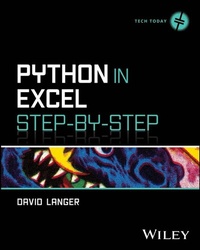
Python in Excel Step-by-Step
Description

An intuitive guide for professionals wanting to prepare for the future of Microsoft Excel by building Python in Excel skills and unleashing the power of their data.
A hands-on guide to the foundational Python in Excel skills you'll need to understand and use this powerful analytics tool, Python in Excel Step-by-Step is for current Excel users interested in expanding their data analysis skillset with Python. Analytics educator and Microsoft Excel MVP David Langer demonstrates how to use Python in Excel, tounlock new analytics capabilities in Excel, and build your foundation for the future of Excel: do-it-yourself (DIY) data science.
The book leverages your existing Excel knowledge to learn the Python foundation you can apply right away. This is the same approach David has used to successfully teach more than 1,000 professionals Python - even if you've never written code before. David also includes:
- Targeted coverage of the Python fundamentals required for analytics - learn just what you need fast
- How to use the powerful pandas and plotnine libraries to facilitate data manipulation and visualization using Python in Excel
- A DIY data science roadmap for you to build the skills you need to unleash the power of your data to have more impact at work
Perfect for professionals use Microsoft Excel for data analysis, like marketing managers, financial analysts, and supply chain manager, Python in Excel Step-by-Step is an invaluable new resource for all business professionals who use Excel and want to build skills for Excel's AI-powered future.
More details
Other editions
Additional editions
Content
ACKNOWLEDGMENTS XIII
ABOUT THE AUTHOR XV
ABOUT THE TECHNICAL EDITORS XVII
INTRODUCTION XIX
CHAPTER 1: INTRODUCING PYTHON IN EXCEL 1
1.1 Introducing Python in Excel 1
1.2 How Python in Excel Works 2
1.3 Why Python in Excel? 5
1.4 Continue Your Learning 11
CHAPTER 2: DATA TYPES 13
2.1 Integers 15
2.2 Floats 17
2.3 Strings 19
2.4 Booleans 26
2.5 Continue Your Learning 31
CHAPTER 3: DATA STRUCTURES 33
3.1 Lists 33
3.2 Dictionaries 41
3.3 Tuples 49
3.4 Sets 51
3.5 Slicing Data 55
3.6 Continue Your Learning 59
CHAPTER 4: CONTROL FLOW AND LOOPS 61
4.1 if/else Statements 61
4.2 for Loops 69
4.3 while Loops 73
4.4 Comprehensions 76
4.5 Continue Your Learning 83
CHAPTER 5: FUNCTIONS 85
5.1 Introducing Functions 85
5.2 Lambdas 96
5.3 Continue Your Learning 99
CHAPTER 6: DATA TABLE FUNDAMENTALS 101
6.1 Introducing Pandas 101
6.2 Loading Data 104
6.3 Exploring Dataframes 109
6.4 The Workbook So Far 119
6.5 Continue Your Learning 120
CHAPTER 7: WORKING WITH COLUMNS 121
7.1 Exploring Columns 121
7.2 Numeric Columns 128
7.3 String Columns 138
7.4 Datetime Columns 151
7.5 The Workbook So Far 158
7.6 Continue Your Learning 160
CHAPTER 8: WORKING WITH DATA TABLES 161
8.1 AdventureWorks Data Analysis 161
8.2 Changing Dataframes 161
8.3 Filtering Dataframes 174
8.4 Combining Dataframes 184
8.5 Pivoting Dataframes 193
8.6 The Workbook So Far 205
8.7 Continue Your Learning 207
CHAPTER 9: DATA VISUALIZATION 209
9.1 Introducing Plotnine 209
9.2 Categorical Visualizations 211
9.3 Time Series Visualizations 235
9.4 The Workbook 243
9.5 Continue Your Learning 243
CHAPTER 10: YOUR DIY DATA SCIENCE ROADMAP 245
10.1 You've Got This 245
10.2 The Roadmap 246
10.3 AI with Copilot in Excel 254
10.4 Continue Your Learning 260
INDEX 261
