

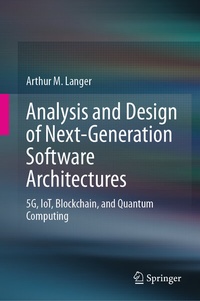
Analysis and Design of Next-Generation Software Architectures
Description

This book provides a detailed "how-to" guide, addressing aspects ranging from analysis and design to the implementation of applications, which need to be integrated within legacy applications and databases.
The analysis and design of the next generation of software architectures must address the new requirements to accommodate the Internet of things (IoT), cybersecurity, blockchain networks, cloud, and quantum computer technologies. As 5G wireless increasingly establishes itself over the next few years, moving legacy applications into these new architectures will be critical for companies to compete in a consumer-driven and social media-based economy. Few organizations, however, understand the challenges and complexities of moving from a central database legacy architecture to a ledger and networked environment.
The challenge is not limited to just designing new software applications. Indeed, the next generation needs to function more independently on various devices, and on more diverse and wireless-centric networks. Furthermore, databases must be broken down into linked list-based blockchain architectures, which will involve analytic decisions regarding which portions of data and metadata will be processed within the chain, and which ones will be dependent on cloud systems. Finally, the collection of all data throughout these vast networks will need to be aggregated and used for predictive analysis across a variety of competitive business applications in a secured environment. Certainly not an easy task for any analyst/designer!Many organizations will continue to use packaged products and open-source applications. These third-party products will need to be integrated into the new architecture paradigms and have seamless data aggregation capabilities, while maintaining the necessary cyber compliances.
The book also clearly defines the roles and responsibilities of the stakeholders involved, including the IT departments, users, executive sponsors, and third-party vendors. The book's structure also provides a step-by-step method to help ensure a higher rate of success in the context of re-engineering existing applications and databases, as well as selecting third-party products, conversion methods and cybercontrols. It was written for use by a broad audience, including IT developers, software engineers, application vendors, business line managers, and executives.
More details
Other editions
Additional editions
Person
Dr. Arthur M. Langer is the Director of the Center for Technology Management and Professor of Professional Practice at Columbia University, New York, NY, USA, where he also serves as the Academic Director of Technology Management Programs at the School of Professional Studies, and as a Professor of Practice at the Department of Organization and Leadership at the Graduate School of Education (Teachers College). Dr. Langer is also the Chairman and Founder of Workforce Opportunity Services (WOS), a non-profit NGO dedicated to assisting socially excluded youth and veterans with their education and professional careers. His other publications include the Springer titles Guide to Software Development , Analysis and Design of Information Systems , and The Art of Analysis.
