

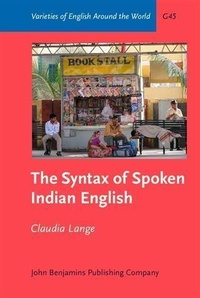
The Syntax of Spoken Indian English
1st Edition
Published on 6. November 2012
XV, 265 pages
978-90-272-7309-3 (ISBN)
Description

This book offers an in-depth analysis of several features of spoken Indian English that are generally considered as 'typical', but have never before been studied empirically. Drawing on authentic spoken data from the International Corpus of English, Indian component, the book focuses on the domain of discourse organization and examines the form, function and distribution of invariant tags such as isn't it and no/na, non-initial existential there, focus markers only and itself, topicalization and left-dislocation. By focusing on multilingual speakers' interactions, the study demonstrates conclusively that spoken Indian English bears all the hallmarks of a vibrant contact language, testifying to a pan-South Asian 'grammar of culture' which becomes apparent in contact-induced language change in spoken Indian English. The book will be highly relevant for anyone interested in postcolonial varieties of English, contact linguistics, standardization, and discourse-pragmatic sentence structure.
More details
Other editions
Additional editions
Claudia Lange
The Syntax of Spoken Indian English
Book
11/2012
John Benjamins Publishing Co
€100.70
Shipment within 10-15 days
Person
Content
- The Syntax of Spoken Indian English
- Editorial page
- Title page
- LCC data
- Table of contents
- List of figures and tables
- List of abbreviations
- Acknowledgments
- Chapter 1. Introduction
- 1.1 English in India or Indian English?
- 1.2 Aims and scope of this study
- 1.3 Structure
- Chapter 2. Conceptual background
- 2.1 New Englishes and outer circles
- 2.1.1 Ideology and terminology: From English to Englishes
- 2.1.2 The legacy of Braj Kachru
- 2.1.3 "The Kachru catch"
- 2.1.4 The Dynamic Model
- 2.1.5 Outlook
- 2.2 The native speaker: An elusive concept
- 2.2.1 The native speaker and the discourse of hegemony
- 2.2.2 The native speaker and linguistic variation
- 2.2.3 Outlook
- 2.3 Contact-induced language change
- 2.3.1 Introduction
- 2.3.2 Mechanisms of contact-induced language change
- 2.4 Norms and standards
- 2.4.1 Norms and the (post)colonial speech community
- 2.4.2 Spoken and written standards
- Chapter 3. Multilingualism in India
- 3.1 Introduction
- 3.2 Typological survey
- 3.2.1 Patterns of multilingualism
- 3.2.2 South Asia as a sprachbund
- 3.2.3 South Asia as a discourse area
- 3.2.4 South Asia as a sociolinguistic area
- 3.3 English as an Indian language
- 3.3.1 Introduction
- 3.3.2 The Indian communicative space
- 3.3.3 Outlook
- Chapter 4. The syntax of spoken Indian English
- 4.1 Introduction
- 4.1.1 Corpus-based approaches to IndE
- 4.1.2 ICE and ICE-India
- 4.1.3 The speakers
- 4.1.4 The data
- 4.1.5 Discourse-pragmatic sentence structure
- 4.2 Non-initial existential there
- 4.2.1 Definition
- 4.2.2 Existentials: Corpus evidence
- 4.2.3 Non-initial existential there in ICE-India
- 4.2.4 The canonical existential in ICE-India
- 4.2.5 Initial and non-initial existential constructions in spoken IndE: Speaker variables
- 4.2.6 Explanatory parameters
- 4.3 Topicalization
- 4.3.1 Definition
- 4.3.2 Topicalization in ICE-India and ICE-GB: Form and frequency
- 4.3.3 Topicalization in ICE-India: Contexts and function
- 4.3.4 Preposing of non-arguments
- 4.3.5 Unlinked topic constructions
- 4.3.6 Explanatory parameters
- 4.4 Dislocation
- 4.4.1 Definition
- 4.4.2 Left dislocation: Form and function
- 4.4.3 Right dislocation: Form and function
- 4.4.4 Dislocation: Corpus evidence
- 4.4.5 Explanatory parameters
- 4.5 Cleft constructions
- 4.5.1 Definition
- 4.5.2 Clefts in ICE-GB
- 4.5.3 Clefts in ICE-India
- 4.5.4 Explanatory parameters
- 4.6 Utterance modifiers
- 4.6.1 Focus markers: Only and itself
- 4.6.2 Invariant tags
- Chapter 5. Conclusion
- 5.1 Indian English as a contact language
- 5.2 Multilingual competence: The norms of spoken Indian English
- 5.3 From norms to standards: Indian English in the 21st century
- References
- Author index
- Language index
- Subject index
