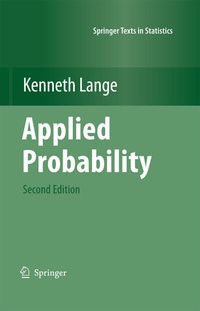
Applied Probability
Description

Chapter 1 reviews elementary probability and provides a brief survey of relevant results from measure theory. Chapter 2 is an extended essay on calculating expectations. Chapter 3 deals with probabilistic applications of convexity, inequalities, and optimization theory. Chapters 4 and 5 touch on combinatorics and combinatorial optimization. Chapters 6 through 11 present core material on stochastic processes. If supplemented with appropriate sections from Chapters 1 and 2, there is sufficient material for a traditional semester-long course in stochastic processes covering the basics of Poisson processes, Markov chains, branching processes, martingales, and diffusion processes. The second edition adds two new chapters on asymptotic and numerical methods and an appendix that separates some of the more delicate mathematical theory from the steady flow of examples in the main text.
Besides the two new chapters, the second edition includes a more extensive list of exercises, many additions to the exposition of combinatorics, new material on rates of convergence to equilibrium in reversible Markov chains, a discussion of basic reproduction numbers in population modeling, and better coverage of Brownian motion. Because many chapters are nearly self-contained, mathematical scientists from a variety of backgrounds will find Applied Probability useful as a reference
Reviews / Votes
From the reviews of the second edition:
"Like the first edition, the new edition presents additional probability background material with applications to graduate students studying mathematical statistics, mathematical biology, engineering and applied mathematics. . one important feature of this edition is that it includes a more extensive list of exercises. I think both instructors and students will appreciate this welcome addition. Further, the new edition offers more than 200 important references. . researchers and graduate students in mathematical sciences with a host of backgrounds will find this new edition a useful reference." (Technometrics, Vol. 53 (1), February, 2011)
"This text contributes to bridging the increasing gap between sophisticated mathematical themes in probability theory and pragmatic, application-oriented concepts in statistics and data analysis. . A large number of exercises, many of which are newly included in this edition, facilitates the usage of the book for teaching purposes." (Thorsten Dickhaus, Zentralblatt MATH, Vol. 1216, 2011)
More details
Other editions
New editions
Additional editions
Previous edition