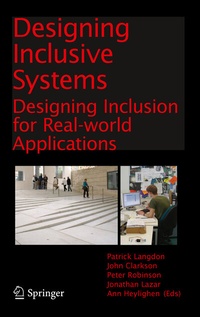
Designing Inclusive Systems
Description

The Cambridge Workshops on Universal Access and Assistive Technology (CWUAAT) are a series of workshops held at a Cambridge University College every two years. The workshop theme: "Designing inclusion for real-world applications" refers to the emerging potential and relevance of the latest generations of inclusive design thinking, tools, techniques, and data, to mainstream project applications such as healthcare and the design of working environments. Inclusive Design Research involves developing tools and guidance enabling product designers to design for the widest possible population, for a given range of capabilities.
There are five main themes:
Designing for the Real-World
Measuring Demand And Capabilities
Designing Cognitive Interaction with Emerging Technologies
Design for Inclusion
Designing Inclusive Architecture
In the tradition of CWUAAT, we have solicited and accepted contributions over a wide range of topics, both within individual themes and also across the workshop's scope. We ultimately hope to generate more inter-disciplinary dialogues based on focused usage cases that can provide the discipline necessary to drive further novel research, leading to better designs. The aim is to impact industry and end-users as well governance and public design, thereby effectively reducing exclusion and difficulty in peoples' daily lives and society.
More details
Other editions
Additional editions