

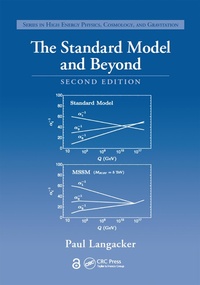
The Standard Model and Beyond
2nd Edition
Published on 26. June 2017
650 pages
978-1-4987-6322-6 (ISBN)
Description

This new edition of The Standard Model and Beyond presents an advanced introduction to the physics and formalism of the standard model and other non-abelian gauge theories. It provides a solid background for understanding supersymmetry, string theory, extra dimensions, dynamical symmetry breaking, and cosmology. In addition to updating all of the experimental and phenomenological results from the first edition, it contains a new chapter on collider physics; expanded discussions of Higgs, neutrino, and dark matter physics; and many new problems.
The book first reviews calculational techniques in field theory and the status of quantum electrodynamics. It then focuses on global and local symmetries and the construction of non-abelian gauge theories. The structure and tests of quantum chromodynamics, collider physics, the electroweak interactions and theory, and the physics of neutrino mass and mixing are thoroughly explored. The final chapter discusses the motivations for extending the standard model and examines supersymmetry, extended gauge groups, and grand unification.
Thoroughly covering gauge field theories, symmetries, and topics beyond the standard model, this text equips readers with the tools to understand the structure and phenomenological consequences of the standard model, to construct extensions, and to perform calculations at tree level. It establishes the necessary background for readers to carry out more advanced research in particle physics.
Supplementary materials are provided on the author's website and a solutions manual is available for qualifying instructors.
The book first reviews calculational techniques in field theory and the status of quantum electrodynamics. It then focuses on global and local symmetries and the construction of non-abelian gauge theories. The structure and tests of quantum chromodynamics, collider physics, the electroweak interactions and theory, and the physics of neutrino mass and mixing are thoroughly explored. The final chapter discusses the motivations for extending the standard model and examines supersymmetry, extended gauge groups, and grand unification.
Thoroughly covering gauge field theories, symmetries, and topics beyond the standard model, this text equips readers with the tools to understand the structure and phenomenological consequences of the standard model, to construct extensions, and to perform calculations at tree level. It establishes the necessary background for readers to carry out more advanced research in particle physics.
Supplementary materials are provided on the author's website and a solutions manual is available for qualifying instructors.
Reviews / Votes
"The textbook by Paul Langacker gives a comprehensive...overview about the Standard Model of Elementary Particle Physics and beyond.... the full Standard Model including mathematical foundations and current experimental references is fully reviewed. After each chapter, the reader finds quite an extensive set of problems which allows [them] to deepen the previously learned knowledge...The book is clearly not intended to serve theorists in their daily life but rather an experimental physicist to understand the theory behind and perform some simple calculations. However, as a kind of compendium and standard reference it is a worthy tool for everybody in the field."-Wolfgang G. Hollik (Hamburg) in Zentralblatt MATH 1376.
"The 2009 first edition of The Standard Model and Beyond provided a long-needed and thorough introductory textbook that focused on the advances in phenomenology that led to the highly successful Standard Model of Elementary Particle Physics. Its author, Paul Langacker, is well known not only for his research, but also his communication skills both as a lecturer and writer. However, much has happened over the last seven years, as the Higgs scalar was discovered, thus completing the minimal spectrum of the Standard Model, whilst the field of neutrino physics continued to mature. At the same time, a number of leading speculations regarding 'new physics', beyond the Standard Model, failed to be observed, causing a re-examination of some beliefs. This newly updated second edition explores such constraints on 'new physics' ideas, in addition to exploring recent discoveries and advances in the field. The text remains lucid, thorough, and well-worth having, and so I strongly recommend it as a resource for students and researchers who wish to understand, and help continue, the legacy of scientific exploration and discovery."
-William J. Marciano, Senior Physicist, Physics Depart
More details
Series
Edition
2nd edition
Language
English
Place of publication
London
United Kingdom
Publishing group
Taylor & Francis Ltd
Target group
College/higher education
Professional and scholarly
Illustrations
143 s/w Abbildungen, 26 s/w Tabellen, 23 s/w Photographien bzw. Rasterbilder, 120 s/w Zeichnungen
26 Tables, black and white; 120 Line drawings, black and white; 23 Halftones, black and white; 143 Illustrations, black and white
File size
20,31 MB
ISBN-13
978-1-4987-6322-6 (9781498763226)
Copyright in bibliographic data and cover images is held by Nielsen Book Services Limited or by the publishers or by their respective licensors: all rights reserved.
Schweitzer Classification
Other editions
Additional editions
Paul Langacker
The Standard Model and Beyond
Book
06/2020
2nd Edition
CRC Press
€72.00
Shipment within 15-20 days
Paul Langacker
The Standard Model and Beyond
Book
07/2017
2nd Edition
CRC Press
€144.70
Article not available at the moment
Person
Paul Langacker is an Emeritus Professor of Physics and Astronomy at the University of Pennsylvania. He is currently a Senior Scientist at Princeton University and a long-term visitor at the Institute for Advanced Study. His research has emphasized the connections between fundamental theory and experiment, and has included work in precision electroweak physics, grand unification, neutrino physics, Z' physics, and string phenomenology.
Content
Notation and Conventions
Review of Perturbative Field Theory
Lie Groups, Lie Algebras, and Symmetries
Gauge Theories
The Strong Interactions and QCD
Collider Physics
The Weak Interactions
The Standard Electroweak Theory
Neutrino Mass and Mixing
Beyond the Standard Model
Appendix A: Canonical Commutation Rules
Appendix B: Derivation of a Simple Feynman Diagram
Appendix C: Unitarity, the Partial Wave Expansion, and the Optical Theorem
Appendix D: Two, Three, and nBody Phase Space
Appendix E: Calculation of the Anomalous Magnetic Moment of the Electron
Appendix F: BreitWigner Resonances
Appendix G: Implications of P, C, T, and Gparity for Nucleon Matrix Elements
Appendix H: Quantum Mechanical Analogs of Symmetry Breaking
Review of Perturbative Field Theory
Lie Groups, Lie Algebras, and Symmetries
Gauge Theories
The Strong Interactions and QCD
Collider Physics
The Weak Interactions
The Standard Electroweak Theory
Neutrino Mass and Mixing
Beyond the Standard Model
Appendix A: Canonical Commutation Rules
Appendix B: Derivation of a Simple Feynman Diagram
Appendix C: Unitarity, the Partial Wave Expansion, and the Optical Theorem
Appendix D: Two, Three, and nBody Phase Space
Appendix E: Calculation of the Anomalous Magnetic Moment of the Electron
Appendix F: BreitWigner Resonances
Appendix G: Implications of P, C, T, and Gparity for Nucleon Matrix Elements
Appendix H: Quantum Mechanical Analogs of Symmetry Breaking
