

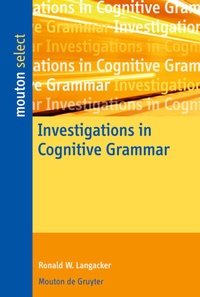
Investigations in Cognitive Grammar
Description

This volume makes accessible a substantial range of recent research in Cognitive Grammar. From disparate sources, it brings together a dozen innovative papers, revised and integrated to form a coherent whole. This work continues the ongoing program of progressively articulating the theoretical framework and showing its descriptive application to varied grammatical phenomena.
A number of major topics are examined in depth through multiple chapters viewing them from different perspectives: grammatical constructions (their general nature, their metonymic basis, their role in grammaticization), nominal grounding (quantifiers, possessives, impersonal it ), clausal grounding (its relation to nominal grounding, an epistemic account of tense, a systemic view of the English auxiliary), the "control cycle" (an abstract cognitive model with many linguistic manifestations), finite clauses (their internal structure and external grammar), and complex sentences (complementation, subordination, coordination). In each case the presentation builds from fundamentals and introduces the background needed for comprehension. At the same time, by bringing fresh approaches and new descriptive insights to classic problems, it represents a significant advance in understanding grammar and indicates future directions of theory and research in the Cognitive Grammar framework.
The book is of great interest to students and practitioners of cognitive linguistics and to scholars in related areas.
Reviews / Votes
"Ronald W. Langacker is universally acclaimed as one of the founding fathers of the cognitive linguistics movement. His pioneering efforts towards developing a meaning-oriented, usage-based theory of grammar have given cognitive linguistics many of its key concepts, and his theory of Cognitive Grammar is not only one of the cornerstones of cognitive linguistics, it is also a magnificent achievement in its own right." Dirk Geeraerts, January 2009More details
Other editions
Additional editions
Person
Content
2 - Contents [Seite 9]
3 - Chapter 1. Constructions in Cognitive Grammar [Seite 15]
4 - Chapter 2. Metonymy in grammar [Seite 54]
5 - Chapter 3. A constructional approach to grammaticization [Seite 74]
6 - Chapter 4. Possession, location, and existence [Seite 95]
7 - Chapter 5. On the subject of impersonals [Seite 123]
8 - Chapter 6. Enunciating the parallelism of nominal and clausal grounding [Seite 162]
9 - Chapter 7. The English present: Temporal coincidence vs. epistemic immediacy [Seite 199]
10 - Chapter 8. A functional account of the English auxiliary [Seite 233]
11 - Chapter 9. Aspects of the grammar of finite clauses [Seite 273]
12 - Chapter 10. Finite complements in English [Seite 304]
13 - Chapter 11. Subordination in Cognitive Grammar [Seite 341]
14 - Chapter 12. The conceptual basis of coordination [Seite 355]
15 - Backmatter [Seite 389]
