

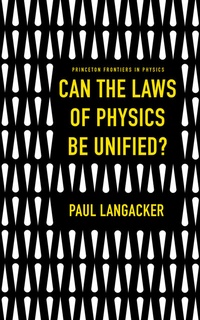
Can the Laws of Physics Be Unified?
1st Edition
Published on 6. February 2017
288 pages
978-1-4008-8550-3 (ISBN)
Description

A concise introduction to the cutting-edge science of particle physics
The standard model of particle physics describes our current understanding of nature's fundamental particles and their interactions, yet gaps remain. For example, it does not include a quantum theory of gravity, nor does it explain the existence of dark matter. Once complete, however, the standard model could provide a unified description of the very building blocks of the universe. Researchers have been chasing this dream for decades, and many wonder whether such a dream can ever be made a reality.
Can the Laws of Physics Be Unified? is a short introduction to this exciting frontier of physics. The book is accessibly written for students and researchers across the sciences, and for scientifically minded general readers. Paul Langacker begins with an overview of the key breakthroughs that have shaped the standard model, and then describes the fundamental particles, their interactions, and their role in cosmology. He goes on to explain field theory, internal symmetries, Yang-Mills theories, strong and electroweak interactions, the Higgs boson discovery, and neutrino physics. Langacker then looks at the questions that are still unanswered: What is the nature of the mysterious dark matter and dark energy that make up roughly 95 percent of the universe? Why is there more matter than antimatter? How can we reconcile quantum mechanics and general relativity?
Can the Laws of Physics Be Unified? describes the promising theoretical ideas and new experiments that could provide answers and weighs our prospects for establishing a truly unified theory of the smallest constituents of nature and their interactions.
The standard model of particle physics describes our current understanding of nature's fundamental particles and their interactions, yet gaps remain. For example, it does not include a quantum theory of gravity, nor does it explain the existence of dark matter. Once complete, however, the standard model could provide a unified description of the very building blocks of the universe. Researchers have been chasing this dream for decades, and many wonder whether such a dream can ever be made a reality.
Can the Laws of Physics Be Unified? is a short introduction to this exciting frontier of physics. The book is accessibly written for students and researchers across the sciences, and for scientifically minded general readers. Paul Langacker begins with an overview of the key breakthroughs that have shaped the standard model, and then describes the fundamental particles, their interactions, and their role in cosmology. He goes on to explain field theory, internal symmetries, Yang-Mills theories, strong and electroweak interactions, the Higgs boson discovery, and neutrino physics. Langacker then looks at the questions that are still unanswered: What is the nature of the mysterious dark matter and dark energy that make up roughly 95 percent of the universe? Why is there more matter than antimatter? How can we reconcile quantum mechanics and general relativity?
Can the Laws of Physics Be Unified? describes the promising theoretical ideas and new experiments that could provide answers and weighs our prospects for establishing a truly unified theory of the smallest constituents of nature and their interactions.
More details
Language
English
Place of publication
Princeton, NJ
United States
Publishing group
De Gruyter
Target group
Professional and scholarly
Edition type
Digital original
Illustrations
11 halftones. 18 line illus. 5 tables.
File size
1,45 MB
ISBN-13
978-1-4008-8550-3 (9781400885503)
Schweitzer Classification
Other editions
Additional editions
Paul Langacker
Can the Laws of Physics Be Unified?
Book
02/2017
Princeton University Press
€46.00
Shipment within 10-20 days
Person
Paul Langacker is senior scientist at Princeton University, visitor at the Institute for Advanced Study in Princeton, and professor emeritus of physics at the University of Pennsylvania. He is the author of The Standard Model and Beyond.
Content
Preface vii
1. The Epic Quest 1
2 The Three Eras 7
2.1 The Ingredients 7
2.2 Prehistory 9
2.3 The Era of Exploration 12
2.4 The Standard Model Era 22
2.5 Beyond the Standard Model 26
3 Particles, Interactions, and Cosmology 29
3.1 The Fundamental Particles 29
3.2 The Interactions 35
3.3 Cosmology 41
4 The Standard Model 51
4.1 Gauge Invariance and QED 51
4.2 Internal Symmetries 65
4.3 Yang-Mills Theories 70
4.4 Quantum Chromodynamics 73
4.5 The SU(2) × U(1) Model 83
4.6 The Higgs Mechanism 86
4.7 The Electroweak Theory 91
5 What Don't We Know? 137
5.1 Arbitrariness and Tuning 138
5.2 Terra Incognita: Unanswered Questions 151
5.3 Are the Paradigms Correct? 163
6 How Will We Find Out? 175
6.1 The Ideas 175
6.2 The Tests 211
7. Epilogue: The Dream 223
Postscript: Run 2 226
Glossary 229
Bibliography 251
Index 259
1. The Epic Quest 1
2 The Three Eras 7
2.1 The Ingredients 7
2.2 Prehistory 9
2.3 The Era of Exploration 12
2.4 The Standard Model Era 22
2.5 Beyond the Standard Model 26
3 Particles, Interactions, and Cosmology 29
3.1 The Fundamental Particles 29
3.2 The Interactions 35
3.3 Cosmology 41
4 The Standard Model 51
4.1 Gauge Invariance and QED 51
4.2 Internal Symmetries 65
4.3 Yang-Mills Theories 70
4.4 Quantum Chromodynamics 73
4.5 The SU(2) × U(1) Model 83
4.6 The Higgs Mechanism 86
4.7 The Electroweak Theory 91
5 What Don't We Know? 137
5.1 Arbitrariness and Tuning 138
5.2 Terra Incognita: Unanswered Questions 151
5.3 Are the Paradigms Correct? 163
6 How Will We Find Out? 175
6.1 The Ideas 175
6.2 The Tests 211
7. Epilogue: The Dream 223
Postscript: Run 2 226
Glossary 229
Bibliography 251
Index 259
