

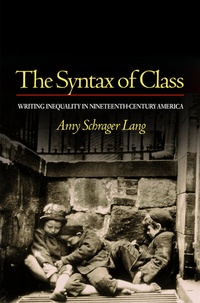
The Syntax of Class
Writing Inequality in Nineteenth-Century America
1st Edition
Published on 10. January 2009
168 pages
978-1-4008-2563-9 (ISBN)
Description

The Syntax of Class explores the literary expression of the crisis of social classification that occupied U.S. public discourse in the wake of the European revolutions of 1848. Lacking a native language for expressing class differences, American writers struggled to find social taxonomies able to capture--and manage--increasingly apparent inequalities of wealth and power.
As new social types emerged at midcentury and, with them, new narratives of success and failure, police and reformers alarmed the public with stories of the rise and proliferation of the "dangerous classes." At the same time, novelists as different as Maria Cummins, Nathaniel Hawthorne, Frank Webb, Elizabeth Stuart Phelps, and Horatio Alger Jr. focused their attention on dense engagements across the lines of class. Turning to the middle-class idea of "home" as a figure for social harmony and to the lexicons of race and gender in their effort to devise a syntax for the representation of class, these writers worked to solve the puzzle of inequity in their putatively classless nation. This study charts the kaleidoscopic substitution of terms through which they rendered class distinctions and follows these renderings as they circulated in and through a wider cultural discourse about the dangers of class conflict.
This welcome book is a finely achieved study of the operation of class in nineteenth-century American fiction--and of its entanglements with the languages of race and gender.
As new social types emerged at midcentury and, with them, new narratives of success and failure, police and reformers alarmed the public with stories of the rise and proliferation of the "dangerous classes." At the same time, novelists as different as Maria Cummins, Nathaniel Hawthorne, Frank Webb, Elizabeth Stuart Phelps, and Horatio Alger Jr. focused their attention on dense engagements across the lines of class. Turning to the middle-class idea of "home" as a figure for social harmony and to the lexicons of race and gender in their effort to devise a syntax for the representation of class, these writers worked to solve the puzzle of inequity in their putatively classless nation. This study charts the kaleidoscopic substitution of terms through which they rendered class distinctions and follows these renderings as they circulated in and through a wider cultural discourse about the dangers of class conflict.
This welcome book is a finely achieved study of the operation of class in nineteenth-century American fiction--and of its entanglements with the languages of race and gender.
More details
Other editions
Additional editions
Book
01/2003
Princeton University Press
€117.61
Article not available at the moment
Person
Amy Schrager Lang teaches American Studies at Emory University. She is the author of Prophetic Woman: Anne Hutchinson and the Problem of Dissent in the Literature of New England.
Content
Acknowledgments ix
INTRODUCTION: Class, Classification, and Conflict 1
CHAPTER I: Home, in the Better Sense: The Model Woman, the Middle Class, and the Harmony of Interests 14
CHAPTER II: Orphaned in America: Color, Class, and Community 42
CHAPTER III: Indexical People: Women, Workers, and the Limits of Literary Language 69
CHAPTER IV: Beginning Again: Love, Money, and a Circle of "Friends" 99
EPILOGUE 128
Notes 131
Index 149
INTRODUCTION: Class, Classification, and Conflict 1
CHAPTER I: Home, in the Better Sense: The Model Woman, the Middle Class, and the Harmony of Interests 14
CHAPTER II: Orphaned in America: Color, Class, and Community 42
CHAPTER III: Indexical People: Women, Workers, and the Limits of Literary Language 69
CHAPTER IV: Beginning Again: Love, Money, and a Circle of "Friends" 99
EPILOGUE 128
Notes 131
Index 149
