

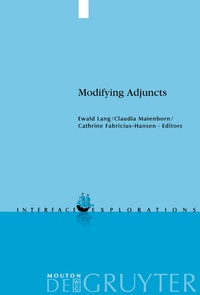
Modifying Adjuncts
1st Edition
Published on 6. February 2013
VI, 657 pages
978-3-11-089464-6 (ISBN)
Description

Unlike the notion of "argument" that is central to modern linguistic theorizing, the phenomena that are commonly subsumed under the complementary notion "adjunct" so far have not attracted the attention they deserve. In this volume, leading experts in the field present current approaches to the grammar and pragmatics of adjuncts. The contributions scrutinize i.a. the argument-adjunct distinction, specify conditions of adjunct placement, discuss compositionality issues, and propose new analyses of event-related modification. They are meant to shed new light on an area of linguistic structure that is deemed to be notoriously overlooked.
Reviews / Votes
"Die Liste der Verf. ist eindrucksvoll. Nicht zu vergessen: Einleitungen zu solchen Sammelbänden sind of trivial - die zum vorl. Bd. jedoch überblickt zuerst den Markt und ordnet dann die Zuleistungen der einzelnen Beiträger ein. Insgesamt ein sehr verantwortungsvoll zusammengestellter und einsichtsreicher Bd. mit viel Klärung gerade zum Deutschen."Werner Abraham in: Germanistik, 46, 1-2/2005More details
Series
Edition
Reprint 2013
Language
English
Place of publication
Berlin/Boston
Germany
Publishing group
de Gruyter Mouton
Target group
Professional and scholarly
US School Grade: College Graduate Student
Illustrations
Zahlr. Abb.
Num. figs.
File size
17,25 MB
ISBN-13
978-3-11-089464-6 (9783110894646)
Schweitzer Classification
Other editions
Additional editions
Ewald Lang | Claudia Maienborn | Cathrine Fabricius-Hansen
Modifying Adjuncts
Book
03/2003
1st Edition
De Gruyter Mouton
€199.95
Shipment within 7-9 days
Ewald Lang | Claudia Maienborn | Cathrine Fabricius-Hansen
Modifying Adjuncts
Book
01/2003
1st Edition
De Gruyter Mouton
€229.00
Article exhausted; check different version
Persons
Cathrine Fabricus-Hansen is Professor at Oslo University, Norway.
Ewald Lang is Professor at the Humboldt University of Berlin, Germany.
Claudia Maienborn is Assistant Professor at the Humboldt University of Berlin, Germany.
Content
- Intro
- Modifying (the grammar of) adjuncts: An introduction
- Part A: The argument-adjunct distinction
- The dual analysis of adjuncts/complements in Categorial Grammar
- Genitives, relational nouns, and argument-modifier ambiguity
- Heads, complements, adjuncts: Projection and saturation
- Part B: Adjunct placement
- Syntactic conditions on adjunct classes
- "Manner" adverbs and the association theory: Some problems and solutions
- Manner adverbs and information structure: Evidence from the adverbial modification of verbs of creation
- Semantic features and the distribution of adverbs
- Clause-final left-adjunction
- Part C: Case studies on wieder/again
- Process, eventuality, and wieder/again
- Competition and interpretation: The German adverb wieder ('again')
- How are results represented and modified? Remarks on Jäger & Blutners's anti-decomposition
- Part D: Flexibility of eventuality-related modification
- Event arguments, adverb selection, and the Stative Adverb Gap
- Event-internal modifiers: Semantic underspecification and conceptual interpretation
- Flexibility in adverbal modification: Reinterpretation as contextual enrichment
- Secondary predication and aspectual structure
- Real adjuncts in the Instrumental in Russian
- German participle II constructions as adjuncts
- Subject index
