

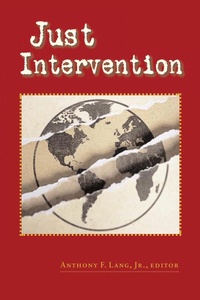
Just Intervention
Description

What obligations do nations have to protect citizens of other nations? As responsibility to our fellow human beings and to the stability of civilization over many years has ripened fully into a concept of a "just war," it follows naturally that the time has come to fill in the outlines of the realities and boundaries of what constitutes "just" humanitarian intervention.
Even before the world changed radically on September 11, policymakers, scholars, and activists were engaging in debates on this nettlesome issue-following that date, sovereignty, human rights, and intervention took on fine new distinctions, and questions arose: Should sovereignty prevent outside agents from interfering in the affairs of a state? What moral weight should we give to sovereignty and national borders? Do humanitarian "emergencies" justify the use of military force? Can the military be used for actions other than waging war? Can "national interest" justify intervention? Should we kill in order to save?
These are profound and troubling questions, and questions that the distinguished contributors of Just Intervention probe in all their complicated dimensions. Sohail Hashmi analyzes how Islamic tradition and Islamic states understand humanitarian intervention; Thomas Weiss strongly advocates the use of military force for humanitarian purposes in Yugoslavia; Martin Cook, Richard Caplan, and Julie Mertus query the use of force in Kosovo; Michael Barnett, drawing on his experience in the United Nations while it debated how best to respond to Rwandan genocide, discusses how international organizations may become hamstrung in the ability to use force due to bureaucratic inertia; and Anthony Lang ably envelopes these-and other complex issues-with a deft hand and contextual insight.
Highlighting some of the most significant issues in regard to humanitarian intervention, Just Intervention braves the treacherous moral landscape that now faces an increasingly unstable world. These contributions will help us make our way.
More details
Other editions
Additional editions
Person
Anthony F. Lang Jr. is a lecturer in the School of International Relations at the University of St. Andrews.
Content
Humanitarian Intervention: The Moral Dimension
Anthony F. Lang Jr.
Part One: Issues
1. The Moral Basis of Humanitarian Intervention
Terry Nardin
2. Normative Frameworks for Humanitarian Intervention
Nicholas Onuf
3. Hard Cases Make Bad Laws: Law, Ethics, and Politics in Humanitarian Intervention
Simon Chesterman
4. Is There an Islamic Ethic of Humanitarian Intervention?
Sohail Hashmi
5. Principles, Politics, and Humanitarian Action
Thomas G. Weiss
Part Two: Challenges
6. The Politics of Rescue: Yugoslavia's Wars and Humanitarian Impulse
Amir Pasic and Thomas G. Weiss
7. Humanitarian Intervention: Which Way Forward?
Richard Caplan
8. Immaculate War: Constraints on Humanitarian Intervention
Martin L. Cook
9. The Impact of Intervention on Local Human Rights Culture: A Kosovo Case Study
Julie Mertus
10. Bureaucratizing the Duty to Aid: The United Nations and Rwandan Genocide
Michael Barnett
11. Humanitarian Intervention after September 11
Nicholas Wheeler
