

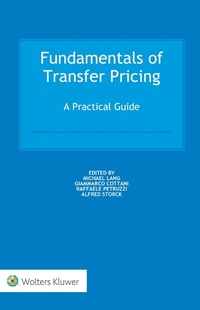
Fundamentals of Transfer Pricing
A Practical Guide
Published on 21. December 2018
576 pages
978-90-411-9021-5 (ISBN)
Description

Transfer pricing continues to be one of the most significant areas of heightened controversy in international taxation for multinational enterprises and tax administrations. Due to its far-reaching consequences, tax professionals and individual tax jurisdictions are required to understand the fundamentals of the topic, which is often caught in a maze of literature. Emerging from the joint research conducted by the WU Transfer Pricing Center at the Institute for Austrian and International Tax Law at WU (Vienna University of Economics and Business), the international tax law firm L&P - Ludovici Piccone & Partners, and the experiences from the annual advanced transfer pricing courses and conferences, this first edition of the book acts as a manual for understanding transfer pricing principles and their practical application. It provides a balanced approach by first detailing the basics of transfer pricing and second proceeding to specific topics that are highly relevant in today's tax environment.
For the purpose of easy understanding, the book is presented in two parts:
Part I: General Topics
- I. Introduction to Transfer Pricing
- II. Accurate Delineation and Recognition of Actual Transactions: Comparability Analysis
- III. Transfer Pricing Methods (Part I): Traditional Transaction Methods
- IV. Transfer Pricing Methods (Part II): Transactional Profit Methods
- V. Administrative Approaches to Avoiding/Minimizing Transfer Pricing Disputes
- VI. Administrative Approaches to Resolving Transfer Pricing Disputes
- VII. Transfer Pricing Documentation: Master File, Country File and Country-by-Country Reporting
Part II: Specific Topics
- VIII. Attribution of Profits to Permanent Establishments
- IX. Transfer Pricing and Intra-group Services
- X. Transfer Pricing and Intra-group Financial Transactions
- XI. Transfer Pricing and Intangibles
- XII. Transfer Pricing, Supply Chain Management and Business Restructurings
- XIII. Transfer Pricing and Customs Valuation
- XIV. Transfer Pricing and EU State Aid
In analysing the above topics, the work undertaken by the OECD, UN, EU, World Customs Organization, World Bank, International Monetary Fund and other international organizations is considered. Moreover, the book contains several practical examples, judicial precedents and illustrative explanations to complement the understanding.
The book will be a catalyst for immense learning of students and young professionals who are at the introductory stage of understanding the nuances of transfer pricing. Further, the book also caters to tax lawyers, in-house tax counsels and academics working in international organizations, the business community and advisory firms as well as government officials interested in understanding transfer pricing.
For the purpose of easy understanding, the book is presented in two parts:
Part I: General Topics
- I. Introduction to Transfer Pricing
- II. Accurate Delineation and Recognition of Actual Transactions: Comparability Analysis
- III. Transfer Pricing Methods (Part I): Traditional Transaction Methods
- IV. Transfer Pricing Methods (Part II): Transactional Profit Methods
- V. Administrative Approaches to Avoiding/Minimizing Transfer Pricing Disputes
- VI. Administrative Approaches to Resolving Transfer Pricing Disputes
- VII. Transfer Pricing Documentation: Master File, Country File and Country-by-Country Reporting
Part II: Specific Topics
- VIII. Attribution of Profits to Permanent Establishments
- IX. Transfer Pricing and Intra-group Services
- X. Transfer Pricing and Intra-group Financial Transactions
- XI. Transfer Pricing and Intangibles
- XII. Transfer Pricing, Supply Chain Management and Business Restructurings
- XIII. Transfer Pricing and Customs Valuation
- XIV. Transfer Pricing and EU State Aid
In analysing the above topics, the work undertaken by the OECD, UN, EU, World Customs Organization, World Bank, International Monetary Fund and other international organizations is considered. Moreover, the book contains several practical examples, judicial precedents and illustrative explanations to complement the understanding.
The book will be a catalyst for immense learning of students and young professionals who are at the introductory stage of understanding the nuances of transfer pricing. Further, the book also caters to tax lawyers, in-house tax counsels and academics working in international organizations, the business community and advisory firms as well as government officials interested in understanding transfer pricing.
More details
Other editions
Additional editions
Michael Lang | Giammarco Cottani | Raffaele Petruzzi
Fundamentals of Transfer Pricing
A Practical Guide
Book
01/2019
Kluwer Law International
€203.52
Shipment within 10-20 days
Persons
Editor
Prof. Dr DDr. h.c. Michael Lang is the head of the Institute for Austrian and International Tax Law of WU (Vienna University of Economics and Business) and Academic Director of both the LLM Programme in International Tax Law and the Doctoral Programme in International Business Taxation (DIBT) of this university. He is the President of the Austrian Branch of the International Fiscal Association (IFA) and has been visiting professor at Georgetown University, New York University, Sorbonne, Bocconi, Peking University (PKU), University of New South Wales (Sydney), and others.
Dr Giammarco Cottani, LLM, is partner at L&P- Ludovici Piccone & Partners, Italian tax law firm. He coordinates the transfer pricing practice, with regards to both prevention and resolution of domestic and international disputes and the assistance in complex audits of large multinational enterprise groups. Until August 2015, he acted as Advisor on lnternational Tax to the Central Assessment Director of ltaly Revenue Agency. In this role, he focused on international tax issues related to large multinational groups and SMEs, with a specific focus on transfer pricing issues. He was one of the delegates far ltaly involved in the OECD BEPS project. Before joining the Agency, he worked as a Transfer Pricing Advisor in the Tax Treaty and Transfer Pricing Unit of the OECD, where he was involved in the introduction of the new Chapter IX of the OECD Transfer Pricing Guidelines concerning business restructurings. Giammarco has served as a Member of the Sub-Committee Group of the United Nations in charge of the Draft of the Practical Manual on Transfer Pricing for Developing Countries and he has been the Delegate for ltaly on a number of OECD Working Parties. Giammarco is a member of the faculty of the International Tax Center of the University of Leiden far transfer pricing. He was the National Reporter for Italy during the 2011 IFA Congress on the topic of cross-border business restructurings. He regularly lectures in postgraduate courses in international taxation (with a specific focus on transfer pricing) both in Europe and the Americas. He is currently involved in a number of technical assistance projects for tax administrations in several LATAM countries on behalf of international and regional organizations. He received his degree in Law from LUISS Rome University in 2003, an LLM in European and International Taxation from the European Tax College (Tilburg and Leuven) in 2005, and a PhD in Corporate Taxation from LUISS Rome University in 2009.
Dr Raffaele Petruzzi, LLM, is the Managing Director of the WU Transfer Pricing Center at the Institute for Austrian and International Tax Law at WU (Vienna University of Economics and Business) and an international tax advisor specializing in international corporate taxation and transfer pricing at L&P Global (Vienna, Austria) and at L&P - Ludovici Piccone & Partners, Italian tax law firm. Since 2007, Raffaele has gained extensive experience in dealing with topics related to international corporate taxation and transfer pricing, both from a professional and an academic perspective. From the professional perspective, he has gained relevant experience in advising clients on specific topics (e.g., international tax issues and transfer pricing issues related to services, permanent establishments, financing, business restructuring, intangibles, and indirect taxes), international tax and transfer pricing risk management and compliance, drafting and reviewing intra-group agreements, optimizing international tax structures, as well as implementing mechanisms of dispute avoidance (e.g., rulings and APAs) and dispute resolution (e.g., MAPs and arbitrations). From the academic perspective, he is a frequent speaker in international conferences and lecturer of numerous courses (in Europe, Asia, and Latin America), as well as author of many publications on international tax and transfer pricing topics. Moreover, he regularly cooperates with professionals in advisory, the business community, governments and international organizations (e.g., OECD, United Nations, World Bank Group, European Union). Inter alia, he has gained experience in providing assistance on tax policy issues, capacity building for tax administrations, and advising governments on projects related to fight against tax evasion. Finally, amongst others, he is a member of the United Nations Subcommittee on Article 9 (Associated enterprises: Transfer Pricing), of the International Fiscal Association (IFA), and of Transfer Pricing Economists for Development (TPED). Raffaele holds a Master of Science degree in Business Administration and Law (major: Corporate Taxation) at Bocconi University (Italy), a Master of Laws degree (LLM) in International Tax Law at WU, and a PhD in International Business Taxation at WU.
Prof. Dr Alfred Storck is co-chair of the board of directors of the WU Transfer Pricing Center at the Institute for Austrian and International Tax Law at Vienna University of Economics and Business (WU) and, since April 2009, has been a visiting professor at the same Institute. The focus of his research and teaching activities are international business taxation and transfer pricing. From 2009 until January 2015, Alfred Storck was teaching as Honorary Professor for Company Taxation and Managerial Finance at the Institute of Accounting, Controlling and Auditing (ACA) at the University of St. Gallen Switzerland. Before his activities at both universities, Alfred Storck held various executive positions in a large multinational company headquartered in Switzerland. Alfred Storck is acting as co-editor of the journal 'Transfer Pricing International' and is appointed as arbitrator in transfer pricing disputes.
Content
- Intro
- Editors
- Contributors
- List of Figures
- List of Tables
- Preface
- PART IGeneral Topics
- CHAPTER 1Introduction to Transfer Pricing
- 1 Introduction
- 2 What is Transfer Pricing?
- 3 The Relevance and Reputational Impact of Transfer Pricing
- 4 The Arm's Length Principle
- 5 The Application of the Arm's Length Principle
- 6 The Consequences of a Transaction Not in Line with the Arm's Length Principle
- 7 Conclusions
- CHAPTER 2Accurate Delineation and Recognition of Actual Transactions: Comparability Analysis
- 2 The Identification of the Commercial or Financial Relations
- 3 The Recognition of the Accurately Delineated Transaction Undertaken
- 4 Comparability Analysis
- 5 Conclusions
- CHAPTER 3Transfer Pricing Methods (Part I): Traditional Transaction Methods
- 2 Comparable Uncontrolled Price Method
- 3 Resale Price Method
- 4 Cost Plus Method
- CHAPTER 4Transfer Pricing Methods (Part II): Transactional Profit Methods
- 2 Transactional Net Margin Method
- 3 Transactional Profit Split Method
- 4 Other Methods
- CHAPTER 5Administrative Approaches to Avoiding/Minimizing Transfer Pricing Disputes
- 2 Advance Pricing Agreements
- 3 Current Experience with International Co-Operation: Simultaneous and Joint Tax Examination
- 4 Safe Harbours
- CHAPTER 6Administrative Approach to Resolving Transfer Pricing Disputes
- 2 Mutual Agreement Procedure
- 3 Arbitration
- 4 Conclusions
- CHAPTER 7Transfer Pricing Documentation: Master File, Local file and Country-by-Country Reporting
- 2 Master File
- 3 Local File
- 4 Country-by-Country Reporting
- 5 Critical Review of the TPD under the BEPS Action 13
- 6 Conclusions
- Annex 1: A Comparative View of the Master File RequirementsA Comparative View
- Annex 2: A Comparative View of the Local File Requirements
- PART IISpecific Topics
- CHAPTER 8Attribution of Profits to Permanent Establishments
- 2 The Attribution of Profits Based on the Fiction of Restricted Independence (i.e., Before the AOA),
- 3 The Attribution of Profits Based on the Fiction of Full (Absolute) Independence (i.e., After the A
- 4 Different Outcomes under Different Approaches
- 5 Different Outcomes Between Article 7 and Article 9 ALP?
- CHAPTER 9Transfer Pricing and Intra-group Services
