

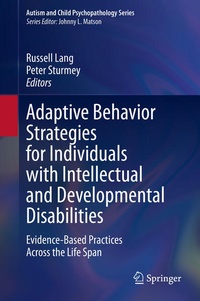
Adaptive Behavior Strategies for Individuals with Intellectual and Developmental Disabilities
Description

This book examines strategies for teaching adaptive behavior across the lifespan to individuals with intellectual and developmental disabilities who regularly experience difficulty learning the skills necessary for daily living. It details evidence-based practices for functional life skills, ranging from teaching such basic hygiene as bathing, brushing teeth, and dressing to more complex skills, including driving. In addition, the volume describes interventions relating to recreation, play, and leisure as well as those paramount for maintaining independence and safety in community settings (e.g., abduction prevention skills for children). The book details existing evidence-based practices as well as how to perform the interventions.
Key areas of coverage include:
- Basic hygiene as bathing, brushing teeth, and dressing.
- Advanced, complex skills, including driving, recreation, play, and leisure.
- Skills to maintain independence and safety in community settings, including abduction prevention skills for children.
- Teaching new technology skills, such as using mobile telephones and apps as well as surfing the web.
- Training caregivers to promote and support adaptive behavior.
- Use of evidence-based practices for teaching and supporting adaptive behavior for individuals with intellectual disabilities and autism.
Adaptive Behavior Strategies for Individuals with Intellectual and Developmental Disabilities is an essential reference for researchers, professors, and graduate students as well as clinicians, therapists, and other scientist-practitioners in developmental psychology, behavioral therapy/rehabilitation, social work, clinical child and school psychology, child and adolescent psychiatry, pediatrics, and special education.
More details
Other editions
Additional editions
Persons
Russell Lang, Ph.D.
, is Associate Professor of Special Education and a Board Certified Behavior Analyst (BCBA-D). He has published more than 100 peer-reviewed research papers and multiple book chapters concerning the education and treatment of people with intellectual and developmental disabilities. His primary research interest is in the treatment of challenging behaviors and the acquisition of play and leisure skills in children with autism spectrum disorders.
Peter Sturmey, Ph.D.,
is Professor of Psychology at the Graduate Center and Queens College, City University of New York. He has published more than 210 articles, 60 chapters, 25 books and more than 250 presentations, mostly in the areas of developmental disabilities and applied behavior analysis.
