

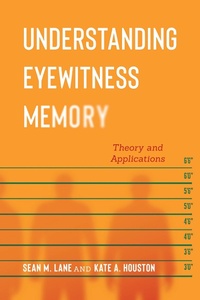
Understanding Eyewitness Memory
Theory and Applications
Published on 25. May 2021
277 pages
978-1-4798-5115-7 (ISBN)
Description

An essential overview of how perception and memory affect eyewitness testimony
In 1981, sixteen-year-old Michael Williams was convicted on charges of aggravated rape based on the victim's eyewitness testimony. No other evidence was found linking him to the attack. After nearly twenty-four years, Williams was released after three separate DNA analyses proved his innocence. The victim still maintains that Williams was the culprit.
This heartbreaking case is but one example of eyewitness error. In Understanding Eyewitness Memory, Sean M. Lane and Kate A. Houston delve into the science of eyewitness memory. They examine a number of important topics, from basic research on perception and memory to the implications of this research on the quality and accuracy of eyewitness evidence. The volume answers questions such as: How do we remember and describe people we've encountered? What is the nature of false and genuine memories? How do emotional arousal and stress affect what we remember?
Understanding Eyewitness Memory offers a brilliant overview of how memory and psychology affect eyewitness testimony, where quality and accuracy can mean the difference between wrongful imprisonment and true justice.
In 1981, sixteen-year-old Michael Williams was convicted on charges of aggravated rape based on the victim's eyewitness testimony. No other evidence was found linking him to the attack. After nearly twenty-four years, Williams was released after three separate DNA analyses proved his innocence. The victim still maintains that Williams was the culprit.
This heartbreaking case is but one example of eyewitness error. In Understanding Eyewitness Memory, Sean M. Lane and Kate A. Houston delve into the science of eyewitness memory. They examine a number of important topics, from basic research on perception and memory to the implications of this research on the quality and accuracy of eyewitness evidence. The volume answers questions such as: How do we remember and describe people we've encountered? What is the nature of false and genuine memories? How do emotional arousal and stress affect what we remember?
Understanding Eyewitness Memory offers a brilliant overview of how memory and psychology affect eyewitness testimony, where quality and accuracy can mean the difference between wrongful imprisonment and true justice.
Reviews / Votes
"An engaging treatment of the current state of the science regarding eyewitness evidence. The authors walk a wise `middle road' that integrates basic and applied research on perception and memory. Despite its brevity and accessibility, the book covers a lot of ground, including many studies published in the last few years. . . . Gives nuanced treatments of topics such as the effects of stress on memory and the relationship between witnesses' confidence and their accuracy." - Stephen Lindsay, University of Victoria "Will be a great addition to the field. Often, the connection between basic understanding of psychological phenomena and how witnesses behave in real life is missed, but Lane and Houston do a great job in addressing this gap." - James Lampinen, University of ArkansasMore details
Series
Language
English
Place of publication
New York
United States
Target group
Professional and scholarly
Illustrations
2 b/w illustrations
ISBN-13
978-1-4798-5115-7 (9781479851157)
Copyright in bibliographic data and cover images is held by Nielsen Book Services Limited or by the publishers or by their respective licensors: all rights reserved.
Schweitzer Classification
Other editions
Additional editions
Book
05/2021
New York University Press
€35.00
Shipment within 10-20 days
Persons
Sean M. Lane (Author)
Sean M. Lane is Dean of the College of Arts, Humanities and Social Sciences and Professor of Psychology at the University of Alabama in Huntsville, and co-editor of Human Capacity in the Attention Economy.
Kate A. Houston (Author)
Kate A. Houston is Associate Professor of Criminal Justice at Texas A&M International University.
Sean M. Lane is Dean of the College of Arts, Humanities and Social Sciences and Professor of Psychology at the University of Alabama in Huntsville, and co-editor of Human Capacity in the Attention Economy.
Kate A. Houston (Author)
Kate A. Houston is Associate Professor of Criminal Justice at Texas A&M International University.
