

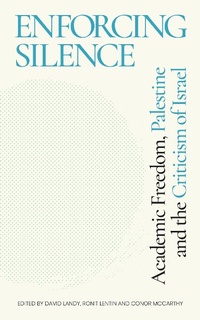
Enforcing Silence
Academic Freedom, Palestine and the Criticism of Israel
1st Edition
Published on 15. May 2020
288 pages
978-1-78699-653-4 (ISBN)
Description

Academic freedom is under siege, as our universities become the sites of increasingly fraught battles over freedom of speech. While much of the public debate has focussed on 'no platforming' by students, this overlooks the far graver threat posed by concerted efforts to silence the critical voices of both academics and students, through the use of bureaucracy, legal threats and online harassment. Such tactics have conspicuously been used, with particularly virulent effect, in an attempt to silence academic criticism of Israel.
This collection uses the controversies surrounding the Israeli-Palestinian conflict as a means of exploring the limits placed on academic freedom in a variety of different national contexts. It looks at how the increased neoliberalisation of higher education has shaped the current climate, and considers how academics and their universities should respond to these new threats. Bringing together new and established scholars from Palestine and the wider Middle East as well as the US and Europe, Enforcing Silence shows us how we can and must defend our universities as places for critical thinking and free expression.
This collection uses the controversies surrounding the Israeli-Palestinian conflict as a means of exploring the limits placed on academic freedom in a variety of different national contexts. It looks at how the increased neoliberalisation of higher education has shaped the current climate, and considers how academics and their universities should respond to these new threats. Bringing together new and established scholars from Palestine and the wider Middle East as well as the US and Europe, Enforcing Silence shows us how we can and must defend our universities as places for critical thinking and free expression.
Reviews / Votes
Enforcing Silence is a much-needed intervention in debates that have long raged about academic freedom in relation to the Palestine question and academic boycott. It provides a thoughtful critique of the usefulness of a liberal notion of academic freedom from a variety of disciplinary and geographic locations ... a thoughtfully curated and insightful collection of essays that will give scholars, students, and activists important lines of analysis to counter enforced silence. * Journal of Palestine Studies * This collection of essays deserves the attention of political theorists and civil liberties lawyers as well as Middle East area experts. Its arguments may also be of interest to a wider public in the wake of America's long, hot summer of protests by Black Lives Matter. * The Middle East Journal * As global support for Palestinian justice grows steadily, the silencing of criticism of Israel takes new aggressive forms. To understand why this is the case, and how the politics of Israel-Palestine has become indelibly connected to academic freedom, read this valuable and wide-ranging collection. * Bashir Abu-Manneh, University of Kent * Criticism of Israel has become the litmus test of "academic freedom". Anyone believing that this is, at bottom, a straightforward and unquestionable notion will change their mind after reading this very stimulating and useful book. * Gilbert Achcar, School of Oriental and African Studies *More details
Edition
1. Auflage
Language
English
Place of publication
United Kingdom
Publishing group
Bloomsbury Publishing PLC
Target group
College/higher education
ISBN-13
978-1-78699-653-4 (9781786996534)
Copyright in bibliographic data and cover images is held by Nielsen Book Services Limited or by the publishers or by their respective licensors: all rights reserved.
Schweitzer Classification
Other editions
Additional editions
David Landy | Ronit Lentin | Conor McCarthy
Enforcing Silence
Academic Freedom, Palestine and the Criticism of Israel
Book
05/2020
Zed Books Ltd
€113.00
Shipment within 3-4 weeks
Persons
David Landy is a lecturer in sociology and the director of the MPhil in Race, Ethnicity and Conflict at Trinity College Dublin, Ireland. He is the author of Jewish Identity and Palestinian Rights: Diaspora Jewish Opposition to Israel (Zed 2011).
Ronit Lentin is a retired associate professor of sociology at Trinity College Dublin, Ireland. Her other books include Thinking Palestine (Zed 2008), Co-Memory and Melancholia: Israelis Memorialising the Palestinian Nakba (2010), and Traces of Racial Exception: Racializing the Israeli Settler Colonialism (2018).
Conor McCarthy is a lecturer in the School of English at Maynooth University, Ireland. His other books include The Cambridge Introduction to Edward Said (2010) and The Revolutionary and Anti-Imperialist Writings of James Connolly (2016).
Ronit Lentin is a retired associate professor of sociology at Trinity College Dublin, Ireland. Her other books include Thinking Palestine (Zed 2008), Co-Memory and Melancholia: Israelis Memorialising the Palestinian Nakba (2010), and Traces of Racial Exception: Racializing the Israeli Settler Colonialism (2018).
Conor McCarthy is a lecturer in the School of English at Maynooth University, Ireland. His other books include The Cambridge Introduction to Edward Said (2010) and The Revolutionary and Anti-Imperialist Writings of James Connolly (2016).
Content
Preface
Introduction, Palestine and Academic Freedom
Part I: Universities and Academic Governance
1. Whose University? Academic Freedom, Neoliberalism and the Rise of 'Israel Studies'
2. Disciplinarity and the Boycott
3. "The Academic Field must be Defended": Excluding Criticism of Israel from Campuses.
4. Lebanese and American Law at the American University of Beirut: A Case of Legal Liminality in Neoliberal Times
5. Precarious Work in Higher Education, Academic Freedom and the Academic Boycott of Israel in Ireland
Part II: Colonial Erasure in Higher Education
6. Colonial Apologism and the Politics of Academic Freedom
7. The Academic Boycott and Beyond: Towards an Epistemological Strategy of Liberation and Decolonization
8. Colonial Academic Control in Palestine and Israel: Blueprint for Repression?
Part III: Interrogating Academic Freedom
9. Lawfare against Academics and the Potential of Legal Mobilization as Counterpower
10. Rethinking Academic Palestine Advocacy and Activism: Academic Freedom, Human Rights, and the Universality of the Emancipatory Struggle
11. Against Academic Freedom: "Terrorism," Settler Colonialism, and Palestinian Liberation
12 Privilege, Platforms, and Power: Uses and Abuses of Academic Freedom
Introduction, Palestine and Academic Freedom
Part I: Universities and Academic Governance
1. Whose University? Academic Freedom, Neoliberalism and the Rise of 'Israel Studies'
2. Disciplinarity and the Boycott
3. "The Academic Field must be Defended": Excluding Criticism of Israel from Campuses.
4. Lebanese and American Law at the American University of Beirut: A Case of Legal Liminality in Neoliberal Times
5. Precarious Work in Higher Education, Academic Freedom and the Academic Boycott of Israel in Ireland
Part II: Colonial Erasure in Higher Education
6. Colonial Apologism and the Politics of Academic Freedom
7. The Academic Boycott and Beyond: Towards an Epistemological Strategy of Liberation and Decolonization
8. Colonial Academic Control in Palestine and Israel: Blueprint for Repression?
Part III: Interrogating Academic Freedom
9. Lawfare against Academics and the Potential of Legal Mobilization as Counterpower
10. Rethinking Academic Palestine Advocacy and Activism: Academic Freedom, Human Rights, and the Universality of the Emancipatory Struggle
11. Against Academic Freedom: "Terrorism," Settler Colonialism, and Palestinian Liberation
12 Privilege, Platforms, and Power: Uses and Abuses of Academic Freedom
