

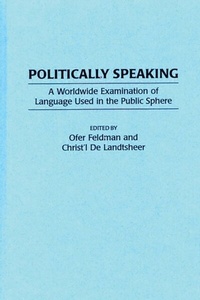
Politically Speaking
A Worldwide Examination of Language Used in the Public Sphere
1st Edition
Published on 24. September 1998
224 pages
978-1-56750-756-0 (ISBN)
Description

The characteristics, nature, and content of the language used in the public sphere of various Western and non-Western societies are examined in this collection of essays. They also analyze the functions language plays in the polity and the link between culture, political culture, and the language that politicians and the public use in their symbolic interaction.
This work details and examines the characteristics, nature, and content of the language used in the public sphere of various Western and non-Western societies; the functions language plays in the polity; and the link between culture, political culture, and the language that politicians and other elites, as well as the public, use in their symbolic interaction. The essays describe and analyze the topic of political language from different perspectives-political science, psychology, philosophy, sociology, gender studies, economics, religious, public administration, mass communication, and linguistics.
Essays examine the discourse of political press reports and TV interviews, political orations and election propaganda, legalistic, political-philosophic, and religious treatises. Throughout it provides an overview of the state of the art of political language, utilizing various research methods and disciplines.
This work details and examines the characteristics, nature, and content of the language used in the public sphere of various Western and non-Western societies; the functions language plays in the polity; and the link between culture, political culture, and the language that politicians and other elites, as well as the public, use in their symbolic interaction. The essays describe and analyze the topic of political language from different perspectives-political science, psychology, philosophy, sociology, gender studies, economics, religious, public administration, mass communication, and linguistics.
Essays examine the discourse of political press reports and TV interviews, political orations and election propaganda, legalistic, political-philosophic, and religious treatises. Throughout it provides an overview of the state of the art of political language, utilizing various research methods and disciplines.
More details
Edition
1. Auflage
Language
English
Place of publication
New York
United States
Publishing group
Bloomsbury Publishing Plc
Target group
Interest Age: From 7 to 17 years
ISBN-13
978-1-56750-756-0 (9781567507560)
Copyright in bibliographic data and cover images is held by Nielsen Book Services Limited or by the publishers or by their respective licensors: all rights reserved.
Schweitzer Classification
Other editions
Additional editions
Christ'l De Landtsheer | Ofer Feldman
Politically Speaking
A Worldwide Examination of Language Used in the Public Sphere
Book
09/1998
Praeger Publishers Inc
€111.76
Article exhausted; check different version
Persons
OFER FELDMAN is Associate Professor at Naruto University of Education in Japan. He is the author of three earlier books and numerous articles and serves as executive editor of Politics, Groups and the Individual.
CHRIST'L DE LANDTSHEER is an Associate Professor of the University of Amsterdam. Before her academic career, she was professionally involved in mass media and politics through the National Belgian Broadcasting Company, the Dutch-Belgian Linguistic Union, and as a Political Cabinet Member in the Belgian government. She has written extensively at the Amsterdam School of Communication Research (ASCOR) on political rhetoric and communication.
CHRIST'L DE LANDTSHEER is an Associate Professor of the University of Amsterdam. Before her academic career, she was professionally involved in mass media and politics through the National Belgian Broadcasting Company, the Dutch-Belgian Linguistic Union, and as a Political Cabinet Member in the Belgian government. She has written extensively at the Amsterdam School of Communication Research (ASCOR) on political rhetoric and communication.
Content
Tables
Preface
Introduction to the Study of Political Discourse by Christ'l De Landtsheer
The Nature and Scope of Political Discourse
The Pervasiveness of Islam in Contemporary Arab Political Discourse: The Case of Sadat and Arafat by Raphael Israeli
The Changing Political Language of Germany by Christa Lang-Pfaff
The Political Language of Japan: Decoding What Politicians Mean from What They Say by Ofer Feldman
The Rhetoric of Jewish Cohesion and Territorial Attachment in Rabbinic Midrashim by Carol B. Conway
Pragamatic Ambiguity and Partisanship in Russia's Emerging Democracy by Richard D. Anderson, Jr.
The Discourse of the Political Elite
The Crisis Tool in American Political Discourse by Amos Kiewe
Discourse as a Stage for Political Actors: An Analysis of Presidential Addresses in Argentina, Brazil, and Venezuela by Maritza Montero and Isabel Rodriguez-Mora
Method of Argumentation of Jean-Marie Le Pan, Leader of the French Extreme Right-Wing, in an Important Political Television Program by Simone Bonnafous
The Media, the Markets, and the Crash: A Consideration of Financial Press Narratives by Matthew G. Sorley
The Poltical Rhetoric of a Unified Europe by Christ'l De Landtsheer
Methods in the Study of Political Discourse
Political Interviews: Television Interviews in Great Britain by Peter Bull
Functions of Recent U.S. Presidential Slogans by Herbert Barry III
Political Language in an Environmental Controversy: Integrative Complexity and Motive Imagery in Advocacy Propaganda and the Press by Peter Suedfeld, Loraine Lavallee, and Jennifer Brough
Post-Realism, Just War, and the Gulf War Debate by Francis A. Beer and Robert Hariman
Epilogue
Where Do We Stand? by Ofer Feldman
Index
Preface
Introduction to the Study of Political Discourse by Christ'l De Landtsheer
The Nature and Scope of Political Discourse
The Pervasiveness of Islam in Contemporary Arab Political Discourse: The Case of Sadat and Arafat by Raphael Israeli
The Changing Political Language of Germany by Christa Lang-Pfaff
The Political Language of Japan: Decoding What Politicians Mean from What They Say by Ofer Feldman
The Rhetoric of Jewish Cohesion and Territorial Attachment in Rabbinic Midrashim by Carol B. Conway
Pragamatic Ambiguity and Partisanship in Russia's Emerging Democracy by Richard D. Anderson, Jr.
The Discourse of the Political Elite
The Crisis Tool in American Political Discourse by Amos Kiewe
Discourse as a Stage for Political Actors: An Analysis of Presidential Addresses in Argentina, Brazil, and Venezuela by Maritza Montero and Isabel Rodriguez-Mora
Method of Argumentation of Jean-Marie Le Pan, Leader of the French Extreme Right-Wing, in an Important Political Television Program by Simone Bonnafous
The Media, the Markets, and the Crash: A Consideration of Financial Press Narratives by Matthew G. Sorley
The Poltical Rhetoric of a Unified Europe by Christ'l De Landtsheer
Methods in the Study of Political Discourse
Political Interviews: Television Interviews in Great Britain by Peter Bull
Functions of Recent U.S. Presidential Slogans by Herbert Barry III
Political Language in an Environmental Controversy: Integrative Complexity and Motive Imagery in Advocacy Propaganda and the Press by Peter Suedfeld, Loraine Lavallee, and Jennifer Brough
Post-Realism, Just War, and the Gulf War Debate by Francis A. Beer and Robert Hariman
Epilogue
Where Do We Stand? by Ofer Feldman
Index
