

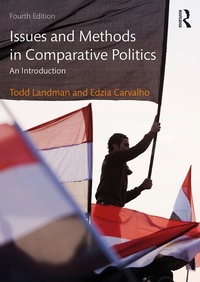
Issues and Methods in Comparative Politics
An Introduction
4th Edition
Published on 1. December 2016
372 pages
978-1-317-53380-1 (ISBN)
Description

Building on the strengths of the third edition, this highly regarded textbook continues to provide the best introduction to the strategies of comparative research in political science. Divided into three parts, the book begins by examining different methods, applying these methods to dominant issues in comparative politics using a wealth of topical examples from around the world, and then discusses the new challenges in the area. This thoroughly revised and updated edition features:
Additional contemporary case studies including the democratisation of technology and the Arab Spring;
Detailed discussion of regression analysis and diffusion;
More analysis of justice, inequality, and compliance;
Reflection on new methods and treatments of contemporary comparative politics.
Balancing reader friendly features with high quality analysis makes this popular academic text is essential reading for everyone interested in comparative politics and research methods.
Additional contemporary case studies including the democratisation of technology and the Arab Spring;
Detailed discussion of regression analysis and diffusion;
More analysis of justice, inequality, and compliance;
Reflection on new methods and treatments of contemporary comparative politics.
Balancing reader friendly features with high quality analysis makes this popular academic text is essential reading for everyone interested in comparative politics and research methods.
Reviews / Votes
'This book fills a longstanding gap in the literature for a clear and concise primer on the purpose and methods of comparative politics. It is also an excellent starting point for scholars and students alike who wish to come to grips with the most important arguments, findings and methodological challenges in the study of democracy and human rights. Required reading for budding comparativists, it should also serve as a benchmark which seasoned scholars should regularly revisit.' - Robert Mattes, University of Strathclyde, UK.'I have relied on this book for years to teach my masters students how to think through their methods choices. It provides a much-needed neutral overview of the trade-offs between Large-N and Small-N methods, presenting these options as the "methodological universe of the field" of comparative politics. The book presents complex material in a clear way - and is useful both in teaching and in my own research.' - Sherrill Stroschein, University College London, UK
'Todd Landman and Edzia Carvalho have written a genuine multi-method textbook. They introduce students into substantive issues through the lenses of contrasting methods. Pluralistic and reflexive, well-structured, thoughtful, and up-to-date, Issues and Methods in Comparative Politics nicely fulfils its didactic promise. Students will encounter a most stimulating guide to the contemporary study of politics.' - Andreas Schedler, CIDE, Mexico City
More details
Edition
4th edition
Language
English
Place of publication
London
United Kingdom
Publishing group
Taylor & Francis Ltd
Target group
College/higher education
Edition type
Revised edition
Illustrations
38 s/w Abbildungen, 38 s/w Tabellen, 38 s/w Zeichnungen
34 Tables, black and white; 40 Line drawings, black and white
File size
2,14 MB
ISBN-13
978-1-317-53380-1 (9781317533801)
Copyright in bibliographic data and cover images is held by Nielsen Book Services Limited or by the publishers or by their respective licensors: all rights reserved.
Schweitzer Classification
Other editions
Additional editions
Book
01/2017
4th Edition
Routledge
€90.20
Shipment within 15-20 days
Book
12/2016
4th Edition
Routledge
€273.20
Shipment within 15-20 days
Persons
Todd Landman is Professor of Political Science and Pro Vice Chancellor of the Faculty of Social Sciences at the University of Nottingham, UK. He has published Democracy and Human Rights (2013), Studying Human Rights (Routledge 2006), Protecting Human Rights (2005), co-authored Measuring Human Rights (Routledge 2009), and edited Human Rights (Volumes I-IV) (2009) and Sage Handbook of Comparative Politics (2009).
Edzia Carvalho is Lecturer in Politics in the School of Social Sciences at the University of Dundee, UK. She is co-author of Measuring Human Rights (Routledge 2009).
Edzia Carvalho is Lecturer in Politics in the School of Social Sciences at the University of Dundee, UK. She is co-author of Measuring Human Rights (Routledge 2009).
Content
Introduction
PART I: WHY, HOW, AND PROBLEMS OF COMPARISON
1. Why Compare Countries?
Reasons for comparison
The science in political science
Scientific terms and concepts
Summary
Further reading
2. How to Compare Countries
Methods of comparison
Comparing many countries
Comparing few countries
Single country studies as comparison
Choosing countries and problems of comparison
Summary
Further reading
3. Comparing Many Countries
Starting assumptions
Measuring concepts
Basic regression analysis
Extending the basic regression model
Limitations to global comparative analysis
Summary
Further reading
4. Comparing Few Countries
Assumptions
Case selection and research design
Combining quantitative and qualitative comparison
Limitations of few-country comparisons
Summary
Further reading
5. Single-Country Studies as Comparison
Functions of single-country studies
Raising observations in single-country studies
Limitations of single-study studies
Summary
Further reading
PART II: COMPARING COMPARISONS
6. Economic Development and Democracy
The research problem
Comparing many countries
Comparing few countries
Single-country studies
Summary
Further reading
7. Violent Political Dissent and Social Revolution
The research problem
Comparing many countries
Comparing few countries
Single-country studies
Summary
Further reading
8. Non-Violent Political Dissent and Social Movements
The research problem
Comparing many countries
Comparing few countries
Single-country studies
Summary
Further reading
9. Transitions to Democracy
The research problem
Comparing many countries
Comparing few countries
Single-country studies
Summary
Further reading
10. Institutional Design and Democratic Performance
The research problem
Comparing many countries
Comparing few countries
Single-country studies
Summary
Further reading
11. Human Rights
The research problem
Comparing many countries
Comparing few countries
Single-country studies
Summary
Further reading
12. International Relations and Comparative Politics
Research problems
Comparing many countries
Comparing few countries
Single-country studies
Summary
Further reading
PART III: COMPARATIVE METHODS AND NEW ISSUES
13. Common Themes and Different Comparisons
Methodological trade-offs
Building theory
Conclusion: drawing the lessons
Further reading
14. New Challenges For Comparative Politics
Full circle
New methods
Maintaining relevance
Summary
Further reading
PART I: WHY, HOW, AND PROBLEMS OF COMPARISON
1. Why Compare Countries?
Reasons for comparison
The science in political science
Scientific terms and concepts
Summary
Further reading
2. How to Compare Countries
Methods of comparison
Comparing many countries
Comparing few countries
Single country studies as comparison
Choosing countries and problems of comparison
Summary
Further reading
3. Comparing Many Countries
Starting assumptions
Measuring concepts
Basic regression analysis
Extending the basic regression model
Limitations to global comparative analysis
Summary
Further reading
4. Comparing Few Countries
Assumptions
Case selection and research design
Combining quantitative and qualitative comparison
Limitations of few-country comparisons
Summary
Further reading
5. Single-Country Studies as Comparison
Functions of single-country studies
Raising observations in single-country studies
Limitations of single-study studies
Summary
Further reading
PART II: COMPARING COMPARISONS
6. Economic Development and Democracy
The research problem
Comparing many countries
Comparing few countries
Single-country studies
Summary
Further reading
7. Violent Political Dissent and Social Revolution
The research problem
Comparing many countries
Comparing few countries
Single-country studies
Summary
Further reading
8. Non-Violent Political Dissent and Social Movements
The research problem
Comparing many countries
Comparing few countries
Single-country studies
Summary
Further reading
9. Transitions to Democracy
The research problem
Comparing many countries
Comparing few countries
Single-country studies
Summary
Further reading
10. Institutional Design and Democratic Performance
The research problem
Comparing many countries
Comparing few countries
Single-country studies
Summary
Further reading
11. Human Rights
The research problem
Comparing many countries
Comparing few countries
Single-country studies
Summary
Further reading
12. International Relations and Comparative Politics
Research problems
Comparing many countries
Comparing few countries
Single-country studies
Summary
Further reading
PART III: COMPARATIVE METHODS AND NEW ISSUES
13. Common Themes and Different Comparisons
Methodological trade-offs
Building theory
Conclusion: drawing the lessons
Further reading
14. New Challenges For Comparative Politics
Full circle
New methods
Maintaining relevance
Summary
Further reading
