

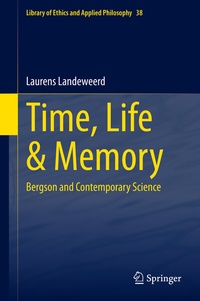
Time, Life & Memory
Description

This book revitalizes the relevance of the ideas of Henri Bergson (1859-1941) for current developments in exact sciences. It explores the relevance of Bergson's thought for contemporary philosophical reflections on three of the most important scientific research areas of today, namely physics, the life sciences and the neurosciences. It does so on the basis of the three interrelated topics of time, life and memory. Henri Bergson (1859-1941) was one of the most widely read philosophers of his era. The European public was seeking for answers to questions of the soul and the nature of life and fitting within a historical niche between intellectual rationalism and intuitive spiritualism, his writings drew much attention.
This work focuses on the relevance of his philosophy for developments in exact sciences today. The discussion of physics in relation to the abstract and the concrete, the life sciences in relation to concepts of life in relation tonew and emerging biotechnology, and the neurosciences in relation to the dual nature of human identity, focuses on one main topic: time. Time, isolated from experience, as the measure of the events in the universe in modern physics; time as the measure of emergent systems in evolution as the backdrop of the theory of evolution in biology; time in relation to memory and imagination in neuropsychological accounts of memory. The author thus discusses the ideas of Henri Bergson as a basis to unveil time as a living process, rather than as an instrument for the measure of events. This view forms the basis of a novel approach to the philosophy of technology. An exciting book for academics interested in the interplay between hard sciences and philosophy.
More details
Other editions
Additional editions
Person
Laurens Landeweerd (1976) is a philosopher who combines metaphysics, ontology and the philosophy of technology. In science and engineering, such ontologies often lie hidden beneath practical and pragmatic discourse. Landeweerd seeks to translate and render explicit such ontologies both to society (communication) and to science itself (critical self-understanding).
Landeweerd is specifically interested in the role of our concepts of change in competing worldviews. Landeweerd's research focuses on the role of science and technology in our understanding of ourselves and our environment. Science and technology are increasingly intertwined with the human condition and on our views of nature and society, and this needs an ontological understanding of science and technology these in their defining role of both (human) being and our environment.
Landeweerd has edited two books and published some 40 peer reviewed papers. Landeweerd studied Philosophy at the University of Amsterdam and Culture & Science at Maastricht University. From 2000 to 2002 he worked on the revision of a Dutch history of philosophy (25 Eeuwen (Westerse) Filosofie). Between 2002 and 2008 he worked for Maastricht University on a study of the role of human identity in genomics. Between 2007 and 2014, he worked for the department of biotechnology at TU Delft. From 2010 till now he has been working for Radboud University Nijmegen's Institute for Science in Society (Science Faculty); between 2014 and 2017 he was senior researcher for Oslo and Akerhus University of Applied Sciences; and from 2017 he has been lecturing for the interdisciplinary bachelor of the Arts Academy in Maastricht. Landeweerd worked on a number of European projects on the ethics and philosophy of biotechnology.
