

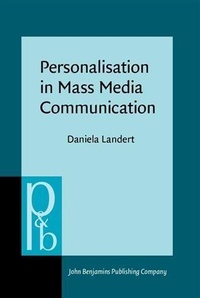
Personalisation in Mass Media Communication
British online news between public and private
1st Edition
Published on 4. February 2014
XIV, 294 pages
978-90-272-7083-2 (ISBN)
Description

It seems to be a truism that today's news media present the news in a more personal and direct way than print newspapers some twenty-five years ago. However, it is far from obvious, how this can be described linguistically. This study develops a model that integrates and differentiates between the various facets of personalisation from a linguistic point of view. It includes 1) contexts that involve the audience by inviting direct interaction and through the use of visual elements; 2) the focus on private individuals who are personally affected by news events; and 3) the use of communicative immediacy, for instance in the form of direct speech and first and second person pronouns. This model is applied to data from five British online news sites, demonstrating how individual features contribute to personalisation, how different features interact, and what personalisation strategies are used by news sites of different market orientations.
More details
Other editions
Additional editions
Daniela Landert
Personalisation in Mass Media Communication
British online news between public and private
Book
02/2014
John Benjamins Publishing Co
€100.70
Shipment within 10-15 days
Person
Content
- Personalisation in Mass Media Communication
- Editorial page
- Title page
- LCC data
- Table of contents
- List of tables
- List of figures
- Acknowledgements
- 1. Introduction
- 2. Personalisation in mass media
- 2.1 Mass media communication between impersonality and personalisation
- 2.2 Personalisation and linguistic immediacy
- 2.3 Public, private, involving, and immediate
- 2.4 Modelling personalisation
- 3. Data collection
- 3.1 Working with online data
- 3.2 Characteristics of the online news sites
- 3.3 Overview of collected data sets
- 3.3.1 The online data
- 3.3.2 The Times from 1985
- 3.4 Technical aspects
- 3.4.1 Zotero snapshots
- 3.4.2 Screenshots
- 3.4.3 Inconsistencies between formats
- 3.4.4 XML format
- 3.5 A comment on statistics
- 4. Feedback and interaction
- 4.1 Audience interaction in mass media communication
- 4.1.1 Modelling audience interaction
- 4.1.2 Interaction on online news sites - a brief history
- 4.2 Forms of feedback and interaction
- 4.2.1 Indirect feedback
- 4.2.2 User comments
- 4.2.3 Opinion polls
- 4.2.4 Contact details and profiles
- 4.2.5 Audience content
- 4.3 Strategies for integrating user-generated content
- 4.3.1 Separation: The Times Online and the Guardian
- 4.3.2 Integration: BBC News
- 4.3.3 Blurring: The Mail Online and the Sun
- 4.4 Summary and conclusion
- 5. Visual elements
- 5.1 Overview of visual elements in news articles
- 5.2 Images and personalisation
- 5.2.1 Functional relations between visual and textual elements
- 5.2.2 The content of visual elements
- 5.2.3 Interactive functions of images: How the content is depicted
- 5.3 Case study: Visual elements in reports on the Edlington hearing
- 5.4 Summary and conclusion
- 6. News actors
- 6.1 Official, private, and celebrity actors
- 6.2 Main topics and actors in top-listed news articles
- 6.2.1 Topic categories in news articles
- 6.2.2 Actor constellations in different topic categories
- 6.2.3 Topic categories across news sites
- 6.3 Representing the actors
- 6.4 Case study revisited: Personalising content in reports on the Edlington hearing
- 6.5 Summary and conclusion
- 7. Direct speech
- 7.1 Forms of speech representation
- 7.1.1 Leech and Short's classification
- 7.1.2 Faithfulness claims
- 7.1.3 Modifications to Leech and Short's classification
- 7.2 Functions of direct speech
- 7.3 Frequency of direct speech
- 7.3.1 Quantifying direct speech
- 7.3.2 Direct speech across subcorpora
- 7.4 Source types
- 7.4.1 Categorisation of source types
- 7.4.2 Named, identified and anonymous sources
- 7.4.3 Private and official sources
- 7.5 Summary and conclusion
- 8. Personal pronouns
- 8.1 Reference of first and second person pronouns
- 8.2 First and second person pronouns as features of immediacy and involvement
- 8.3 Frequency of first and second person pronouns
- 8.3.1 Identification of first and second person pronouns
- 8.3.2 First and second person pronouns across subcorpora
- 8.4 First and second person pronouns within direct speech in news articles
- 8.5 First and second person pronouns outside of direct speech in news articles
- 8.6 First person singular pronouns across different types of articles
- 8.7 Summary and conclusion
- 9. Conclusion
- References
- Appendix A: List of articles
- Appendix B: Statistical tests
- Author index
- Subject index
