

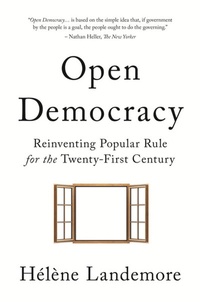
Open Democracy
Reinventing Popular Rule for the Twenty-First Century
1st Edition
Published on 12. October 2020
272 pages
978-0-691-20872-5 (ISBN)
Description

"Open Democracy envisions what true government by mass leadership could look like."-Nathan Heller, New Yorker
How a new model of democracy that opens up power to ordinary citizens could strengthen inclusiveness, responsiveness, and accountability in modern societies
To the ancient Greeks, democracy meant gathering in public and debating laws set by a randomly selected assembly of several hundred citizens. To the Icelandic Vikings, democracy meant meeting every summer in a field to discuss issues until consensus was reached. Our contemporary representative democracies are very different. Modern parliaments are gated and guarded, and it seems as if only certain people-with the right suit, accent, wealth, and connections-are welcome. Diagnosing what is wrong with representative government and aiming to recover some of the lost openness of ancient democracies, Open Democracy presents a new paradigm of democracy in which power is genuinely accessible to ordinary citizens.
Hélène Landemore favors the ideal of "representing and being represented in turn" over direct-democracy approaches. Supporting a fresh nonelectoral understanding of democratic representation, Landemore recommends centering political institutions around the "open mini-public"-a large, jury-like body of randomly selected citizens gathered to define laws and policies for the polity, in connection with the larger public. She also defends five institutional principles as the foundations of an open democracy: participatory rights, deliberation, the majoritarian principle, democratic representation, and transparency.
Open Democracy demonstrates that placing ordinary citizens, rather than elites, at the heart of democratic power is not only the true meaning of a government of, by, and for the people, but also feasible and, today more than ever, urgently needed.
How a new model of democracy that opens up power to ordinary citizens could strengthen inclusiveness, responsiveness, and accountability in modern societies
To the ancient Greeks, democracy meant gathering in public and debating laws set by a randomly selected assembly of several hundred citizens. To the Icelandic Vikings, democracy meant meeting every summer in a field to discuss issues until consensus was reached. Our contemporary representative democracies are very different. Modern parliaments are gated and guarded, and it seems as if only certain people-with the right suit, accent, wealth, and connections-are welcome. Diagnosing what is wrong with representative government and aiming to recover some of the lost openness of ancient democracies, Open Democracy presents a new paradigm of democracy in which power is genuinely accessible to ordinary citizens.
Hélène Landemore favors the ideal of "representing and being represented in turn" over direct-democracy approaches. Supporting a fresh nonelectoral understanding of democratic representation, Landemore recommends centering political institutions around the "open mini-public"-a large, jury-like body of randomly selected citizens gathered to define laws and policies for the polity, in connection with the larger public. She also defends five institutional principles as the foundations of an open democracy: participatory rights, deliberation, the majoritarian principle, democratic representation, and transparency.
Open Democracy demonstrates that placing ordinary citizens, rather than elites, at the heart of democratic power is not only the true meaning of a government of, by, and for the people, but also feasible and, today more than ever, urgently needed.
More details
Other editions
Additional editions
Book
03/2022
Princeton University Press
€25.00
Shipment within 10-20 days
Book
10/2020
Princeton University Press
€56.00
Shipment within 10-20 days
Person
Hélène Landemore is associate professor of political science at Yale University. She is the author of Democratic Reason (Princeton) and Hume. Twitter @landemore
Content
- Cover
- Contents
- Acknowledgments
- Prologue
- 1. Introduction
- A New Paradigm
- On Vocabulary
- On Method
- 2. The Crisis of Representative Democracy
- The Crisis of Representative Democracy: Empirical
- The Crisis of Representative Democracy: Conceptual
- The Road Not Taken
- The Realists' Objections
- Contemporary Solutions and Their Limits
- 3. The Myth of Direct Democracy
- Rousseau's Mistake
- Representation, Modernity, and the Problem of Size
- The Myth of Classical Athens as a Direct Democracy
- Direct versus Open
- 4. Legitimacy and Representation beyond Elections (Part One)
- The Problem with Consent Theory
- Definitions
- Lottocratic Representation
- Self-Selected Representation
- On the Accountability of Non-Elected Democratic Representatives
- Conclusion
- 5. Legitimacy and Representation beyond Elections (Part Two)
- On Legitimacy Again
- Tacit versus Explicit Majoritarian Authorization
- Conflicts of Legitimacy
- Liquid Representation
- 6. The Principles of Open Democracy
- Assembly Democracy versus Electoral Democracy
- The Principles of Open Democracy
- What about the Role of Parties in Open Democracy?
- What about Referendums in Open Democracy?
- 7. Let the People In! Lessons from a Modern Viking Saga
- Iceland as an Early Democratic Laboratory
- The 2010-2013 Constitutional Process
- Democratic Innovations in the Icelandic Process
- Was the Constitutional Proposal Any Good?
- Causal Mechanisms
- Iceland as an Open Democracy?
- 8. On the Viability of Open Democracy
- On the Alleged Failure of the Icelandic Experiment
- Objections to the Generalizability of the Icelandic Case
- The Objection from Incompetence
- The Risk of Capture by the Permanent Bureaucracy and Interest Groups
- The Objection from the Possible Illiberalism of More Majoritarian Institutions
- How Many Evenings Would Open Democracy Take?
- From Here to There
- 9. Conclusion: Open Democracy in a Global World
- On the Scale of Popular Rule: Toward Dynamic Inclusiveness
- On the Site of Popular Rule: Toward Substantive Equality
- Conclusion
- References
- Index
