

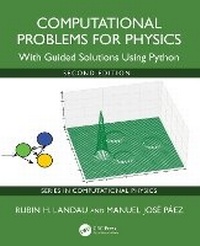
Computational Problems for Physics
With Guided Solutions Using Python
2nd Edition
Will be published approx. on 18. November 2026
490 pages
E-Book
978-1-040-76965-2 (ISBN)
Description

Our future scientists and professionals must be conversant in computational techniques. In order to facilitate integration of computer methods into existing physics courses, Computational Problems for Physics offers a large number of worked examples and problems with fully guided solutions in Python (as well as Mathematica, Java, C, Fortran, and Maple on the Web). The book can be used as a self-study guide for learning how to use computer methods in physics. Fully revised, this second edition includes:
A chapter on neural networks, machine learning, and artificial intelligence, with the building of simple networks, and the use of machine learning software.
A chapter on quantum computing with some problems to be run on the IBM Quantum Computer.
A chapter on general relativity with manipulations of the field equations and with computation of GR corrections to classical mechanics.
An expanded coverage of principal component analysis.
A crucial resource for students beginning their study of computational physics with in-depth and engaging problems and exercises.
A chapter on neural networks, machine learning, and artificial intelligence, with the building of simple networks, and the use of machine learning software.
A chapter on quantum computing with some problems to be run on the IBM Quantum Computer.
A chapter on general relativity with manipulations of the field equations and with computation of GR corrections to classical mechanics.
An expanded coverage of principal component analysis.
A crucial resource for students beginning their study of computational physics with in-depth and engaging problems and exercises.
More details
Series
Edition
2nd edition
Language
English
Place of publication
London
United Kingdom
Publishing group
Taylor & Francis Ltd
Target group
College/higher education
Illustrations
12 Tables, color; 123 Line drawings, color; 49 Line drawings, black and white; 6 Halftones, color; 1 Halftones, black and white; 129 Illustrations, color; 50 Illustrations, black and white
ISBN-13
978-1-040-76965-2 (9781040769652)
Copyright in bibliographic data and cover images is held by Nielsen Book Services Limited or by the publishers or by their respective licensors: all rights reserved.
Schweitzer Classification
Other editions
Additional editions
Rubin H. Landau | Manuel Jose Paez
Computational Problems for Physics
With Guided Solutions Using Python
Book
approx. 11/2026
2nd Edition
CRC Press
€74.50
Not yet published

Rubin H. Landau | Manuel Jose Paez
Computational Problems for Physics
With Guided Solutions Using Python
Book
approx. 11/2026
2nd Edition
CRC Press
€197.50
Not yet published
Persons
Rubin Landau is a Distinguished Professor Emeritus in the Department of Physics at Oregon State University in Corvallis and a Fellow of the American Physical Society (Division of Computational Physics). His research specialty is computational studies of the scattering of elementary particles from subatomic systems and momentum space quantum mechanics (over 100 papers). Landau has taught courses throughout the undergraduate and graduate curricula, and, for over 20 years, in computational physics, as well as authoring a number of textbooks. He was the founder of the OSU Computational Physics degree program, an Executive Committee member of the APS Division of Computational Physics, the AAPT Technology Committee, the Extreme Science and Engineering Discovery Environment (XSEDE) advisory committee, and has been part of the Education Program at the SuperComputing (SC) conferences for over a decade.
Manuel Jose Paez-Mejia has been a Professor of Physics at Universidad de Antioquia in Medellin, Colombia, since January 1969. He has been teaching courses in Modern Physics, Nuclear Physics, Computational Physics, Numerical Methods, Mathematical Physics, and Programming in Fortran, Pascal, and C languages. He has authored scientific papers in nuclear physics and computational physics, as well as texts on the C Language, General Physics, and Computational Physics (coauthored with Rubin Landau and Cristian Bordeianu). In the past, he and Landau conducted pioneering computational investigations of the interactions of mesons and nucleons with few-body nuclei. Professor Paez has led workshops in Computational Physics throughout Latin America, and has been Director of Graduate Studies in Physics at the Universidad de Antioquia.
Manuel Jose Paez-Mejia has been a Professor of Physics at Universidad de Antioquia in Medellin, Colombia, since January 1969. He has been teaching courses in Modern Physics, Nuclear Physics, Computational Physics, Numerical Methods, Mathematical Physics, and Programming in Fortran, Pascal, and C languages. He has authored scientific papers in nuclear physics and computational physics, as well as texts on the C Language, General Physics, and Computational Physics (coauthored with Rubin Landau and Cristian Bordeianu). In the past, he and Landau conducted pioneering computational investigations of the interactions of mesons and nucleons with few-body nuclei. Professor Paez has led workshops in Computational Physics throughout Latin America, and has been Director of Graduate Studies in Physics at the Universidad de Antioquia.
Content
1. Basic Computational Tools 2. Data Analytics 3. Classical and Nonlinear Dynamics 4. Waves and Fluids 5. Electricity and Magnetism 6. Special and General Relativity 7. Quantum Mechanics 8. Quantum Computing (QC) 9. Neural Networks and Artificial Intelligence 10. Statistical Simulations MC, Thermal, MD 11. Population Dynamics and Growth Models 12. Some Entry-Level Problems
