

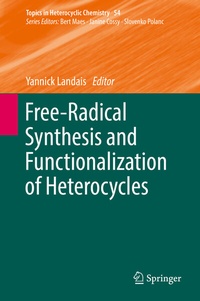
Free-Radical Synthesis and Functionalization of Heterocycles
Description

This volume describes the recent developments in the free-radical mediated synthesis and elaboration of heterocycles. The first chapter, dealing with radical cascade processes illustrates the power and the beauty of radical chemistry with some striking examples of total synthesis of complex natural heterocycles. As organic chemists strive towards sustainability, radical chemistry has recently seen major advances and efforts in this direction, including C-H activation of arenes and unactivated alkyl groups. Photochemical activation, for a long time the preferred mode of activation in radical chemistry has also seen an unexpected revival with the advent of visible light metal- and organocatalyzed photoredox processes. A survey of these emerging areas is provided along with the concepts at the origin of these developments.
The venerable Minisci reaction allows for direct access to functionalized heterocycles. This process has lately seen an interesting renaissance and is discussed in this volume. Addition of heteroatom-centered radicals onto unsaturated systems constitutes another powerful method to construct heterocycles. Examples of such a strategy are proposed along with the formation of various heterocycles relying on homolytic substitution at sulfur, phosphorus and selenium. Additionally free-radical functionalization of reactive functional groups including isonitriles, isothiocyanates and related unsaturated systems which offer a straightforward route towards useful aromatic and non-aromatic heterocycles are discussed. Finally, as metals are able to trigger single electron transfer both in reductive and oxidative modes this provides another possibility for the synthesis of heterocycles. Significant research efforts have focused on the use of samarium, copper and other metals to access a broad variety of heterocycles in a single pot process, starting from readily available raw material. Examples and mechanistic insights are discussed by experts in thisarea.
More details
Other editions
Additional editions
Person
Content
Photocatalyzed Formation of Heterocycles.- C-H activation via radical processes using photo-excited ketones.- Free Radicals in Heterocycle Functionalization.- Heteroatom-Centred Radicals for the Synthesis of Heterocyclic Compounds.- Metal-Mediated Oxidative Radical Processes for the Synthesis of Heterocycles.- Reductive Electron Transfer in the Synthesis of Heterocycles.- Synthesis of Nitrogen-Containing Heterocycles via Imidoyl or Iminyl Radical Intermediates.- Radical cascades in the total synthesis of complex naturally occurring heterocycles.
