

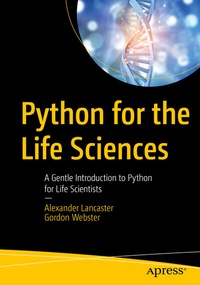
Python for the Life Sciences
Description

Treat yourself to a lively, intuitive, and easy-to-follow introduction to computer programming in Python. The book was written specifically for biologists with little or no prior experience of writing code - with the goal of giving them not only a foundation in Python programming, but also the confidence and inspiration to start using Python in their own research.
Virtually all of the examples in the book are drawn from across a wide spectrum of life science research, from simple biochemical calculations and sequence analysis, to modeling the dynamic interactions of genes and proteins in cells, or the drift of genes in an evolving population.
Best of all,
Python for the Life Sciences
shows you how to implement all of these projects in Python, one of the most popular programming languages for scientific computing.
If you are a life scientist interested in learning Python to jump-start your research, this is the book for you
.
What You'll Learn
Write Python scripts to automate your lab calculations
Search for important motifs in genome sequences
Use object-oriented programming with Python
Study mining interaction network data for patterns
Review dynamic modeling of biochemical switches
Who This Book Is For
Life scientists with little or no programming experience, including undergraduate and graduate students, postdoctoral researchers in academia and industry, medical professionals, and teachers/lecturers."A comprehensive introduction to using Python for computational biology... A lovely book with humor and perspective"
-- John Novembre, Associate Professor of Human Genetics, University of Chicago and MacArthur Fellow
"Fun, entertaining, witty and darn useful. Amagical portal to the big data revolution" -- Sandro Santagata, Assistant Professor in Pathology, Harvard Medical School "Alex and Gordon's enthusiasm for Python is contagious"-- Glenys Thomson Professor of Integrative Biology, University of California, Berkeley
More details
Other editions
Additional editions
Persons
Alex has published many peer-reviewed papers and is interested in solving problems in biology using evolutionary and complex adaptive systems approaches. He has done pioneering work in this area as a co-developer of the open-source agent-based modeling toolkit, Swarm,one of the first tools for large-scale modeling of collective behavior in biology and beyond. He is passionate about the power of open source and open science approaches to accelerate discovery.
Gordon Webster has a PhD in biophysics and structural biology from the University of London, Gordon has worked in life science R&D in both Europe and the U.S., with a particular emphasis on molecular engineering and computational biology. In academic and commercial environments ranging from universities and medical schools to small venture capital-funded startups and global pharmaceutical companies, he has served in a diversity of roles from research faculty to company vice president.
Gordon is the author of numerous original scientific articles and patents and has created and managed some very successful research partnerships with industrial, academic and government organizations. He initiated and managed the first translational oncology clinical trial at a multinational pharmaceutical company and has coached and led research project teams in large matrix organizations, as well as large, distributed teams of scientists. software developers and technical specialists, working together across multiple time zones.
Gordon's career path has always reflected his belief that the most interesting and potentially promising areas of research lie at the intersections between the traditional scientific disciplines.
