

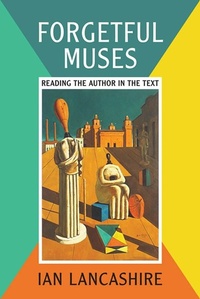
Forgetful Muses
Reading the Author in the Text
1st Edition
Published on 15. April 2016
320 pages
978-1-4426-8632-8 (ISBN)
Description

How can we understand and analyze the primarily unconscious process of writing? In this groundbreaking work of neuro-cognitive literary theory, Ian Lancashire maps the interplay of self-conscious critique and unconscious creativity.
Forgetful Muses shows how a writer's own 'anonymous,' that part of the mind that creates language up to the point of consciousness, is the genesis of thought. Those thoughts are then articulated by an author's inner voice and become subject to critique by the mind's 'reader-editor.' The 'reader-editor' engages with the 'anonymous,' which uses this information to formulate new ideas. Drawing on author testimony, cybernetics, cognitive psychology, corpus linguistics, text analysis, the neurobiology of mental aging, and his own experiences, Lancashire's close readings of twelve authors, including Caedmon, Chaucer, Coleridge, Joyce, Christie, and Atwood, serve to illuminate a mystery we all share.
Forgetful Muses shows how a writer's own 'anonymous,' that part of the mind that creates language up to the point of consciousness, is the genesis of thought. Those thoughts are then articulated by an author's inner voice and become subject to critique by the mind's 'reader-editor.' The 'reader-editor' engages with the 'anonymous,' which uses this information to formulate new ideas. Drawing on author testimony, cybernetics, cognitive psychology, corpus linguistics, text analysis, the neurobiology of mental aging, and his own experiences, Lancashire's close readings of twelve authors, including Caedmon, Chaucer, Coleridge, Joyce, Christie, and Atwood, serve to illuminate a mystery we all share.
Reviews / Votes
'The age of authors, whether afflicted by dementia or not, can have a profound effect on their works. Late style, characterized by spareness in writing and by clarity in bringing out essentials, also witnesses authors facing up to changes in themselves. [Agatha] Christie must have recognized in herself the condition of forgetfulness and confusion that she depicts in her alter ego, the detective-fiction writer Ariadne [Oliver] ... Was her embodied intention to brood on a suspected cause of the decay in her cognitive powers that she had suspected her novels to show for some time?' - From Forgetful Muses, with research featured in The New York Times Magazine's Ninth Annual Year in IdeasMore details
Language
English
Place of publication
Toronto
Canada
Target group
College/higher education
Professional and scholarly
Edition type
Digital original
Illustrations
18 halftones; 24 tables
18 halftones; 24 tables
File size
2,24 MB
ISBN-13
978-1-4426-8632-8 (9781442686328)
Copyright in bibliographic data and cover images is held by Nielsen Book Services Limited or by the publishers or by their respective licensors: all rights reserved.
Schweitzer Classification
Other editions
Additional editions
Book
12/2010
University of Toronto Press
€82.50
Shipment within 10-20 days
Person
Ian Lancashire is a professor in the Department of English at the University of Toronto.
Content
Introduction
Experiencing the Muse
Sightings - Richard Eberhart's "The Groundhog" - William Stafford's "Ask Me"
Uttering
Modelling the Inaccessible Skill - Mind on Fire - Conceptualizer and Verbalizer - Self-Monitor and Working Memory - Reading Span and Cognitive Lead - Conclusion
Cybertextuality
Poet-Authors
Geoffrey Chaucer - William Shakespeare - Samuel Taylor Coleridge - W. B. Yeats - T. S. Eliot
Novelist-Authors
James Joyce - Agatha Christie - Margaret Atwood - Iris Murdoch
Reading the Writers' Own Anonymous
Appendices
Experiencing the Muse
Sightings - Richard Eberhart's "The Groundhog" - William Stafford's "Ask Me"
Uttering
Modelling the Inaccessible Skill - Mind on Fire - Conceptualizer and Verbalizer - Self-Monitor and Working Memory - Reading Span and Cognitive Lead - Conclusion
Cybertextuality
Poet-Authors
Geoffrey Chaucer - William Shakespeare - Samuel Taylor Coleridge - W. B. Yeats - T. S. Eliot
Novelist-Authors
James Joyce - Agatha Christie - Margaret Atwood - Iris Murdoch
Reading the Writers' Own Anonymous
Appendices
