

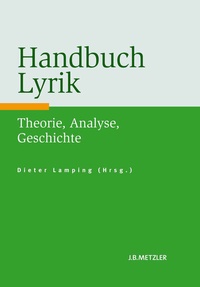
Handbuch Lyrik
Theorie, Analyse, Geschichte
1st Edition
Published on 14. November 2011
X, 451 pages
978-3-476-05316-9 (ISBN)
Description

Gesamtüberblick über die Gattung der Lyrik. Das komparatistisch ausgerichtete Handbuch stellt die Poetiken der Lyrik seit der Antike und die wissenschaftlichen Gattungstheorien vor. Es umreißt Tendenzen der neueren Lyrikforschung und macht mit Grundbegriffen der Interpretation vertraut, wie z. B. Form, Sprache und Medialität. Die Themen und Verfahren der Lyrik werden ebenso behandelt wie das Verhältnis zu anderen Genres, inklusive Film und Pop. Auch Aspekte der Lyrikvermittlung kommen zur Sprache - darunter: Übersetzung, Edition, Lesung und Lyrik in der Schule.
All prices
More details
Series
Language
German
Place of publication
Stuttgart
Germany
Publishing group
J.B. Metzler, Part of Springer Nature - Springer-Verlag GmbH
Target group
Professional and scholarly
Literaturwissenschaftler und Komparatisten, Musikwissenschaftler, Gattungstheoretiker
Illustrations
2 s/w Abbildungen
X, 451 S.
File size
4,63 MB
ISBN-13
978-3-476-05316-9 (9783476053169)
DOI
10.1007/978-3-476-05316-9
Schweitzer Classification
Other editions
New editions
E-Book
11/2016
2nd Edition
J.B. Metzler
€89.99
Available for download
Additional editions
Book
11/2011
1st Edition
J.B. Metzler
€29.95
Article exhausted; check for reprint
Person
Dieter Lamping, Professor für Allgemeine und Vergleichende Literaturwissenschaft, Universität Mainz
Content
- Cover
- Title
- Copyright
- Inhalt
- Vorwort
- I. Theorie und Poetik der Lyrik
- 1. Poetiken der Lyrik: Von der Normpoetik zur Autorenpoetik
- 2. Aktuelle poetologische Diskussionen
- 3. Theorien der Lyrik seit dem 18. Jahrhundert
- II. Lyrikanalyse
- 1. Methoden der Lyrikinterpretation
- 2. Rhetorische Lyrikanalyse: Formen und Funktionen von Klang- und Bildfiguren
- 3. Das lyrische Ich
- 4. Lyrik und Narration
- 5. Lyrik und Figur
- 6. Rhetorik und Semantik lyrischer Formen
- 7. Die Sprache der Lyrik
- 8. Die Medialität der Lyrik
- 9. Kontexte der Lyrik
- III. Typologie der Lyrik
- Funktionen
- 1. Funktionen der Lyrik
- Themen und Verfahren
- 2. Lyrik und Religion
- 3. Liebeslyrik
- 4. Naturlyrik
- 5. Philosophische Lyrik
- 6. Politische Lyrik
- 7. Geschichtslyrik
- 8. Poetologische Lyrik
- Relationen
- 9. Lyrik und Fiktion
- 10. Lyrik in Erzähltexten
- 11. Lyrik und Dramatik
- 12. Lyrik und Musik
- 13. Lyrik und (bildende) Kunst
- 14. Lyrik und Interkulturalität
- 15. Lyrik und Film
- 16. Lyrik und Pop
- IV. Lyrikvermittlung
- 1. Lyrikübersetzung
- 2. Lyriklesung
- 3. Lyrik in der Literaturkritik
- 4. Lyrik in der Schule
- 5. Lyrikedition
- V. Geschichte der Lyrik
- 1. Griechische Lyrik
- 1. Die mediale Entwicklung der griechischen Kultur: von der Mündlichkeit zur Schriftlichkeit
- 2. Lyrik und melopoiía
- 3. Funktionen und Teilbereiche melischer Dichtung
- 4. »Frühgriechische Lyrik«: eine Begriffserweiterung im 19. Und 20. Jahrhundert
- 5. Inwiefern war die griechische Elegie >elegisch<?
- 6. Der poetologische Status des Iambos
- 7. Iambos zwischen Aischrologie und politischer Botschaft
- 8. Der Kanon der neun Lyriker
- 9. Sappho und ihr Kreis
- 10. Kurze Geschichte der frühgriechischen Elegie
- 11. Elegie und Symposion: Theognis
- 12. Erbe der Lyrik in der Schriftkultur: das Epigramm
- 2. Römische Lyrik
- 1. Gattungsgrenzen
- 2. Lyrikbegriff
- 3. Erste Formen römischer Lyrik
- 4. Catull
- 5. Martial
- 6. Horaz
- 7. Weitere römische Lyriker
- 8. Christliche Autoren
- 9. Rezeption der römischen Lyrik
- 10. Die römische Elegie
- 3. Mittelalter
- 1. Voraussetzungen
- 2. Mediale Aspekte
- 3. Mittellateinische Lyrik
- 4. Altokzitanische Lyrik
- 5. Altfranzösische Lyrik
- 6. Mittelhochdeutsche Lyrik
- 7. Mittelenglische Lyrik
- 8. Spanische und portugiesische Lyrik
- 9. Italienische Lyrik
- 10. Zusammenfassung: Mittelalterliche Lyrik und europäische Kultur
- 4. Frühe Neuzeit
- 1. >Lyrik< als Gattungsbegriff
- 2. Petrarcas Rerum vulgarium fragmenta
- 3. Lyrik der Renaissance
- 4. Die Lyrik des Barock
- 5. Zur Geschichte der religiösen Lyrik
- 6. Ode und Elegie
- 7. Bukolik
- 8. Deutschsprachige Lyrik im 18. Jahrhundert
- 9. Komisch-burleske und satirische Lyrik
- 5. Romantik
- 1. »Romantik« und »Lyrik«: Bestimmungsansätze in einem komplexen poetischen Feld
- 2. Konvergenzen und Kontraste: die deutschen »Klassiker« und die Lyrik
- 3. Wichtige Vertreter romantischer Lyrik in Europa
- 6. Zwischen Romantik und Moderne
- 1. Der deutschsprachige Raum
- 2. England
- 3. Frankreich
- 7. Moderne
- 1. Modernebegriff
- 2. Charakteristika der modernen Lyrik
- 3. Bezug zur Wirklichkeit: Realisten und Antirealisten
- 4. Die französische Moderne
- 5. Die deutsche Moderne
- 6. »Weltsprache« der modernen Poesie: Amerikanische Lyrik, Ungaretti, Lorca
- 8. Gegenwart
- 1. Gegenwartslyrik: Begriff, Zäsuren, Markierungen
- 2. Nachkriegsmoderne: 1940er und 1950er Jahre
- 3. Übergänge und Neuorientierungen: Die 1960er Jahre
- 4. Die 1970er und 1980er Jahre
- 5. Tendenzen seit den 1990er Jahren
- Verzeichnis der Beiträgerinnen und Beiträger
- Auswahlbibliografie
- Sachregister
- Namen- und Titelregister
