

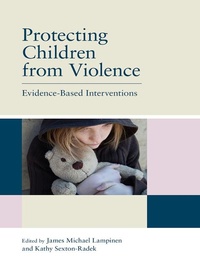
Protecting Children from Violence
Evidence-Based Interventions
Published on 13. September 2010
392 pages
978-1-136-98003-9 (ISBN)
Description

Providing an evidence-based understanding of the causes and consequences of violence against children, experts in the field examine the best practices used to help protect children from violence. Various types of violence are reviewed including physical and sexual abuse, (cyber-)bullying, human trafficking, online predators, abductions, and war. In addition, it reviews the various perpetrators of such violence including parents and relatives, strangers, other children, and societal institutions. The possible outcomes of such violence including physical injuries, death, depression, anxiety, post-traumatic stress disorders, and damage to the social fabric of the local community are also explored.
To enhance accessibility, each contributor addresses common themes:
Opening case studies dramatically illustrate the human cost of abuse and neglect
Empirically driven estimates of the scope of problem to better understand who is at risk and why
Empirically driven testing of interventions to maximize effectiveness of programs
How current research compares to public perception and the impact on public policy
The worldwide problem of violence against children
Evidence-based recommendations for reducing violence against children.
The book opens with a review of the history of the problem, the methodological approaches used to study it, and current "best practice" prevention strategies. The methods used to identify peer victims are then explored. Next child eyewitness memory is examined including the most effective techniques for maximizing the retrieval of information. This is followed by the research on missing and abducted children including the effectiveness of recovery programs such as supermarket campaigns and forensic age profiles. Next how the Internet is used in the victimization of children is explored including tips to help protect children online. Public attitudes toward sex offender registration laws are then reviewed followed by vulnerabilities that include genetic, neuropsychological, temperamental, cognitive, perceptual and social factors. International perspectives on protecting children from violence and global health inequities are then addressed. The book concludes with recommendations for future research.
Contributors are noted scholars from a broad range of disciplines. As such, the book appeals to researchers and advanced students in developmental, counseling, clinical, cognitive, evolutionary, and social psychology, as well as sociology, social work, criminal justice, education, and law enforcement.
To enhance accessibility, each contributor addresses common themes:
Opening case studies dramatically illustrate the human cost of abuse and neglect
Empirically driven estimates of the scope of problem to better understand who is at risk and why
Empirically driven testing of interventions to maximize effectiveness of programs
How current research compares to public perception and the impact on public policy
The worldwide problem of violence against children
Evidence-based recommendations for reducing violence against children.
The book opens with a review of the history of the problem, the methodological approaches used to study it, and current "best practice" prevention strategies. The methods used to identify peer victims are then explored. Next child eyewitness memory is examined including the most effective techniques for maximizing the retrieval of information. This is followed by the research on missing and abducted children including the effectiveness of recovery programs such as supermarket campaigns and forensic age profiles. Next how the Internet is used in the victimization of children is explored including tips to help protect children online. Public attitudes toward sex offender registration laws are then reviewed followed by vulnerabilities that include genetic, neuropsychological, temperamental, cognitive, perceptual and social factors. International perspectives on protecting children from violence and global health inequities are then addressed. The book concludes with recommendations for future research.
Contributors are noted scholars from a broad range of disciplines. As such, the book appeals to researchers and advanced students in developmental, counseling, clinical, cognitive, evolutionary, and social psychology, as well as sociology, social work, criminal justice, education, and law enforcement.
Reviews / Votes
"The contributing authors in this book bring a wealth of practice and research experience applying psychology to the long-standing and endemic nature of violence towards children ... this is an important contribution to the question of how to use evidence-based practice to reduce violence towards children." - Professor David Crighton, Durham University, in The Psychologist"Protecting Children from Violence will be useful to professionals in a variety of disciplines, such as clinical psychology, criminal justice, law enforcement, and public policy. It also provides therapists with a valuable overview of empirical research, a first step toward the integration of these findings into effective policy and practice." - Mary Lindahl, Ph.D., Marymount University in PsycCRITIQUES
"A must-read, Lampinen and Sexton-Radek's book reflects the vibrancy and breadth of a crucial field of scientific study-protecting children from violence. Chapters cover a wide range of important topics. This book is essential reading for all who care about children's welfare." - Gail S. Goodman, University of California, Davis, USA
"This book provides an excellent, research based overview of violence against children and makes empirically based suggestions for addressing this problem. It is an outstanding resource for researchers and child advocates." -Monica L. McCoy, Ph.D., Converse College, USA
"A major strength of this volume is that it focuses on evidence-based practices. This by itself will add to the field... [It] highlights the complex nature of children's exposure to violence and the importance of considering all contextual levels when trying to understand violence exposure... I can see this book being beneficial to social work students (and social workers) as well as practioners working with children, and graduate students in clinical/counselling programs." - Manfred H.M.van Dulmen, Kent State University, USA
More details
Language
English
Place of publication
London
United Kingdom
Publishing group
Taylor & Francis Ltd
Target group
Professional and scholarly
Product notice
Reflowable
Illustrations
8 s/w Tabellen
8 Tables, black and white
File size
0,75 MB
ISBN-13
978-1-136-98003-9 (9781136980039)
Copyright in bibliographic data and cover images is held by Nielsen Book Services Limited or by the publishers or by their respective licensors: all rights reserved.
Schweitzer Classification
Other editions
Additional editions
James Michael Lampinen | Kathy Sexton-Radek
Protecting Children from Violence
Evidence-Based Interventions
Book
04/2010
1st Edition
Psychology Press Ltd
€215.77
Shipment within 3-4 weeks
James Michael Lampinen | Kathy Sexton-Radek
Protecting Children from Violence
Evidence-Based Interventions
Book
04/2010
1st Edition
Psychology Press Ltd
€79.38
Article not available at the moment
Persons
James M. Lampinen is an Associate Professor of Psychology at the University of Arkansas. He received his PhD in Cognitive Psychology from Northwestern University in 1996.
Kathleen J. Sexton-Radek is a Professor of Psychology at Elmhurst College in Illinois. She received her PhD in Clinical Psychology from Illinois Institute of Technology in 1989.
Kathleen J. Sexton-Radek is a Professor of Psychology at Elmhurst College in Illinois. She received her PhD in Clinical Psychology from Illinois Institute of Technology in 1989.
Content
J.M. Lampinen, K. Sexton-Radek, Protecting Children from Violence: Historical Roots and Emerging Trends. J. Galezewski, Exposure to Violence: Who is Most Effected and Why? L. Abrams, S.G. Portwood, Protecting Children in Their Homes: Effective Prevention Programs and Policies. K. Sexton-Radek, Empirically-based Violence Prevention Interventions. R.A. Newgent, A.D. Seay, K.T. Malcolm, E.A. Keller, T.A. Cavell, Identifying Children Potentially At-risk for Serious Maladjustment Due to Peer Victimization: A New Model Using Receiver Operating Characteristics (ROC) Analysis. T.N. Odegard, C.M. Cooper, R.E. Holliday, S.J. Ceci, Interviewing Child Victims: Advances in the Scientific Understanding of Child Eyewitness Memory. J.M. Lampinen, J.D. Arnal, A. Culbertson-Faegre, L. Sweeney, Missing and Abducted Children. C.S. Peters, R.W. Kowalski, L.A. Malesky, Jr., Looking Both Ways Before Crossing the Information Superhighway: Issues of Concern for Minors in Cyberspace. J.M. Salerno, M.C. Stevenson, T.R.A. Wiley, C.J. Najdowski, B.L. Bottoms, R.A. Schmillen, Public Attitudes Toward Applying Sex Offender Registration Laws to Juvenile Offenders. P.A. Petretic, E. White Chaisson, Mediating Factors in the Long-Term Outcome Following Childhood Abuse: Cognitive and Other Factors Predicting Personal Distress, Intimacy Functioning and Resilience. R. Schleser, M.E. Bodzy, Cognitive Development and Exposure to Violence in Children. J. Hahn-Holbrook, C. Holbrook, J. Bering, Snakes, Spiders, Strangers: How the Evolved Fear of Strangers May Misdirect Efforts to Protect Children from Harm. P.T. McWhirter, E. Altshuler-Bard, International Perspectives on Domestic Violence. C.E. Stout, Protecting Children from the Violence of Global Health Inequities: Working Beyond Academic Halls and Clinic Walls. K. Sexton-Radek, J.M. Lampinen, Protecting Children from Violence: Historical Roots and Emerging Trends: Conclusions.
