

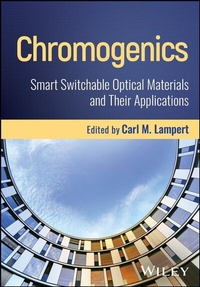
Chromogenics
Description

Firsthand insights into the current and future technology and large-scale applications of color- and opacity-changing optical materials
Chromogenics delivers a comprehensive overview of the industry-relevant scientific background of chromogenics and provides details on successful manufacturing techniques for the scalable fabrication of products, enabling readers to apply chromogenic materials in billion-dollar market segments such as the car industry (rear-view mirrors) and building and construction industries (self-tinting windows), as well as for individual end-user products such as sunglasses.
This work includes contributions from developers of chromogenic products from leading companies and industry-near research institutions such as Fraunhofer, Merck, Pleotint, and Gentex, Chromogenics explores topics including:
- Electrochromics (both inorganic and polymeric), thermochromics, and suspended particle devices (SPD)
- Encapsulated pigment devices, specific liquid crystals, and polymer dispersed liquid crystals (PDLC)
- Vacuum web coaters and their large-area coatings, transparent electronic conductors, sputter coating processes, and pyrolytic doped tin oxide
- Commercial technologies including pyrolytic deposition, magnetron sputtering, slot die coating, and doctor blade coating
- Products such as switchable self-dimming mirrors and switchable glazing for glare reduction, solar energy control, and privacy glazing
Presenting state-of-the-art research in the field along with future outlooks, Chromogenics is an essential reference on the subject for materials scientists, physical chemists, applied physicists, and engineering scientists in industry.
More details
Other editions
Additional editions
Person
After working on University- Industry projects at UC Berkeley -LBNL Carl M. Lampert, PhD, became a full-time consultant working for industry on chromogenics for architectural building glazing, automotive windows and sunroofs mirrors, train windows, and satellite surfaces for emissivity control in 2000. He has written many scholarly articles and has given lectures at companies such as Toyota Motors, Nissan Motors, Asahi Glass, DuPont, Applied Materials, JX Nippon Oil, Teijin, Toray Industries, and Dai Nippon Printing.
Content
List of Contributors xiii
Preface xv
Part I Technologies 1
1a Overview of Chromogenics 3 Carl M. Lampert
Nomenclature 3
1a.1 Introduction 5
1a.2 The Dynamic Glass Market 7
1a.2.1 Automotive 8
1a.2.2 Eyewear 9
1a.2.3 Architectural 10
1a.2.4 Aerospace 12
1a.2.5 Information Display 12
1a.3 Families of Chromogenic Materials 13
1a.3.1 Chromogenics Switching by Collective Physical Movement 14
1a.3.1.1 Electromechanical 17
1a.3.1.2 Mechanochromism 19
1a.3.1.3 Magnetochromics and Magnetoionics 20
1a.3.1.4 Electrokinetics 21
1a.3.1.5 Dispersed Liquid Crystals (PDLC and NCAP) 22
1a.3.1.6 Suspended Particles 26
1a.3.2 The Chemichromic and Electrochemichromic Families 28
1a.3.2.1 Gasochromic 30
1a.3.2.2 Halochromism 34
1a.3.2.3 Solvatochromism 35
1a.3.2.4 Hydrochromism 35
1a.3.2.5 Electrochemichromic 35
1a.4 Chromogenic Switching by Discrete Movement of Ions, Atoms, and Molecules 36
1a.4.1 Electrochromics 37
1a.4.1.1 Inorganic Electrochromics 38
1a.4.1.2 Organic and Polymer Electrochromics 41
1a.4.2 Light-Induced Switching - Photochromics 42
1a.4.3 Thermal-Induced Switching - Thermochromic and Thermotropics 45
1a.4.3.1 Thermal-Induced Switching - Ligand Exchange Thermochromic (LETC) 46
1a.4.3.2 Thermal-Induced Switching - Thermotropics 48
1a.5 Multiband Switching Windows and Surfaces 49
1a.6 Running a Chromogenics Business 50
1a.6.1 Organizational Viewpoint 51
1a.6.2 Materials Viewpoint - Chromogenics 51
1a.6.3 Materials Viewpoint - Electrochromics 52
1a.6.4 Manufacturing Viewpoint 52
1a.6.5 Marketing Perspective 53
1a.7 Additional Information about Chromogenics 53
Acknowledgments 54
References 54
1b Introduction to Glazing Design and Measurements 69 Carl M. Lampert
Nomenclature 69
1b.1 Common Metrics for Glazing 71
1b.2 Solar Radiation and the Earth's Atmosphere 72
1b.2.1 Clearness Index 74
1b.2.2 Daylighting 74
1b.3 Transmittance, Reflectance, and Absorptance Measurements 75
1b.3.1 Solar Transmittance 75
1b.3.2 Luminous, Visible Transmittance, and Visible Light Transmittance (VLT) 75
1b.3.3 Absorbance or Optical Density Measurement 77
1b.3.4 Haze and Scattering Measurements 78
1b.4 Color Measurements 80
1b.5 Thermal Emissivity and Emittance 82
1b.5.1 Low-e Coatings and Transparent Conductors used in Insulated Glass Units (IGUs) 83
1b.6 Design of an IGU Window System 86
1b.7 Energy Flow Mechanisms in Glazing Fenestration 87
1b.7.1 Conductive Heat Transport 88
1b.7.2 Convective Heat Transport 88
1b.7.3 Radiative Heat Transport 88
1b.8 Parameters Commonly Used to Characterize Window Glazing 89
1b.8.1 U-Factor 89
1b.8.2 Solar Heat Gain Coefficient (SHGC) 90
1b.8.3 Solar Factor (g-Value) or Total Solar Energy Transmittance (TSET) 91
1b.8.4 Total Solar Transmittance 91
1b.8.5 Instantaneous Heat Flow in a Whole Glazing 91
Acknowledgments 92
References 92
2 Electrochromics 97 Carl M. Lampert, Anoop Agrawal, and Junichi Nagai
Nomenclature 97
2.1 Introduction to the Field of Electrochromics 100
2.2 Electrochromic Materials 101
2.2.1 Coloration Efficiency 105
2.3 Electrochromic Device Design 106
2.3.1 Transparent Conductors 110
2.3.2 Electrochromic Device Switching Time 111
2.4 Self-Dimming Automotive Rearview Mirrors 112
2.5 Early Development of Electrochromic Automotive Sunroofs 116
2.6 Early Electrochromic Windows Developed at Asahi Glass Company 118
2.7 Designing Materials Systems for Electrochromic Glazing 120
2.8 Dynamic Building Windows 123
2.9 Commercial Electrochromic Windows 124
2.9.1 Window Performance Parameters 125
2.9.2 Electrochromic Glazing Examples 127
2.10 Multiband Switching for Glazing 134
2.10.1 Localized Surface Plasma Resonance (LSPR) 134
2.10.2 Early Commercial Development of LSPR Nanocrystals for Dual-Band Switchable Glazing 136
2.10.3 Research in Dual-Band Electrochromics 136
2.11 Electrochromic Windows for Aircraft 139
2.12 Electrochromic Eyewear 142
2.13 Electrochromic Information Displays 144
2.14 Electrochromic Gradient Filter 146
2.15 Dynamic Thermal Emittance Electrochromics for Spacecraft and Spacesuits 149
2.16 Other Electrochromic Devices: Photoelectrochromic and Photovoltaic-Electrochromic 151
Acknowledgments 151
References 151
3 Trends in Organic Electrochromic Materials and Their Applications 173 Melepurath Deepa and Anoop Agrawal
Nomenclature 173
3.1 Introduction to Organic Electrochromics 174
3.2 Organic EC Materials and Device Architectures 176
3.3 Electrochromic Supercapacitors (ESCs) with at Least One Transparent State 182
3.4 Integration of PV and ECD-Photoelectrochromic Device 187
References 191
4 Polymeric Electrochromics 195 Marco Schott and Uwe Posset
Nomenclature 195
4.1 Introduction 196
4.2 Electrochromic Polymers 196
4.2.1 Conjugated Polymers 196
4.2.2 Metal Coordination Polymers 204
4.3 Device Manufacturing 206
4.4 Industrial Applications of Polymeric Electrochromic Devices 213
4.5 Conclusion and Outlook 216
References 218
5 Evolution of Industrial Polymer Dispersed Liquid Crystal (PDLC) Technology in Europe: A Review of Research, Development, Manufacturing, and Potential Emerging Technologies 229 H. Hakemi
Nomenclature 229
5.1 Introduction to PDLC Technology 229
5.2 The Original PDLC Inventions 232
5.2.1 Micro-Emulsion (ME) Invention 233
5.2.2 Phase Separation (PS) Invention 233
5.2.2.1 Polymer Induced Phase Separation (PIPS) 233
5.2.2.2 Solvent Induced Phase Separation (SIPS) 233
5.2.2.3 Thermal Induced Phase Separation (TIPS) 233
5.3 Manufacturing Methods of PDLC Film 235
5.4 Historical Evolution of Industrial PDLC Technology 236
5.4.1 The Early Period (<1995) 237
5.4.2 The Setback Period (1995-2005) 238
>2005) 238
5.5 PDLC Industrial Development in Italy 240
5.5.1 SNR (Italy) PDLC License 240
5.5.2 SNR Industrial R&D Program 242
5.5.3 SNR Production Program 243
5.5.3.1 Dry/Coating & Lamination Technique 244
5.5.3.2 Wet/Coating & Lamination Technique 244
5.5.4 SNR Intellectual Property 246
5.6 Important Industrial Development Issues 247
5.6.1 The Significance of Scale 247
5.6.2 The Significance of Time 247
5.7 Industrial Development of PDLC in Europe 247
5.7.1 Innoptec S.p.A. (Italy) 248
5.7.2 Dream Glass S.L. (Spain) 248
5.7.3 Gauzy Ltd. (Israel) 248
5.8 Potential Emerging Industrial PDLC Technologies 249
5.8.1 Direct PDLC Glazing 249
5.8.2 Bistable PDLC 250
5.8.3 Solar-Control PDLC 251
5.8.4 Dynamic PDLC Signage 251
5.9 The PDLC Market Situation 253
References 253
6 Suspended Particle Devices 261 Philippe Lemarchand and Brian Norton
Nomenclature 261
6.1 Introduction 262
6.2 Materials 264
6.3 Manufacture and Commercial Specifications 266
6.3.1 Switching Duration 267
6.3.2 Spectral Transmittance 272
6.4 Applications in the Built Environment 276
6.5 Accelerated Testing 279
6.6 Conclusion 284
Acknowledgment 287
References 287
7 Inorganic Thermochromics and Photochromics 293 Lars Österlund, José Montero, and Gunnar A. Niklasson
Nomenclature 293
7.1 Introduction 294
7.2 Optical Properties 295
7.3 Thermochromic Coatings 297
7.3.1 Challenges for VO 2 -Based Films 299
7.3.2 Synthesis of VO 2 -Based Thermochromic Films 304
7.3.3 Synthesis of VO 2 -Based Nanoparticles and Nanocomposites 307
7.4 Photochromic Coatings 310
7.4.1 Silver Halides 312
7.4.2 Transition Metal Oxides 312
7.4.3 Rare-Earth Oxyhydrides 315
7.5 Thermochromic and Photochromic Smart Windows 318
7.5.1 Applications of Thermochromic and Photochromic Glazing 318
7.5.2 Performance Limits 322
7.6 Conclusions 324
References 325
8 Overview of Organic Thermochromic Materials 341 Gunnar A. Niklasson, José Montero, and Carl M. Lampert
Nomenclature 341
8.1 Introduction 342
8.2 Clear Organic Thermochromics 344
8.2.1 Ligand-Exchange, Metal-Organic Materials 344
8.2.2 Leuco Dyes in a Matrix 350
8.3 Thermotropic Materials 353
8.3.1 Hydrogels 354
8.3.2 Polymer Blends 357
8.3.3 Ionogels 359
8.3.4 Casting Resins 360
8.3.5 Additional Materials 361
8.4 Discussion and Comparison 361
References 365
9 Other Chromogenic Technologies 371 Carl M. Lampert
Nomenclature 371
9.1 Introduction 372
9.2 E Ink - Encapsulated Electrophoretic Ink 373
9.3 eyrise® Liquid Crystal Glazing 379
9.4 ELSTAR Dynamics Electrophoretic Glazing 383
9.5 MEMS and Microshutter Materials 385
9.6 Optofluidics 388
9.7 Thermochromic Perovskites 390
Acknowledgments 391
References 392
Part II Manufacturing 395
10 Introduction to Manufacturing 397 Carl M. Lampert
Nomenclature 397
10.1 Manufacturing Introduction 398
10.2 The Glass Industry 398
10.3 Surface Cleaning 402
10.4 Flat Glass Sputter Coating 403
10.5 Vacuum Web Coating 406
10.5.1 Flexible Electrochromic Coating 406
10.5.2 Flexible Glass 407
10.6 Other Flat Glass Coating Processes 408
10.7 Slot-Die Coating 408
10.8 Wet-Chemical Sol-Gel Deposition 410
10.9 Atomic Layer Deposition (ALD) 413
10.9.1 Spatial ALD 413
10.10 Inkjet Deposition 415
10.11 Photonic Processing 417
10.12 Busbars and Electrical Connections 418
Acknowledgments 418
References 419
11 Sputter Coating Processes and Industrial Approaches 427 Wilmert C.S. De Bosscher
Nomenclature 427
11.1 Large-Area Magnetron Sputtering Basics 427
11.2 Magnetron and Process Concepts for Sputter Deposition of Metals 431
11.3 Tweaking Deposition Rate for Reactive Sputtering of SiO 2 434
11.4 Uniform Deposition of a Transparent Conductive Oxide (TCO) of Indium Tin Oxide (ITO) 436
11.5 Improved Process Stability and Performance for Metal Oxide Layers 439
11.6 Controlling Stoichiometry of Electrochromic Wo X Layers 442
11.7 High-Pressure Sputtering Increasing Mechanical Stability of NiO Layer 445
11.8 Conclusions 448
Acknowledgments 448
References 449
12 Vacuum Web Coaters and Their Large-Area Coatings Used in Chromogenic Products: Technology and Applications of Transparent Electronic Conductors 453 Paul Lippens
12.1 Vacuum Web or Roll Coaters 453
12.1.1 Definition, Basic Configuration 453
12.1.2 Industrial Systems Available on the Market 455
12.2 Coating Systems Produced on Web Coaters 458
12.2.1 Overview of a Few Important Coating Systems 458
12.2.2 An Important Building Module: Transparent Conducting Electrodes 459
12.2.2.1 Semiconducting ITO 459
12.2.2.2 Nodule Formation 460
12.2.2.3 Typical ITO Compositions for Web Coating 461
12.2.2.4 Other Transparent Electronic Conductors 463
12.3 Outlook 464
12.3.1 Web Coating on Thin Rollable Glass 464
12.3.2 Machine-Related Developments 465
12.3.2.1 Combination of Several Deposition Technologies on the Same Web Coater 465
12.3.2.2 Air-to-Air Coaters 465
References 466
13 Pyrolytic Fluorine-Doped Tin Oxide on Glass for Chromogenic Products 469 George Neuman
13.1 Introduction 469
13.2 The Development of Online Pyrolytic Deposition of Conductive Tin Oxide 469
13.3 Manufacturers 484
13.4 Chemical Vapor Deposition (CVD) 484
13.5 Properties 488
13.6 Color Suppression Technology (CSI) 493
13.7 Physical and Chemical Properties 494
13.8 Commercial Products 497
13.9 Conclusion 497
Acknowledgments 498
References 499
Index 503
Preface
I became involved with electrochromics in the mid-1970s when I was studying wavelength selective solar materials at the University of California, Berkeley, in the Departments of Materials Science and Mineral Engineering, and Electrical Engineering and Computer Science. My interest was in developing materials which interact with light. This research involved materials called heat mirrors, now known as low-e (low emittance) coatings. One group of low-e coatings is degenerately doped semiconductors which are utilized as transparent conductors. The development of transparent conductors led to electrically powered displays, such as liquid crystal displays. This in turn led to the concept of large window displays or large area switchable windows which could control the flow of light and heat into a room. The big question was could one find a material with a broad enough wavelength response to effectively switch the solar spectrum. The key was to find a physical process that would be able to switch in the visible and possibly over the entire solar spectrum. This led me to electrochromic materials, such as hydrogen tungsten and molybdenum tungsten bronzes because they had the potential to be a strong switch with dual-ion intercalation and electron injection. Devices could modulate the visible and be modified for use in the near-infrared spectrum. Also, these inorganics showed the necessary stability required for long life in a glazing environment, usually over 10 years. At the time electrochromics were experimental and used in prototype non-transparent information display devices. Following early work on electrochromic displays, I wondered if they could be made transparent.
In the late 1970s, while in the Department of Materials Science and Mineral Engineering at Berkeley, I began a conversation about methods for dynamic light control of building glazing with Dr. Sam Berman at the Lawrence Berkeley National Laboratory (LBNL), Windows and Lighting, which later resulted in being offered a position at the Laboratory. Work at LBNL resulted in over 20 years of materials research on chromogenic and low-e coatings, in partnership with industry. A few select colleagues including Claes Granqvist, Angstrom Institute (Uppsala, Sweden), and I would organize solar and switchable materials conferences for SPIE, The International Optical Engineering Society, The Society of Vacuum Coaters (SVC), and other organizations.
The term "chromogenics" for the field of switchable materials was coined by this writer back in the 1980s during a bus ride with solar materials specialists at the first SPIE European conference on switchable media and solar materials in Hamburg, Germany. Chromogenics comes from Latin for the creation of color. The term chromogenics does exist in other fields. But at the time we needed a broad name to cover all phenomena that changes color or opacity with the application of temperature, light, electricity, electric fields, magnetic fields, or chemicals. So chromogenics was broad enough to be used as a title for future conferences. The term chromogenics covers the entire range of electrochromics, electrophoretics, photochromics, thermochromics and liquid crystals, as well as new technologies yet to be developed.
Colleague Acknowledgements
I wish to thank all the authors for their time and efforts in putting this work together. For those who were invited, but unable to write, I thank you for the information and images you supplied for the book.
I have worked with so many technical colleagues over the last 45 years. It is hard to thank all, so allow me to select a few. I wish to thank posthumously, Profs. Jack Washburn, Marshall Merriam and Alan Searcy for all their work encouraging solar materials research at the University of California, Berkeley. I wish to thank posthumously Mr. Kawahara, former General Manager, Nippon Sheet Glass (NSG) (Itami, Japan), Yuchi Yano, Managing Director of NSG UMU PDLC switchable glazing (Japan), Dr. Junichi Nagai, Head Electrochromics Lab., Asahi Glass (Yokohama, Japan), Dr. Jean-Christophe Giron, VP Sage Electrochromics (Faribault, MN) (former student), and Dr. Philip Yu, Director, PPG (Monroeville, PA) (former student). I wish to thank Dr. Nilgun Ozer (Guest Scientist and Prof. San Francisco State University) for all her work on sol-gel deposited coatings. Special thanks go to Marca Doeff and Steve Visco of the LBNL Energy Technologies for their direction on ionic polymers for electrochromics. This includes polymer work by my former students Yan Ping Ma and Yongxiang He. Another special thanks goes to the team of Prof. Agostino Pennisi and Dr. Francisca Simone (University of Catania, Italy) who were guest electrochromic scientists in my laboratory. I wish to thank my dear colleagues, Profs. Claes Granqvist, and Gunnar Nicklassen, Angstrom Laboratory (Uppsala, Sweden), and Anoop Agrawal, Glass Dyenamics (Tucson, AZ), for discussions about electrochromics starting in the late 1970s. I wish to posthumously thank Prof. Mick Hutchins, Oxford Brooks University, (Oxford, UK) for all his help with optical measurements. It was in Hutchins's lab, where I first met Prof. Xingfang Hu, Chinese Academy of Sciences (Shanghai) working on electrochromics. I wish to thank the late Bob Sax and the current CEO, Joe Harary, Research Frontiers Inc. (Woodbury, NY), for their tireless energy and information about SPD electrophoretic glazing. Also, I thank Dr. Gottfried Haake, American Cyanamid (Stamford, CT), for our discussions about new transparent conductors and electrochromics for displays. In addition, I wish to thank the late John Thornton, Telic Corp. (Santa Monica, CA) and University of Illinois (Urbana-Champaign) for his friendship and advice about post magnetron sputtering in the early days of its development. Also, thanks to John Vossen, RCA Labs (Cambridge, NJ), for our collaborative work on thin-film patents. I wish to thank the late Prof. David Adler, MIT (Cambridge, MA) for his help with the study of thermochromic metal-to-insulator transition materials. Also, I wish to thank Dr. Hulya Demiryont, Eclipse Energy Systems (St. Petersburg, FL), for all our work together on commercial electrochromics. I wish to thank posthumously, Prof. Angus McLeod, Thin Film Center, Tucson, AZ, for his mentoring on thin film optics and the late Michael Andreasen, Guardian Glass and Vacuum Edge (Fairfield, CA), for our work together on industrial PVD coating equipment designs. Also, Walter G. Overacker, Airco Temescal (later BOC Corp., Berkeley, CA), for all his advice about high-volume sputtering and e-beam deposition. Furthermore, I enjoyed working with Rolf Illsley, President, OCLI (Santa Rosa, CA), on solar products. I wish to thank Ric Shimshock, MLD Technologies (Mountain View, CA), for his friendship and practical experience in a wide range of vacuum deposition systems. Also, "Al" Albany Grubb (BOC Technologies, Fairfield, CA) for his "big vision" of large-scale sputtering plants. I wish to thank posthumously Dr. Stan Ovshinsky, Ovonic Battery Company (Rochester Hills, MI), for his "never give up" attitude in the pursuit of researching the development of amorphous materials. I wish to thank Dr. Harlan Byker, Pleotint (Mt. Olive, MI), and Dr. Martin Preuss, Wiley-VCH publisher, for suggesting I compile this book. Little did I know what I was getting in to. Also, I wish to thank Monica Chandrasekar, Wiley, and her publishing team for their help assembling and editing this work.
Personal Dedication
I wish to dedicate this work to my parents, my mother, Gwen (UCLA '34), for her showing me the importance of deep study and analysis for problem-solving. I thank my father, Gailard, for passing on his practical knowledge in making inventions and his ability to visualize and construct almost anything. Also, I wish to thank my keen-eyed manufacturing engineer and wife, Joyce, for her proofreading.
Organization of the Book
This book is the culmination of several chapters written by some of the best experts in the field of chromogenics. The goal of the work is to give industry and those just getting involved in this field a clear view of chromogenics and its applications in real glazing and other useful products based on this technology. This compilation covers a wide range of technologies. We have seen several books written on electrochromics and research books on photochromics and thermochromics. Some books are very hard to obtain. This work is not intended to be a deep review of ongoing research in the area chromogenics. I will leave that for other academic authors. It does contain some history, especially industry history, as best we know it, that led to several developments in the field. I have collaborated with many companies during my work as a scientist with the University of California, Lawrence Berkeley National Laboratory, as a consultant with Star Science and as Technical Director of the Society of Vacuum Coaters.
This work is organized in two main sections, chromogenic technologies and manufacturing processes, used to make chromogenic products. In the technologies sections, the topics covered are introduction to chromogenics, introduction to measurements and glazing design, inorganic, organic and polymer electrochromics, polymer dispersed liquid crystals, suspended particles, inorganic and organic thermochromics and photochromics. The chapter on emerging technologies includes guest-host liquid crystal windows, electronic ink-based and water-based...
